Swamiji on Facebook Swamiji on Twitter Swamiji on Youtube

My Life

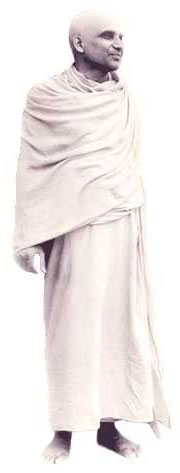
Autobiography of Swami Krishnananda

I took the train back that arrived in Mathura. We reached Mathura station in the evening of the 9th of December, 1969, where Sri Chamanlal Sharma and family, Sri Devadhar Sastri from Birla Mandir, Smt. Vimala Shankar from Jaipur and Sri Baetibabaji of Vrindavan were there to receive us. From the station we went straight to Sri Krishna Janmasthana and attended the Arati in the temple. Sri Devadhar Sastriji took us around the place and explained the way in which the actual location of the birth of Sri Krishna was excavated beneath a Masjid that was built during the Mohammedan rule. The authorities concerned with the new work of excavation and renovation of this sacred place have already cleared the whole area, paved the ground with marble slabs, built a temple of Sri Krishna and kept in isolation the real spot of the 'birth', that is supposed to be a part of the prison near the palace of Kamsa, where the divine advent took place. A joint effort of the Birla and Dalmia families is now contemplating to construct a Satsanga Bhavan in which they will either engrave in marble the eighteen thousand verses of the Srimad Bhagavata or set up a painting and picture gallery depicting the life of the Lord.

We then moved to Vrindavan, where our stay was very beautifully arranged by Sri Chamanlalji and family. Immediately, we went to have the sacred Darshan of Sri Banke-Behariji, which is the name of the principal deity in Vrindavan. The idol of this temple is said to have been discovered, under a divine ordainment, by Saint Haridas, at a place called Nidhivan, in Vrindavan. This occasion of the discovery of the idol and the founding of the temple is celebrated annually in a grand scale on the fifth day of the bright half of the month of Margasirsha (November-December). We also paid our respects at the temple of Sri Radhavallabh, founded under the sponsorship of Saint Hitaharivamsh. The Radhavallabh cult of devotion in Vrindavan is quite different from that of Sri Vallabhacharya, who taught the Pushti-Marga type of devotion, and the two should not be confused with each other, though both these types of devotees of the two Sampradayas are to be found in Vraja-Bhumi, which is a collective name designating the entire area of about 168 miles of circumference within which Lord Sri Krishna played his sports in his early days. Instead of regarding, as it is usual, God as the embodiment of love (Prema-swarupa Bhagavan), the followers of Radhavallabh Sampradaya consider love as the embodiment of God (Bhagavat-swarupa Prema), and try to live a life of such devotion to God, in their practical lives.

On the 10th, we visited certain other temples in Vrindavan, including that of the famous Sri Ranganatha-Swami, built in the South Indian fashion of the Srirangam shrine. We also were taken to Nidhivan, mentioned above, and to Seva Kunj that is of particular importance. It is believed that in the grove of Seva Kunj, Lord Sri Krishna plays his eternal Rasa-Lila with his divine consorts even this day, during the night, and any entry into this area during the night by people is totally barred. It is said that those who hazard access into this place during the night do not return, either due to their absorption into God or due to an aberration of mind in which they get involved. We also went to the beautiful cave-like small room in Vrindavan, where Saint Mira lived a life of devotion to the Lord during her days. In all these visits of ours to the various temples, we were ably assisted by Sri Sevak Saran Sharma of Dehli, who had an expert knowledge of life in Vrindavan.

On an invitation from the Principal of the Institute of Oriental Philosophy, here, I went to address the students of the Institute in the forenoon of the 10th. I took up for discussion a pertinent theme of the relation of religion to practical life. It is seen that State Governments, perhaps almost everywhere in the world, try to make administration secular and would have nothing to do with religion. This should open the eyes of the protagonists of religion, who should be able to detect the reason behind this bifurcation of religion from practical life. It is quite evident that religion is not regarded as a part of life, but for which there should be no reason why religion should be ostracised from social and political circles. On a scrutiny of the matter it would become evident that there is on one hand a misunderstanding of the meaning of religion by the administration of governments and on the other hand a misrepresentation of religion by those who profess to teach it and try to live it. There has always been a fear haunting the haters of religion that it is concerned with life-after-death, which may be or may not be, and has little to do with the problems of life in this world. God, if at all He is, is not in this world, and so religion that is supposed to be a way to Him, cannot have relevance to life on earth. If this is a fact, religion can have nothing to do with social and political administration, which is a matter of this world and not the other world. There is also at the same time an obstinate clinging by the followers of religion to its forms, such as ritual, ceremony tradition and custom, with a secret suspicion that God is above and not in the world. As men who follow this religion are also those who set examples before the framers of the constitution, the members of the parliament, and the leaders of society, there should be no wonder in the banishment of religion from the circles of the latter. But if life has nothing to do with religion, it should only follow that religion can be dispensed with in life, especially as no one has seen the after-life.

This is the malady that has been created by our religionists who seem to have done more harm than good by their dogmas and creeds. We have many religions, but not a religious consciousness. It should not be that we practise religion just as we go to the clubs and cinemas, as a kind of diversion or change after the day's labour. The Pandits of religion, unfortunately, seem to have created this impression in the minds of people, whatever they may say about the nature of an all-pervading God, who gets confined only to scriptures and religious gatherings. This kind of religion cannot survive, for it is not truth. What is not true cannot attract, for we cannot love even God if He has no relation to our personal life. God and religion should mean something to us, and not remain as objects of hearsay and tools that we can handle or cast away according to our needs. We lack proper teachers of the real religion which is not merely one of the functions of life but is only another name for life perfectly lived. Religion is thus a great science, surpassing the other sciences known to man, which while these latter tell man how to acquire things and create conditions outside, the science of religion tells him how to live, for nothing can be dearer than life, of which the objectives of the other sciences are only accessories. Religion which is the life of truth and justice is also life in God, for God is truth and justice, and vice versa. Religion in this sense connects man's existence with his cosmic relations and awakens him to the facts of his being a centre of universal importance, in which realisation humanity becomes a brotherhood and life a haven of peace and joy. No one can live without such religion and it should be the duty of every citizen of Bharatavarsha to strive to achieve this ideal and to prepare adepts and heroes who will spread this knowledge of the true life. Life cannot be without religion, for religion is the soul of life.

On the 11th, in the morning, we left for Barsana, which, among the shrines in Vraja, is, in importance, next only to Vrindavan. Barsana is reputed as the ancient dwelling place of Radha, the divine companion of Krishna, whose dalliances have been elaborately sung by many a poet right from the time of the Brahmavaivarta Purana down through the great Chaitanya Mahabrabhu to the ecstatic Vaishnava devotees of our own times. The temple of Radha is on a hill that is worshipped as a veritable manifestation of Brahma in celestial association with other two sacred hills nearby, the one in Govardhan, being the manifestation of Vishnu and the other in Nandagaon as the manifestation of Siva. Revered Sri Swami Harisharananandaji Maharaj, our elder Gurubhai, who was once resident of the Ashram at the Headquarters, is now staying in Barsana and performing Tapas and Sadhana. On a kind invitation from him we went to his Kutir in a Dharmashala, where we were put up for the day. Sri Chamanlal Sharma and family had accompanied us and arranged for this trip to Barsana. All our visits to the different shrines in Vraja were very lovingly arranged by these good friends, who had taken immense pains not only in taking us around but also explaining the importance of the holy places. Mention also has to be made of the silent but important contribution made by the son of Sri Hari Govindji, the famous Rasalila exponent and organiser of Brindavan, who saw that throughout our stay in Vraja we were provided the facilities of being taken to the widely distributed shrines in the area. In Barsana, after Darshan of Radha at the holy temple, we moved to the holy Ghavar Kunj (meaning, the deep grove) that is another renowned spot of the ancient Rasalila of Bhagavan Sri Krishna with Radha and the Gopis of Brindavan. The plantations in Seva Kunj and Ghavar Kunj have some similarity and seem to hint at both these places having been the locations of the same divine sport of the Lord. There is deep silence and an air of solemnity in these parts of Vraja Bhumi. There are also two mountains whose rocks are respectively black and white and are known to be embodiments of Krishna and Radha in two hues. The narrow, single-person-passage between the two hills is said to be the path along which Gopis in olden days used to carry milk, curd and butter in pots and Krishna as a child used to encounter them on the way, demand the contents and make this a kind of frequent routine. As a memory of this Lila of the Lord, villagers even today pour down a little milk or milk-product on the spot when carrying the same along the passage. It is believed that if this custom is not observed there will be no good sale of the items.

We had a short Satsanga in the Kutir of Sri Swami Harisarananandaji Maharaj and then we left for Nandagaon. This latter shrine we reached by sunset and we paid our obeisance at the temple of Nanda, Yasoda, Balarama and Krishna. Then we reached back Vrindavan in the night of the same day.

In the morning of the 12th, we went to have Darshan of Gokul. This is a place, lying across the river Yamuna, to which Vasudeva, the father of Krishna, took the child from the prison-house, on divine command. Here we have also a temple dedicated to Balarama, the elder brother of Krishna, with his consort Revati. The main temple is dedicated to the child Krishna and there are also a few other smaller temples dedicated to the childhood sports of Krishna. The early life of Krishna is spread over Mathura, Gokul, Vrindavan and their suburbs.

In the afternoon, we left for Govardhan. On the way we had Darshan also of Radha Kund and Shyam Kund, two tanks, dedicated to Radha and Krishna. Govardhan is the famous hill whose form Krishna is said to have assumed to receive the offerings made by the residents of Vraja, in opposition to Indra, a story which is familiar to us after the record of this incident in the Srimad-Bhagavata. People who visit Govardhan go near the hill and arrange small stones in the pattern of a house and the like with a Sankalpa (fond wish) that they want to fulfil in their lives. It is believed that this ensures the fulfilment of the wish and also promises in the holy spot an abode for the soul of the devotees after shedding their mortal coil. We went to Mukharavind, which is one of the mouths of the Lord in the form of the hill, through which he received the offerings. After making our prostrations here, we went to the other mouth below the temple of Srinath on the hill. We made our obeisance here again, and, having touched the sacred shrine, we returned to Vrindavan. On the way back, we visited Manasi Ganga, a sacred tank which contains the holy waters that are said to have been the visible manifestation of Ganga (Ganges) that issued forth in Vraja by the very thought of Krishna, for the benefit of his colleagues.

In the evening of the same day, I was invited to speak at the Rotary Club at Mathura. In this gathering of Rotarians I had an occasion to express some views, almost unexpected by the audience. What caught my eyes, on my stepping into the hall, was a phrase written on the board, as the motto of the Club: 'Service above self'. I endeavoured to state before the audience that the motto of the Rotarians is really magnificent, because it has in it a hidden truth, rarely manifest in the public life of people. But the intention is to manifest it. Work and self are two significant terms connoting two important aspects of the face of life, viz., becoming and being. While work is in some way inseparable from one's self, for it is the self that seems to express itself in work, it becomes difficult to understand how work can be above self. The effect is not above the cause. But, though this may be the surface difficulty posed by the ideal, it gets resolved on a closer examination of the nature of work and self.

There are two types of work, and for purpose of analysis they may be called the lower and the higher. The lower work is that which emanates from the personal self, as an external effect, of which oneself is the cause. Here the self is above work, in a causative sense. It is this type of work that produces secondary effects that turn back upon this causal self and bind it to nemesis. In this given circumstance, the self, though it appears to be the cause of action, stands on an equal footing with the reality of action, both being individualistic, spatio-temporal and mutually determinant of each other. The network of such personal selves with the retributive actions is the world of bondage.

But there is a higher kind of work that is not binding but liberating, and it is this work that goes by the name of service, and is above self. Normally, no action that is of the nature of an effect can transcend the agent who is its cause. But there is a special connotation in the service that stands transcendent to the individual self and this becomes possible when the motive behind action surpasses the desireful nature of the individual. Motive or intention behind an act decides whether it is going to fetter the agent or leave him free. The larger the motive behind an act, the greater is the freedom of the agent concerned and the higher also is the value of the act. The largeness of the motive consists in the extent to which it exceeds the limitations of personal longing, covetousness, greed or desire. There are degrees of this self-transcendence, and the highest self which is supremely transcendent above all particular notions of it is the ultimate reference and determining factor of an action or work when it becomes service and a spontaneous expression of one's freedom and goodness. The greater is one's approximation to the universality of the self, the more intense is one's freedom and intrinsic goodness of character and conduct. The dictum, 'Service above self,' signifies, therefore, not only an ethical principle but points to an unavoidable reference to the spiritual reality in our day-to-day life.

The 13th of December happened to be the day of the anniversary celebration of the temple of Banke-Behariji in Vrindavan, it being the Panchami on which the idol was discovered by the Saint Haridas. A magnificent music festival is held on this day in Nidhivan, where the image was found by the saint and, in this, many reputed songsters and poet-saints participate. From here a grand procession moves with Sankirtan and band music to the main temple. We witnessed the procession towards its end and offered our prostrations at the holy shrine. In the evening of the same day we had Darshan of Sri Dwarakadhish, known also as Mathuradhish, in Mathura, after a visit to Vishramghat, where Sri Krishna is said to have taken rest after the destruction of Kamsa. We moved again to Sri Krishna-Janmasthana and offered our concluding prayers at the spot which is identified with the actual birth-place of Krishna. We attended the Arati and then took leave for our residence at Vrindavan.

During our stay in Vrindavan, we also witnessed a part of the Rasalila, enacted by devotees. Rasalila, as it means today, is the enactment of the divine sports of Sri Krishna in Vraja-Bhumi, in its several forms and phases, intended to rouse a devotional spirit and love of God in the hearts of people. There are at least two big Rasa-Mandalas or grounds for this play in Vrindavan. Here the Rasa is played daily throughout the year. The language used in these plays is the old 'Vraja' dialect, both in the song and in prose. The Rasalila is, however, not restricted merely to the rehearsal of the Rasa dance of Krishna with the Gopis, but is a general term indicating any sport of Sri Krishna in Vraja-Bhumi. The picturesque and melodious presentation of characters in action and song is indeed beautiful and touching and one cannot go without an elevated feeling after witnessing a well-performed Rasalila.

From Dhrangadhra, where I was living with Dr. Gangadhar Bhatt, who built in three days a big house for me under the title 'Krishna' about 7 miles away from his house, after staying there for sometime I went to Kurukshetra in Dr. Gangadhar Bhatt's car. I told him about a tradition that no one goes to Kurukshetra without encountering some tragedy. All things went well, when suddenly the car stuck to the ground in a mire and could not be lifted. I told my host doctor that the Mahabharata had already taken place as anticipated. He quickly ran out and brought a truck, tying the car with a rope to the truck, and asked the truck man to pull the car up. This was done and all went well. There were some friends known to me who were waiting for us for lunch. We ate quickly some rice and dhal. There was no time to take rest. I wanted to see any memento of a monument of Lord Sri Krishna in Kurukshetra, but I saw none. I complained vehemently at the callous attitude of people to this great Superman of India, that they could not think of erecting a monument. In disgust, I wanted to see the place where Bhishma fell. I was taken to a pond near which Bhishma ought to have lied down and felt thirsty, asking for water. Duryodhana hurriedly went round and brought a pot of water, but Bhishma said, "I want hero's water" at which Arjuna struck an arrow on the ground with such force that water gushed forth and fell directly on the mouth of Bishma. My trip to Kurukshetra did not satisfy me because there was no Krishna there, though he ought to have been the principal figure of devotion and respect.

From Delhi, Swami Chidananda sent a note that I should not miss the function in Delhi arranged by the Swami Sivananda Cultural Association, under the guidance of Sri H.D. Sharmaji. This function was for collecting funds in order to build the Cultural Association. The method adopted was to invite cinema stars like Manna De and some other well-known cinema stars, who came one by one from the screen and sang some bhajans and went away. Though they sang only a few sentences, the audience was so mad after these people that they were hounded again by the request, "Once more, once more!". Thus went the function. They had arranged also food for us in Ashoka Hotel, which was a cheap, insipid stuff. I wished to go away from there, but I could not due to social etiquette. I starved and then went away. One could imagine from this incident that people respect and love only cinema stars, and no one else.

I had a little time with President Zail Singh in the FICCI Auditorium, as they had arranged a function in honour of the President's visit. Though he knew some English, he always preferred people speaking in Hindi language. I too had to speak in Hindi, but the thing that I said was beyond ordinary understanding. After my speech, the President said, "You are a great man to have said these things. Your speeches should go into the All India Radio."

From Panipat we returned to Delhi and from there back to the Ashram.

When I was born on the 25th of April, 1922, on the ascending of the star Revati, I was told that I was a very weak-bodied child, yellow in colour, with a strange bilious effect. People around thought that this child would not survive. At that time my grandfather, father's father, was alive, who seemed to have cast a chart of horoscope of the birth of this child. He said, it seems, "If the horoscope that I have cast is correct, then this child will not die." My mother used to apply the paste of a leaf on my body to diminish the effect of bile, and this went on for a long time. The bile disappeared. Then I developed asthma as a legacy from my mother, which freed my mother from this agony immediately after my birth. It was something like the transfer of property. Strange indeed. My mother had another local recipe for asthma, and that was the boiled juice of the bark of the tree that produced drumstick. It was a very terrible potion to drink, but it had its effect for the time being. When the asthmatic attack became very acute at an early age, my father used to carry me on his shoulders to Dr. M.S. Satyasundar Rao, who was our family physician, and request the doctor to give me an injection against asthma. Then the father used to carry me back home. This doctor was a general physician for us in the family for every kind of illness. Surprisingly, this doctor visited the Sivananda Ashram many years back, to see me, and told me, "I did not know whether you would accept me at all, yourself being a big man and myself being a poor doctor."

Asthma is continuing even now in my case, with many doctors treating me in many ways, even up to cortisone that damaged my health. Nowadays it is diminishing and I seem to be well-off with the care-taking genius of one doctor, N.B. Srivastava of the Government Hospital in Rishikesh. I should however be careful not to give way to any lapse in my regimen, lest it should leap up again. I am a chronic asthmatic patient, but God has been taking care of me with great love, and all is well.

When I became all right and had my thread ceremony performed in a religious manner with three Brahmin priests performing three havans, I began to do my religious practices with great vigour. My mother used to get up at 3:00 in the morning and prepare hot water. I would take bath and then sit for Japa of Gayatri Mantra and any other mantra that I liked, and felt benefited. This Japa gave me a lot of strength inside. The gods of the Mantras began operating and I appeared to be the potential embodiment of the operating power of the gods.

I was a cynosure of all eyes wherever I went, for reasons I cannot understand. One of the visitors to the Ashram told me, "When I see you, I get strength." Another told me, "When I see you, I feel happy." Maybe so, but now I have discontinued seeing people, because I thought later that people who sit around me for the purpose of meditation go on looking at me but do not do any meditation. This obsession on the part of people has cost me enough, and instead of my spiritual energy going to people around, it appeared that their illness, their obsessed nature, interfered with me and I decided not to have a common meditation. I have closed it forthright. Let me be with God alone and not with people. The same is the case with Darshan, which also I have closed. Now I am alone and feel happy with God.

- THE END -