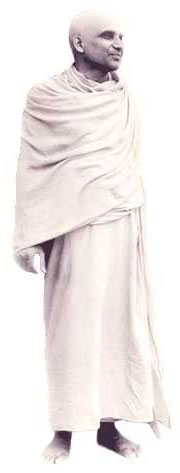
by Swami Krishnananda
Ekonavimsati-mukhah is the word that is used in the Mandukya Upanishad. This god that is operating through the individual has nineteen mouths – ekonavimsati is nineteen – so it is with the nineteen mouths of the things that we come in contact with in the world. The Vedanta Sastra tells us that the nineteen sense organs mentioned as the operating media conducted by higher divinities are: the eye conditioned by Sun, the nose by the Aswinis, the tongue by Varuna, the tactile sense by Vayu, the ears by the Dik Devatas, the speech by Agni, the mind by Moon, the chitta by Vishnu, the ego by Rudra, the buddhi by Brahma, and so on. So what remains in us apart from the contributions made by these gods? Considering the fact that even the physical body is made up of the building bricks of the five elements and the sense organs being conditioned by these gods, where are we existing individually? We are living a borrowed existence, as it were – physically, psychologically, socially, and in every way.
The ordinance of Prajapati is that we have to consider the fact of our mutual involvement with not only people outside, not only with nature as prakriti, but also with the gods in heaven. The gods will bless us. Actually, the blessing of the gods is nothing but the recognition of there being a conscious element connecting us with other people. The perception of an object through the eyes is not possible unless there is a superintending conscious medium. For example, you are seeing me here. This knowledge of the fact that I am here does not arise through your eyes, though you are looking at me with your eyes and it appears as if your eyes are telling you that I am here. The eyes are physical eyeballs which can even be removed, so it is not the eyes that tell you I am here.
So what else is it that tells you that I am here? Tell me. You have not entered into me; you are sitting far away from me. There is a physical distance between us. If the distance precludes your knowledge of my existence here, and the eyes and the sense organs are physical in their nature and, therefore, cannot know that I am here, there must be something else which is consciously operating. The connecting link between me and you should be a conscious connection. There cannot be only a connection of space and time. There is something like space and time between us of course, but space and time are unconscious principles and, therefore, cannot become the media of your knowing that I am here. Even light is not a conscious element, so you cannot say that you know that I am here because of the light. None of these objects of your perception can be the media for your knowing that I am here. There is an unknown principle superintending all things, a permeating principle – yena sarvam idam tatam – which pervades all things; it pervades you, it pervades me, and it also pervades that link between us.
Thus, the god who we have to respect and worship every day, by way of the ritualistic worship that we perform either in our house or in a temple, is nothing but an inner recognition of there being a higher principle than ourselves, than others, than even the whole world. With this knowledge, we live in this world by mutual sacrifice, mutual understanding and mutual cooperation among the world, ourselves and God. This is the principle of karma yoga, finally, where we can be sensible human beings, worthwhile individuals in the eyes of not only other people but also in the eyes of the gods themselves.
This is a very intricate subject, and not everyone in the world can be taught this knowledge because people are in different states of evolution. There are varieties of human beings. There are human beings who eat other human beings; they are called cannibals. There are human beings who are not as bad as cannibals, but they are intensely selfish and say, “Tit for tat: if you are good to me, I’ll be good to you; if you are bad to me, I’ll be bad to you.” There are others who will be good to you even if you are bad to them. Higher than this is the saint who lives a holy life of consciousness of God. Still higher is the sage who is established in God. Hence, even among human beings there are levels, so we cannot give the same teaching to every human being, as it will not be possible for them to absorb it.
The higher stage should not condemn people who are in lower categories and follow one view of life. This is what the compassionate Lord says: saktah karmanyavidvamso yatha kurvanti bharata, kuryad vidvams tathasaktas cikirsur loka-sangraham (3.25). We should not think that we are superior to a child that babbles and crawls. Its existence is as valuable and as meaningful to the cosmos as ours, so we must cooperate with it. Swami Sivanandaji Maharaj was like that. If a child came, he would behave like a child; if a sick man came, he would appreciate him; if a rich man came, he would appreciate him; if a dancer came, he would appreciate the dance; if a musician came, he would appreciate the music; if a scholar came, he would talk on philosophy. Whatever be the object in front of the sage, that is reflected in his mind. A sage never considers himself to be superior to others.
The world is not made up of superior and inferior items. In this large machinery of the cosmos, which part can be considered as superior and which part inferior? A nut and bolt in a machine is as important as a pulley or an engine. The wheel of a car is as important as the engine. Hence, those who are blessed with the knowledge of total detachment from involvement in objects and are established in Sankhya and yoga should encourage other people to move in the right direction, and should not condemn them. As a matter of fact, we should behave as other people behave.
The great sage does not put on airs. He behaves like a normal human being. He is not an opponent of the existing conditions of life. He is a reformer by the harmonizing features that emanate from him, and he does not become a source of conflict. There is no condemnation or sense of inferiority towards others. There is a systematic method in the process of education that gradually takes the child up from the state in which it is; and the best teacher is he who does not tell what he knows but tells what is necessary for the student. He must be able to appreciate the condition of the student, the state in which he is or she is, and his teaching should be commensurate with the degree of the knowledge of the student. Then only is there a rapport between the teacher and the student.
Digressing a little from the great subject of Sankhya and yoga, Sri Krishna says there should not be an airing of knowledge. The higher we are, the simpler should we look. The greater we are, the smaller we should appear to people; this is a saint. Nobody can know that the saint is a great man because he does not appear as a great man. In one context Sri Sankaracharya quotes a verse in the commentary on the Brahma Sutras. Yam na santam na cha’santam nasrutam na bahudhritam; na smritam na veda kaschit tam brahmanah: He is the knower of Brahman, by looking at whom, nobody will know whether he is a fool or an intelligent man, whether he is a good or a bad man, or what kind of person he is. Nobody will be able to assess what kind of person he is. Such a person is Brahmana, a knower of Brahman.
Gudhakarma’shrito vidvan ajnatacharitam charet. Let your knowledge be inside you, as a guide, as a lamp for others, but never be a lamp for the ego to prop it up and then project your individuality through that knowledge. Let not your knowledge be broadcast. The light will shine by itself even if it is covered with bushes and, therefore, your existence itself will speak in a louder voice than the words that you speak. Your way of living, your thinking and feeling, your mode of behaviour is your teaching, so let not there be any parading of knowledge. Knowledge makes a person humble; and when you reach the highest knowledge, you become so humble you do not seem to be existing at all because your knowledge has pervaded the hearts and souls of all people. You become what the Bhagavadgita calls sarva bhuta hite rata – a person intent on the welfare of everyone. You are a friend of the higher and the lower, the good and the bad, the king and the beggar, the animal and the fool. You are the friend of all, and nobody will show teeth or claw before you because of your being a friend.
Gudhakarma’shrito vidvan ajnatacharitam charet – let not anybody know what kind of person you are. Let the Almighty know; it is enough. If all the world knows what you are and God does not recognize you, it is nothing for you; but if you are not known to the world at all and you are known to some central principle of the universe, that is enough for you. He who is last here will be the first in heaven; and he who is first here will be the last.
Do not always occupy the front seat. You can sit further away. It is said that where Ramayana Katha is going on, Hanuman appears as an old man sitting near the shoes. You may live like a deaf and dumb man, like a man who knows nothing. This state of affairs, this kind of attitude of not exhibiting oneself – not being presentable in any manner whatsoever, looking like a deaf and dumb person or a person with no understanding at all – is the characteristic that the body assumes automatically when the knowledge heightens, like with Jada Bharata.
Jada Bharata was a great saint who is mentioned in the Srimad Bhagavata Mahapurana. He was the son of Rishabhadeva. He would not talk at all; people thought he was an idiot. He would not do any work. His brothers told him to tend cattle, but he would simply allow the cattle to go into anybody’s field and eat the harvest. So they told him to remain quiet and not do any work at all. He would not talk. He was a very well-built person but he looked like an idiot sitting somewhere in a corner. One day some dacoits caught hold of him. They wanted a person to be offered as a sacrifice to Kali, the devata whom they were worshipping. They thought that here is a well-built man who doesn’t talk, so they took him. They tied him up and dragged him into the Kali temple where they were about to offer him in sacrifice. When the sword was lifted by the priest, the Kali murti burst open and the divinity rushed forth and grabbed the sword from the hand of the dacoits, destroyed them, and returned to the murti. Can you imagine such a possibility? This is how the Brahma shakti which Jada Bharata maintained operated. It could draw energy from a stone. This is only a small digression from the main subject. Sri Krishna’s point is that a person who is wise should not show his wisdom too much before other people. Let him be humble. He may be an educating medium to others to take them higher and higher from the stage in which they are, and not suddenly make them jump into higher realms.
Prakriteh kriyamanani gunaih karmani sarvashah, ahankara-vimudhatma kartahamiti manyate (3.27). We again come back to the main subject. As prakriti is doing all things – the gunas of prakriti are mutating in a cyclic fashion – therefore, it becomes obligatory on our part to act. He who imagines that he is doing the action is really in the state of highest unwisdom. From where comes the question of our individually participating in the work? We are actually participating cosmically, as an agent of the cosmos, as it were – like an ambassador of a government who does not act independently and only represents the government which has deputed him for a particular purpose. Similarly, we become instruments in God’s hand. We act like ambassadors of God; the ordinance of God is to remain in our minds always, and we should never think that we are acting independently. Suppose the ambassador starts behaving as if he is an independent man – as if he is the government himself; then the whole purpose will be defeated. No individual has the right to project the ego to such an extent as to feel that he is doing or she is doing; and if anybody feels that way, that is the height of unwisdom. Prakriteh kriyamanani gunaih karmani sarvashah, ahankara vimudhatma kartahamiti manyate: This sense of agency or doership is our undoing.
We have learnt many scriptures, listened to many lectures, studied the Gita and Ramayana and Bhagavata, but each one of us should get up in the morning and sit for a few minutes and feel: How far has this teaching gone into our very blood and veins? How many times do we get angry? The spiritual diary of Swami Sivanandaji Maharaj is a very, very important check that will keep us on track. How much time have we idled away? How many minutes have we spent in unnecessary gossip and chat? How many minutes have been spent in undesirable company? How many minutes have we spent in telling non-truths, etc.? These are the checkpoints in the diary that is to be maintained by us. Otherwise, the ego will again and again assert itself, and all our knowledge of the Gita will be buried underground because if whatever knowledge we have gained through our intelligence and through our understanding does not soak itself into our feeling, there will be no blending of our character.
Knowledge is the very way in which we are living. Knowledge is not a theoretical book-learning. It is not a certificate from a college. It is the very way and behaviour in which we conduct ourselves in life – not only in respect of ourselves, but also in respect of other people, and perhaps even in respect of God Himself.
How difficult is this teaching! The comprehensiveness of the teaching is so profound that the fractional thinking that the mind is accustomed to will find it very hard to grasp. A total thinking is required of us in the understanding of the Gita and the Upanishads, but we are accustomed to fractional thinking. When we think of one thing, we do not think of another thing. It is necessary for us to think of one thing together with all other things which are also related in a holistic fashion.
There is a modern system of psychology which has now discovered that the mind works in a holistic fashion. Though it looks as if we are thinking one or two thoughts at a time, the other thoughts which are buried or implicit, and which are not actually on the surface of the mind, have some impact on the present thought, and they condition us so that our actions are not entirely faultless. If our actions are motivated or directed only by one or two thoughts, and we completely ignore the presence of other aspects of our thought, our action will not be faultless. Sarvarambha hi doshena dhumenagnirivavritah (18.48): Every action is subject to some mistake. As where there is smoke there is fire, there is some mistake involved in everything that we do because whenever we act, whenever we do anything, we use the part of our minds that works on the basis of the notions of like and dislike. We have partitioned the world into two blocks – the necessary and the unnecessary.
Hence, the Bhagavadgita teaching becomes necessary for such fractional thinkers. A high standard of purification of the mind is necessary by the yamas and niyamas of Patanjali, and the Sadhana Chatushtaya of the Vedanta Sastra. Suddenly jumping into the meditative techniques of the Bhagavadgita will not take us any further unless our mind is prepared for it and we are really asking for God.