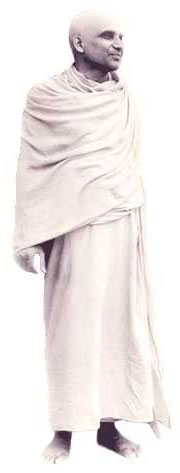
by Swami Krishnananda
Dravya-yajnas tapo-yajna yoga-yajnas tathapare, svadhyaya-jnana-yajnas ca yatayah samsita-vratah: Yogis, students of yoga, offer physical substances to the gods in heaven as a form of worship. This is called material offering: dravya yajna. Others offer themselves through the performance of tapas. Tapas is the creating of the heat in one’s own body or mind by subjugating the sense organs. There is an energy content in ourselves which always maintains an optimum. It never increases or decreases. As they say, the total energy in the cosmos is always stable – it does not increase or decrease – but, it can increase or decrease under certain circumstances. When the consciousness is contemplating an object of sense which is outside, particularly with an emotional charge upon it, the energy flows through the channel of the perceptive organ – and to that extent, the energy quantum is diminished. And the more we are emotionally conscious of an object, the weaker we are in mind and body, and the worse we are in every way. The greater the power of the consciousness to not allow itself to move in the direction of the objects of the sense organs and stabilise itself in itself, the greater is the energy quantum in us. And then indomitable strength, invincible power and such things as siddhis may develop in one’s own self if our energies are maintained in ourselves and they are not allowed to move outside in the form of objects or move through the sense organs to the parts of the body.
We have seen the beauty of a little baby. Why does an old man look ugly while the baby looks very beautiful? The reason is the equidistribution of energy in the baby’s system. As the child grows into an adolescent and an adult, the energies begin to concentrate themselves in the different parts of the body, and the equidistribution ceases. The harmony with which the energy is distributed in a baby makes every part of its body beautiful. There is no comparison of one part with another part. Whether it is the nose or the leg or the foot, all are beautiful. But when the energies get diverted due to the desires of the adult, they concentrate themselves in the eye or the nose or the tongue or the other organs, and the energy leaks out as water may leak out through a pot with many holes. This should not be allowed.
Tapas is the strength that we exercise in ourselves with which we maintain our energy in ourselves, and we do not wish that energy to go into some other object of sense, or even a particular part of the body. It should be equally distributed everywhere. Hence, children who are innocent and have no desires, and also saints who have no desires, have beautiful and radiant faces. But ordinary people who have desires feel compelled to let out the energies towards objects through their sense organs. This is called tapo-yajna.
Dravya-yajnas tapo-yajna yoga-yajnas tathapare: In terms of the practice of yoga, we do a yajna in a spiritual sense. It is left to us to determine what kind of yoga Bhagavan Sri Krishna means here. It may be karma yoga, it may be bhakti yoga, it may be the raja yoga of Patanjali, or the jnana yoga or brahmabhyasa of the Yoga Vasishtha and the Upanishads; by the practice of this kind of yoga, the highest kind of yajna is performed.
Dravya-yajnas tapo-yajna yoga-yajnas tathapare, svadhyaya-jnana-yajnas ca. There are people who are devoted to sacred study. Every day they read the whole Gita, or the whole Srimad Bhagavata, or the Ramayana, or the Mahabharata, or the Bible, or the Koran, or whatever their holy text is. They pour themselves into the theme of the text, so that this tremendous concentration that they are bestowing on the theme that is delineated in the sacred text becomes a kind of concentration. Svadhaya is sacred study. Svadhaya does not mean reading books in the library – just picking up anything randomly and reading it. It is a concentrated study of a single text or a single group of texts – Upanishads, Bhagavadgita, Vedas, etc. – so that the thoughts of the great masters who wrote these texts will have such an impact upon their minds that they are virtually meditating not only on the thoughts of these great sages but also on the noble themes which are delineated in the text. Thus svadhyaya, sacred study which is to be conducted every day by everyone, is also a yajna, a great sacrifice that a spiritual seeker ought to perform and must perform.
Jnana yajna is again mentioned as the pouring of the soul into the cosmos, the melting of ourselves into all the five elements, and ceasing to exist as individuals – existing only in God. The Yoga Vasishtha is especially devoted to jnana yoga. It tells us how to melt ourselves into the Supreme Being and deny the whole world as an existent subject itself – to see only God permeating everything, and know that only God is.
Dravya-yajnas tapo-yajna yoga-yajnas tathapare, svadhyaya-jnana-yajnas ca yatayah samsita-vratah. Apane juhvati pranam prane’panam tathapare: Some people offer the prana into the apana as an oblation in a sacrifice. The offering of the prana into the apana is done by taking the breath inward. As I mentioned, the prana takes the breath outward. The apana pulls it down. So when we breathe in, the prana which is otherwise outwardly motivated is restrained from its outward activity and poured into the apana, as it were. This pouring of the prana into the apana by way of inhalation exercises is also a yajna of pranayama.
Prane’panam tathapare: Some offer the apana in the prana. That happens when we exhale. When the prana goes out, the apana is pulled up; the prana wants to take the energy of the downward pull together with it, and we exhale. But when we deeply inhale, the opposite action takes place: The prana is offered to the apana. So, apane juhvati pranam is actually a description of inhalation and exhalation. Puraka is filling; rechaka is exhaling. Hence, what is mentioned here is nothing but the process of puraka and rechaka, inhalation and exhalation, as part of the pranayama process. Apane juhvati pranam prane’panam tathapare, pranapana-gati ruddhva pranayama-parayanah: Some people practise only inhalation or only exhalation, but some people restrain both the outward breath and the inward breath at a particular spot. That is called kumbhaka, retention, which is true pranayama. Therefore, this verse actually describes the pranayama process – the inhalation process and the exhalation process, and the stopping process.
How will we stop the breath? Generally people do it by closing the nostrils, though it causes a little suffocation. That is one way, but the better method of stopping the heaving of the breath is to concentrate the mind on one particular object. The more is the concentration on one thing, the less is the breathing process. Suppose we are walking on the precipice of a deep gorge; the path is only one foot wide, and if we step outside it even a little we will fall down into the gorge. What would we do? Suppose we are walking on a tightrope in a circus. So much concentration is required! If we waver even a little bit, we will fall down. Therefore, concentration of the mind on a particular thing is a better method of bringing the breath to a stop. It cannot stop completely, but it becomes the minimum of inhalation and exhalation, so that the breath which usually extends about twelve inches in the ordinary process of breathing will become shorter and shorter. In the end, in perfected pranayama, the breath will move only inside the nostrils. It will not move outside. We will not even know whether the person is breathing unless a piece of cotton is put near his nose. This is type of pranayama is also one of the yajnas in spiritual practice.
Apane juhvati pranam prane’panam tathapare, pranapana-gati ruddhva pranayama-parayanah. Apare niyataharah pranan praneshu juhvati: Others restrain themselves by abstentious diet. They take a minimum diet. Niyataharah – ahara is a food of the sense organs. Though generally ahara means the food that enters through the mouth, in the yogic sense it can also be considered as anything that the sense organs take into themselves. Colour and form are the food of the eyes, sound is the food of the ears, smell is the food of the nose, taste is the food of the tongue, and touch is the food of the skin. Therefore, these are also food. So when we are abstentious and eat very little food, we not only diminish our chapatti and rice but also diminish the desire to see, the desire to hear, the desire to smell, the desire to taste and the desire to touch. All the sensations become diminished in their activity, and they become virtually controlled. This is niyataharah – restrained diet of the sense organs.
Apare niyataharah pranan praneshu juhvati: We can offer the senses unto the gods who superintend over the sense organs. Tell the god of the eyes, “Take your property.” Tell the god of the ears, “Take your property,” etc. We distribute the belongings which are not ours, which we borrowed from these gods. We give them back, and then we offer a terrible sacrifice of ourselves completely in terms of the dismemberment of the sense organs, and the pranas are offered into the cosmic prana. The senses are offered to the gods, the divinities that superintend or control the senses, so that the senses no longer work independently. They are centralised in the cosmic divinities. Similarly, the pranas are centralised in the cosmic prana, Hiranyagarbha.
Apare niyataharah pranan praneshu juhvati, sarve’pyete yajnavido yajnakshapitakalmashah: All these processes of self-restraint that have been mentioned are equally good, and whoever takes to any one of these practices is to be considered as a real spiritual seeker, a real sadhaka, a real tapasvin. We can resort to any one of these methods of self-control that have been described by Bhagavan Sri Krishna in these great verses in the Fourth Chapter of the Bhagavadgita.