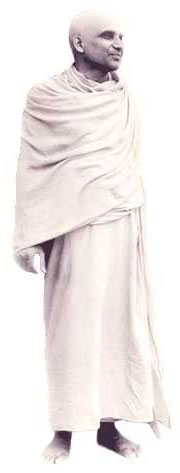
by Swami Krishnananda
Abhyasa-yoga-yuktena chetasa nanya-gamina, paramam purusham divyam yati parthanuchintayan (8.8): The supreme resplendent purusha, the Absolute Being, is our goal. By the constant practice of the yoga of meditation, and not allowing the mind to flicker hither and thither, absorbing ourselves entirely in this practice of total concentration on the Universal Reality, we shall attain to that supreme Sun of all suns – parama purusha – and we shall be most blessed. Eternity and infinity shall be the fruits that we gather by this hard effort of meditation on the universal existence of God Almighty.
Kavim puranam anusasitaram anor aniyamsam anusmared yah, sarvasya dhataram achintya-rupam aditya-varnam tamasah parastat (8.9): For the purpose of enabling us to picture that Supreme Being at the time of death – or always, as the case may be – we are told what kind of person that Supreme Being is. That Being is All-knowing – kavi. There is nothing that we can hide from that Almighty Being. That Supreme Being is most ancient – purana – because It was there even before creation. Before there was space, before there was time, before there was anything, It was there. Therefore, It is the purana purusha, the adi purusha, the most ancient one; the all-knowing ancient one: kavim puranam. Anusasitaram: It is the ruler of all the worlds, the ultimate destiny of everything, the final authority of all things, and the great God of creation.
Anoraniyamsam: It is subtler than the subtlest. Atoms, electrons and energy cannot be seen except in a mathematical fashion as points, but even such conception is not possible here. It is subtler than the subtlest, because of the fact that It is pure subjectivity. The grossness characterising objects of sense cannot touch this pure subjectivity. It is deeper than our ordinary physical subjectivity as Mr. So and so, etc.; it is deeper than our psychological subjectivity as learned persons, great persons, etc. It is deeper than even the causal personality of individuality. It is an unconditioned deepest essence and, therefore, It is the highest subjectivity. The highest subjectivity means free from any kind of externality of space, time and connection. Therefore, It is called subtle – the subtlest of all – and not even the subtlest space can be compared to It.
Anor aniyamsam anusmaredyah: whoever can contemplate this Mystery of mysteries. What kind of mystery? Sarvasya dhataram: the father and the grandfather of all people, the great protector of all beings, the final resort of everyone. Achintyarupam: unthinkable is that Being. Our eyes will be blinded, we will become deaf by the vibrations that It produces, and our sense organs will simply melt into the liquid of an experience that can best be described as spiritual realisation – achintya-rupam.
Adityavarnam: Solar light is the brilliance of that goal. The sun is like a shadow before that light. Thousands of suns cannot stand before It: na tatra suryo bhati. The sun does not shine there. The rays of the sun, the light of the sun is like darkness before it – pitch darkness – because of the excess of light. When light increases in frequency, it becomes darkness. Because of a commonness of frequency between the apparatus of our eyes and the light of the sun, we are able to see it; but if the level of the sunlight's frequency is raised or lowered, we will not see the light at all, just as radio waves cannot be heard unless the radio’s frequency is the same as the frequency in which the waves are being broadcast by the radio station. Hence, the solar description is symbolic and does not mean that God is merely like a sun. Millions of suns will be darkness before that light of all lights – jyotisham api tajjyotih; light that is beyond all lights, light that is tamasah param – beyond the darkness of the ignorance of people. Aditya-varnam tamasah parastat: The whole world is darkness in comparison with that light of all lights. We think we are in daylight, but it is pitch darkness before that utter luminosity.
Can we contemplate on That? We must contemplate on That at the time of passing: prayanakale (8.10). Manasachalena: without allowing the mind to go hither and thither, but getting absorbed in all love and affection and endearing feeling; pouring ourselves on That, and allowing It to pour Itself on us without allowing the mind to flicker; full of devotion for That, and wanting nothing else, and crying for It always. Bhaktya yuktah yogabalena chaiva: full of devotion to It, but at the same time we are highly determined to see that we get It. “Now or never! Let this flesh melt and the bones crack. I shall not get up from this place until I get it!” was the resolution of Buddha. If we have that resolution with a devotion that surpasses all understanding, we are really blessed. Bhaktya yukto yogabalena chaiva: Yogabala is the power of the will of concentration.
Bhruvor madhye pranam avesya samyak is one type of concentration that is prescribed here: concentration on the point between the eyebrows because of the fact that in the waking condition the mind is supposed to be actively operating in the ajna chakra, which is located there. In the dream state, it is in the throat, as it were; and in the sleep state, it is in the heart. Inasmuch as we are mostly in the waking condition and the mind is already in the point between the eyebrows – which is its svasthana, or its own abode – it is profitable for us to concentrate on that point instead of dragging the mind from its abode to some other direction. So it is said to concentrate the mind on the point between the eyebrows and raise the prana to that point – because wherever the mind is, there the prana is. The prana rushes to wherever we are concentrating our mind, and even the bloodstream moves in that direction. Sa tam param purushamupaiti divyam: By this practice, we shall reach that Parama Purusha, Purushottama, the Being of all beings, the Supreme God, Whose realisation is our be-all and end-all.
Yad aksharam vedavido vadanti (8.11): “I shall now tell you a secret – that imperishable secret which is known to the knowers of the Veda, the students of the three Vedas. There is a secret which is known to them, and I shall tell you what it is.” Visanti yadyatayo vitaragah: “That secret which I am going to tell you is the quintessence of Vedic knowledge, and is that abode into which restrained tapasvins and yogins enter.” Yad icchanto brahmacharyam charanti: “The longing for which union, people practise continence, and restraint of the senses and the mind.” Tat te padam sangrahena pravakshye: “Briefly I shall tell you what this imperishable seed is on which you have to meditate always, and at the time of passing.”
Sarvadvarani samyamya (8.12): “Close all the gates of your body.” The five senses of perception, these avenues which are the windows of knowledge, are closed completely. Do not see, or hear, or touch, or smell, or taste; and do not allow any agitation of the other active limbs such as the hands and the feet, etc. Neither the sense organs of knowledge, nor the organs of action should be active at that time. These principles of action are withdrawn completely into the mind, in which case the mind becomes intently potent. Usually the mind is weak, because more than fifty percent of its energy is depleted through sense perception – through the sense organs of knowledge and the activities of the other karmendriyas, or organs of action. A very little knowledge is there, and that is also distracted by the activities of the senses. But when the activity of the senses is withdrawn, the holes through which the energy goes out in the direction of space and time are blocked. This is called sarvadvarani samyamya: blocking all the holes which are the ten sense organs.
Mano hridi nirudhya cha. It was said that the mind is to be concentrated on the point between the eyebrows. Now it is being said that the mind will be concentrated in the heart. In deep sleep, in death, and in the samadhi state the mind goes to the heart; but at other times it moves in the throat or the brain. In deep meditation, transcending the consciousness of the concentration that we are practicing on the point between the eyebrows, we go deeper into the heart. When the mind is made to slowly descend to the position of the heart, it ceases from externalised ways of thinking and settles in its true abode. The final abode of the mind is the heart. As the Upanishads tell us, in the state of deep sleep it is supposed to be lying in the puritat nadi.
Murdhny adhayatmanah pranam asthito yoga-dharanam: A very difficult technique is placed before us here. The pranas have to be raised to the centre of the head. At the same time, it is said that the mind has to be concentrated on the heart. This seems to be a very difficult injunction. The idea is that our reason, feeling, understanding and emotion should get blended together so that what we think through the brain – the concentration that is active through the reason – is blended together with our deepest feeling. We are not merely in a state of understanding or feeling; we are in a state of intuition, which is a direct grasp of the total essence of things. Therefore, it is an injunction for two things: concentration on the centre of the head, which is the abode of the activity of rationality, and concentration on the heart, which is the abode of feeling.
Asthito yoga-dharanam: Thus being absorbed in the highest mood of yoga meditation; om ity ekaksharam brahma vyaharan (8.13): chant OM. When we chant OM, we will feel that it finally becomes soundless. The matra of the pranava, or omkara, becomes amatra, or soundless vibration. The message that we receive from the broadcasting station is not a moving sound. It is a vibration which is converted into sound waves in our receiving set. In a similar manner, the sound that is articulated in the form of chanting OM, or pranava, becomes rarefied into a soundless universal equilibrium of energy wherein we get lodged as the soul of the cosmos. Om ity ekaksharam brahma: The eternal Brahma it is, in His form of vibration. Vyaharan – chanting like this, uttering this great pranava, and deeply concentrating on My Being; yah prayati – whoever departs from this body; yah prayati tyajan deham – whoever leaves this world quitting this body; sa yati paramam gatim – he reaches the eternal abode.