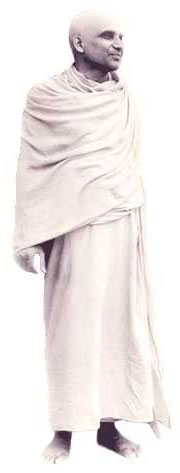
by Swami Krishnananda
The Brahmaloka that is conceived by us has two characteristics: a universal in which we find our abode, and a universal that is ourselves. Are we going to live in Brahmaloka as residents of that place, due to the tapas we have done? If that is the case, when the effect of the tapas is over by the exhaustion of the momentum thereof, we will come back. So, in a way, there is a possibility of our coming back from Brahmaloka if we have attained it with the power of our meditation on objective universality – a vast kingdom of heaven or Absolute, yet a kingdom into which we have to enter as individuals, with the prerogative of participating in the joys of that realm. If that is the case, we will come back. But if we identify with Brahmaloka as the essence of what we ourselves are – because Brahmaloka is universal, we cannot be outside it – the question of staying there as a citizen cannot arise. We have a very funny idea when we imagine that we can go and stay in Brahmaloka as a resident, as a guest, etc. Such a thing is not possible because Brahmaloka is all-pervading and inclusive of all things. If that is the case, we are also inside it, so how will we come back from That? We ourselves are Brahmaloka. The largest dimension of our soul is Brahmaloka. If this is our meditation, we will not come back; we will be lifted up in the Supreme Absolute. But if we think it is a kingdom which is vastly spread out, like this world, and we are only residents there, we will come back.
So, abrahma-bhuvanallokah punar avartina: Even if we reach that abode of the Creator, as an abode where we will reside, we will come back because it is in space and time; it is an extended kingdom. Because it is an extended kingdom, it is characterised by spatiality and temporality. That is the reason why when we enter there, we will have to come back.
Mam upetya tu kaunteya punar janma na vidyate: “You will not be reborn after having attained Me.” Would we like to be reborn? If so, we will have freedom to be reborn as we like. But if we enter that which is not capable of coming back into space and time, we will enjoy that eternal beatitude.
Some cosmological information is given to us here in the succeeding verse, as a preparation for something more that is going to be told to us regarding the departure of the soul after leaving this body. The manner of going out of this body and ascending upwards is described through the paths called northern and southern. In connection with that context, we are told that Brahma’s life is for one hundred years, and we have to imagine what kind of one hundred years they would be.
There are four yugas – called Krita, Treta, Dvapara and Kali. These are the time cycles or ages, as we say. We are supposed to be in Kali Yuga, the worst age, where there is conflict. The age of conflict is called Kali Yuga. This age is supposed to extend for 432,000 years. The duration of Dvapara Yuga is double that, the duration of Treta Yuga is triple, and Krita Yuga is quadruple. The total of all these figures is called one thousand divine years; but according to us, it is a multiple of several thousands of human years. Imagine what it means: 432,000 multiplied by 2, then multiplied by 3, and then multiplied by 4. That total is the duration of one day of Brahma. One day of Brahma is as long as this computation of the years of the four yugas, and one night of Brahma is equally long. This is twelve hours of day and twelve hours of night of Brahma. What is the night? The pralaya, or the dissolution of the cosmos that will take place at the end of the yugas – that is the night of Brahma.
There are two kinds of dissolution. There is dissolution of all life everywhere, but not dissolution of the elements – earth, water, fire, air and ether; they remain. The dissolution of all life takes place after one day of Brahma; and then he sleeps. When Brahma wakes up, he creates beings once again – gods, celestials, angels, men, beasts, etc. – as he has done previously. But there is another kind of dissolution which dissolves everything. The whole cosmos is dissolved, including the five elements. After one hundred years of Brahma, the entire universe is dissolved, and Brahma also gets dissolved. He enters the Absolute.
Sahasra-yuga-paryantam ahar yad brahmano viduh (8.17). One day of Brahma is one thousand years for the gods, but according to the human concept it is many millions of years. Ratrim yuga-sahasrantam te’ho-ratra-vido janah: The length Brahma’s night is the same.
Avyaktad vyaktayah sarvah prabhavanty ahar-agame, ratry-agame praliyante tatraivavyakta-samjnake (8.18). When the day of Brahma commences, activity starts in the universe, just as we start our business after we get up in the morning. And, we do things today in the same way that we did them yesterday. Yatha puravamakalpayat: Brahma created this world in the same way that he created it in earlier cycles of time. Avyaktad: When Brahma goes to sleep, all beings, including us, merge in the avyakta prakriti. It does not mean that we will be liberated. Just as in deep sleep we are not liberated, similarly, in this avyakta prakriti, or the unconscious universal where Brahma is in deep sleep, we too enter and sleep with Brahma; and when he wakes up, we also will wake up. The cosmic sleep does not mean liberation. This is referred to in Patanjali’s sutras as prakriti laya, etc. Cosmic ignorance absorbs us in the same way that individual ignorance absorbs us in deep sleep.
Avyaktad vyaktayah sarvah prabhavanty ahar-agame: From the unconscious, unknown, cosmic equilibrium of darkness which is the sleep of Brahma, arises the day of Brahma; and all creation sprouts forth, as plants rise up from the earth when it is raining. But when the day concludes, everything is withdrawn, and all life goes into sleep. Ratry-agame avasah partha: We are helplessly driven back to the cosmic sleep of Brahma in the same way that we helplessly go to sleep as individuals.
Bhuta-gramah sa evayam bhutva bhutva praliyate (8.19): Endless is creation, and endless is dissolution. How many times we have come, and how many times we have gone! In all the eighty-four lakhs (8,400,000) of species through which we have to pass, as they say, we are now at the human level. Perhaps we have passed through all these eighty-four lakhs of species. Many a time we have come, and many a time we have gone. Endless is creation, and endless is destruction. There is no beginning and no end for it. Bhuta-grama:The total of all living beings enters and sinks into unconsciousness and rises from unconsciousness, and again sinks into it and rises up. Just as we sink into sleep and rise up into waking, and again sink into sleep and rise up to waking, etc., the same process also takes place in the cosmos: bhuta-gramah sa evayam bhutva bhutva praliyate, ratry-agame’vasah partha prabhavaty ahar-agame.
Beyond that entanglement in prakriti’s ignorance, beyond that creativity and destructive process of the universe, there is the transcendent luminosity which is the Supreme Godhead – paras tasmat tu bhavo’nyo’vyakto’vyaktat sanatanah (8.20): eternal radiance, light that shines beyond the darkness of the ignorance of the three gunas of prakriti. Paras tasmat tu bhavo’nyo’vyakto’vyaktat sanatana, yah sa sarveshu bhuteshu na’syatsu na vina’syati (8.20): If all people die, that Eternal Being will not die. Even if millions of Brahmas come and go, that winkless (unblinking) Eternal is aware of all that is happening. In the Yoga Vasishtha it is said that within the time that a great being like Vishnu or Siva closes his eyes and opens his eyes, millions of Brahmandas, or cosmoses, come and go. This is the mystery of the relativity of the cosmos.
Avyakto’kshara ity uktas tam ahuh paramam gatim (8.21): The supreme abode of eternal beatitude is beyond even this cosmic ignorance, and that is the goal of all beings, including Brahma himself. Te brahmalokeshu paranatakale paramritah parimuchyanti sarve: Together with Brahma, we merge into the Absolute at the end of time. Avyakto’kshara ity uktas tam ahuh paramam gatim, yam prapya na nivartante: Again it is said that after reaching That, we will not come back. Tad dhama paramam mama: “That is My abode.”
Purushah sa parah partha bhaktya labhyas tv ananyaya (8.22): That Supreme Abode, the great brilliance which is God Almighty, can be attained only by unconditional devotion. This is only a repetition of the idea that has already been mentioned – that unconditioned devotion is the only way to God-realisation. Unconditioned devotion means wanting God only and wanting nothing else at any time. Purushah sa parah partha bhaktya labhyas tv ananyaya. Ananya bhakti is dispassionate devotion to God which cares not for the values of anything else in the world. Anya bhakti is an adulterated kind of devotion which has love for something else also – vyabhicharini bhakti. Avyabhbicharini bhakti is totally concentrated devotion on one thing only, to the exclusion of any other possibility. Purushah sa parah partha bhaktya labhyas tv ananyaya, yasyantah sthani bhutani yena sarvam idam tatam: That transcendent thing beyond all concepts of even Brahmaloka is here, just now. Do not be under the impression that it is a long journey in the process of time, for millions and millions of years, as if we are going to reach a distant star. It is nothing of the kind. It is a timeless experience and, therefore, it is an instantaneous experience. It is ‘not dying’ and, therefore, it is not above us; it is also within us.
After the passing from this body, how do we approach the realms of being that are above us? Do we suddenly enter God as if we are shaken up by a kick, or do we move to God gradually, stage by stage? The stage by stage ascent to God is called krama mukti – a graduated ascent to the Supreme Being. The sudden illumination is called sadyo mukti – immediate dissolution in God. Immediate dissolution is like a drop on the surface of the ocean sinking into the ocean; it does not have to travel any distance to go into the ocean. Krama mukti is like reaching a distant place by trudging along a long road and having many experiences on the way.
What kind of path it is that we are going to tread after the dispatch of the soul from this body? The coming verses describe to us the process of krama mukti, or gradual ascent through various stages – just as when we go to Badrinath there are so many chattis (halting places). We halt in one place and then move on, and halt in another place, and so on, until we reach our destination. We take rest in the chattis or the choultries and resume our journey in the morning, and when it is sunset we halt at another chatti or choultry. We take rest there, have a little refreshment, and then continue onwards.
Similarly, there are various stages in our movement towards God. We do not suddenly jump like a rocket and rise to the topmost level. How are we going to ascend? What are the stages of the ascent? Here the ascent is to be taken in the sense of the ascent of a purified soul on the way to God. It is not an ascent to hell or to a nether region or treading the path of rebirth, etc. That is not described here, because after death we may tread the path of ascent towards God, or we may tread another path of coming back to this world through rebirth, or we may even go to hell; that is also possible. But that is not the subject here. The subject here is in connection with the purified soul who is going to reach God, and the soul who not so purified as to deserve the instantaneous merging but has permission to go gradually by a self-purification process that takes place slowly, step by step.