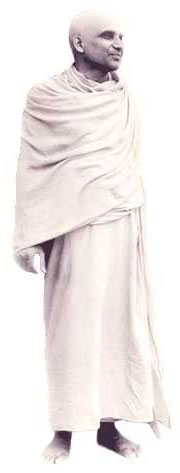
by Swami Krishnananda
Those who have not awakened themselves spiritually, and have not done spiritual meditation, have insufficient devotion to God. Even if they are very good people, highly charitable and humanistic in their approach, they will not be allowed to move along this northern path to the sun. They will not go to Brahmaloka. They will go to a lower realm, called Chandraloka. The smoke which rises from the fire during cremation will be their guiding principle. The dark half of the lunar month and the southern movement of the sun signify a deficiency in divine powers and a lesser chance of the soul going up along the path of brightness. It will reach Chandraloka, where it will enjoy the fruits of the good deeds it has done. Whatever good deeds were done will have their effect. Every action produces a reaction. Any good, charitable deed will bring the soul an abundance of joy there in Chandraloka; but the soul will come back, because anyone who has not realised the universality of God will come back. Only a soul who is totally devoted to God will gradually pass through these stages of divine ordinances to the Ultimate Being. But if the soul is united with God here itself, it will immediately merge into God. Dhumo ratris tatha krishnah shan-masa dakshinayanam, tatra chandamasam jyotir yogi prapya nivartate (8.25).
Sukla-krishne gati hy ete jagatah sasvate mate (8.26). Broadly speaking, these are two paths of the soul after death. Either we go that way or we go this way, according to our karma and our spiritual status. Sukla-krishne gati hy ete jagatah sasvate mate, ekaya yaty anavrittim anyaya’vartate punah: By the one path, one does not come back to this world; by the other path, one returns.
Naite sriti partha janan yogi muhyati kaschana, tasmat sarveshu kaleshu yoga-yukto bhavarjuna (8.27). Having known clearly that these are the two paths, who would like to tread the lesser path? “Therefore, be a yogi, O Arjuna, and try to tread the upper path.” Whoever knows the merits and demerits of these two paths will certainly pursue the path of merit rather than of demerit. It is the lack of knowledge that prevents us from working for our own salvation. But if we know that such a thing exists, and that even after death our karmas will pursue us wherever we go – that even if we go to the nether regions, we will be caught by the nemesis of our actions, the results of what we have done, because there is a law which punishes us – we will obey the law. And if we know that there are these two paths and there is chance of our entering into the lower one, we will certainly work to attain the higher one. Knowing this, we will certainly become wiser and, therefore, work for a state of establishment in yoga – union with the divinities in the various graduated scales of development, or with the Supreme Absolute itself, whatever the case may be. Either way, one will be a supreme yogi who is united with the Absolute now, or one will be a graduated yogi who will move systematically through the stages mentioned. Anyway, knowing this, one will not come to grief. Tasmat yogi bhavarjuna: “Therefore, become a yogi, Arjuna!”
Vedeshu yajneshu tapahsu chaiva, daneshu yat punya-phalam pradishtam, atyeti tat sarvam idam viditva, yogi param sthanam upaiti chadyam (8.28). These discourses that you are hearing now as satsanga – the knowledge of these wonderful things beyond this world that you are gaining – is greater than all the good deeds that you do by way of charity, and all the sacrifices that you perform. All the merits that you will accrue by doing charity, good deeds and even the study of scriptures like the Vedas, and by doing austerity and living an abstemious life will bring you some good results. But this phala of satsanga – the blessing of this highly purifying training that your soul is undergoing by listening to these glorious eternal realities – certainly has a greater capacity to produce an effect than all the charities, studies and scriptures, etc. It transcends even the Vedas, and you attain to that place, that abode, which is ancient. With this, we conclude the Eighth Chapter.
The Ninth Chapter is something like the Seventh Chapter. Whatever we have been told in the Seventh Chapter by way of a universal religion is explained in a different way, in a more deviated style, with some detailed descriptions. Practically, the Ninth Chapter is a continuation of the very same theme that we had in the Seventh Chapter, with the Eighth Chapter in between and its message of it being necessary for us to know what will happen to us after death even if we are highly religious people. The Ninth Chapter is a highly religious scripture by itself.
Idam to te guhyatamam (9.1): “This is the secret of secrets that I am going to tell you.” Pravakshy amyanasuyave: “Because you are highly devoted to Me and you are not prejudiced against anything, I shall tell you this secret of secrets.” Jnam vijnana-sahitam yaj jnatva mokshyase’subhat. The reference to jnana and vijnana was also made in the Seventh Chapter. Now once again it is repeated: “I shall tell you everything regarding jnana and vijnana – that is, knowledge as well as spiritual experience. Or it can also mean the knowledge of everything connected with this world and the knowledge of the eternal realities. I shall describe to you what these are.”
This is called rajavidya, the kingly science and the kingly secret. Raja-vidya raja-guhyam (9.2): It is as secret as the king’s abode, and as glorious as the king himself. “Such is this vidya, this knowledge into which I am going to initiate you.” Raja-vidya raja-guhyam pavitram idam uttamam: Most sacred is this knowledge; best of all learning is this. Pratyakshavagamam dharmyam: You will know the result of it by direct experience. The proof of the pudding is in the eating of it. You will know what the meaning of all this is by direct experience, and you will rejoice to have that experience. Susukham: Immense rejoicing – from blessedness you move to blessedness by knowing this truth. Kartumavyayam: It is easy to practise, and the effect it produces is imperishable.
Asraddadhanah purusha dharmasyasya parantapa, aprapya mam nivartante mrityu-samsara-vartmani (9.3): “Those who do not have faith in this kind of teaching and are attached to the objects of sense come back to this world of mortality and this suffering of samsara because they do not know that I pervade all things. They are mostly motivated by the sense organs, and they believe what they see, and their reason is not sufficiently operative. They are people without faith – asraddadhanah purushah. They do not know what the Supreme Universal Dharma is. They do not reach Me and, therefore, they come back to this great sorrow-ridden world of materiality and sensuality.”
Maya tatam idam sarvam jagad avyakta-murtina (9.4): “Invisibly, un-understandably, as it were, I am pervading all things. There is no place, no nook or cranny, or corner where I am not. I bring about an organic relation among all the things in the world, though they are millions of light years away from the point of view of sense perception.” Something may be millions and millions of years away, yet it is connected with us just here. The moment we sigh here on this earth, it is known in the abode of Brahma that we sighed. Such is the organic relationship of all things, because there is a life principle invisibly operating in all things. “I am present in all things. Everything is pervaded by Me. There is no location where I am not. You cannot hide anything from Me.” Maya tatam idam sarvam jagad avyakta-murtina, matsthani sarva-bhutani: “All things are located in Me.” This is also a repetition of something that is said in the Seventh Chapter. Matsthani sarva-bhutani, na chaham teshv avasthitah: “I am not in them.”
All particulars are in the Universal; the Universal is not in the particulars. The waves are in the ocean; the ocean is not in the waves. We can draw a similar analogy when the Lord says, “I am in everything, but things are not in Me.” Existence-Consciousness-Bliss, or satchidananda svarupa, is present in every name and form, but name and form are not in satchidananda. God is in the world, but the world is not in God. This is the reason why the Lord says, “Everything is in Me, but I am not in them. I remain transcendent, though at the same time I am immanent in all things.”
Na cha mat-sthani bhutani (9.5): “I said that everything is in Me, but now I am also saying that, in another way, they are not in Me.” This is because the world of dream cannot be sticking to our waking consciousness. “Nothing in the world can be in Me, inasmuch as the world does not exist for Me. Though I said earlier that inasmuch as I am immanent in all things and I pervade all things, all things may be said to be in Me, now I say that I am without externality, without space, without time. Therefore, things cannot be there; and therefore, the question of things residing in Me also does not arise.” Na cha matsthani – immediately the previous statement is contradicted. “Things are also not in Me, for another reason altogether.” Pasya me yogam aisvaram: “Look at My glory; see My majesty.” “Look at Me,” the Almighty says. “How wonderful is this majesty of My abode where I am everywhere. Everything is in Me, and yet nothing is in Me.”