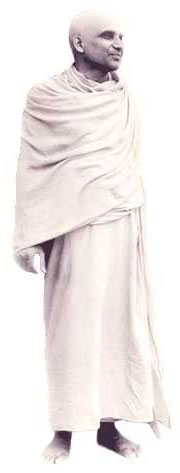
by Swami Krishnananda
Satatam kirtayanto mam yatantas cha dridha-vratah, namasyantas cha mam bhaktya nitya-yukta upasate (9.14): “They dance and sing and are in a state of ecstasy due to communion with My great, glorious spirit. They always sing about My greatness and glory, and speak of Me wherever they go. In the streets, in the marketplace, in the house, in satsangas, in the family circles – everywhere they talk of Me.” An example is Saint Tukaram, who had no other thought wherever he went. Whether it is in the shop, in the marketplace, in the house or in the satsanga hall, it is one continuous, ecstatic thought which compels them to glorify God wherever they go. Satatam kirtayanto mam yatantas cha dridha-vratah: “And perpetually striving to come nearer and nearer Me, so that they become one with Me.” Namasyantas cha: always prostrating themselves in temples, in holy tirthas, near holy trees andto holy saints and sages. Wherever there is a pre-eminence of the manifestation of divinity in this world, to that place and to that thing they resort and offer themselves through deep prostration. These great souls are the humblest people in the world. They prostrate themselves before anybody, even before a child. Swami Sivanandaji Maharaj was one great example. He would touch the feet of anyone, even a baby; it did not matter. Humility is the prerogative of great mahatmas. The greater they are, the smaller they look; and they do not seem to exist at all in their personality because of their not being in one place as egos. They pervade all places as veritable representations of God’s glory in this world. They are called gods moving in the world – bhudvija. They are also called bhudvijas: great souls veritably representing God.
“They worship Me not merely by dancing and singing and prostration, but also by an inward communion of their souls.” Jnana-yajnena chapy anye yajanto mam upasate (9.15): “In this wisdom of the spirit which is jnana yajna, they behold Me in all varieties of forms.” Ekatvena prithaktvena bahudha visvato-mukham: “As I am everywhere, they can behold Me as one Being existing everywhere; or they can behold Me as two realities indwelling as a transcendent element and also as an immanent element; or they may look upon Me as a multifaceted Reality indwelling many souls.” God can be visualised as a manifold manifestation, as souls of all created beings; or He can be considered as a dual manifestation, transcendent and immanent; or He can be beheld as one only. Sri Ramakrishna Paramahamsa is supposed to have once come to Benares to have darshan of the great saint and sage Trailingaswami, a great siddha. The greatness of that siddha was such that it drew even Ramakrishna Paramahamsa. It appears that Sri Ramakrishna put a question to Trailingaswami: “Maharaj, how many gods are there?” [Swamiji raises three fingers, then two fingers, then one finger.] That was the answer. “Yes I understand you.” The great disciple understood the great master’s significant gesture: God is threefold, God is twofold, God is single. Ekatvena prithaktvena bahudha visvato-mukham: In any form we can worship Him.
This is the great charity of feeling and vision that we develop when we become the greatest of souls. The greatest of souls are highly charitable in their feelings, in their gestures, in their speech, in their behaviour, in their actions. Ekatvena prithaktvena. Prithak means double, two; bahudha means manifold. According to Sankaracharya, there is one reality; according to Ramanuja, there are two realities; according to Madhva, there are many realities. Therefore, all the three Acharyas are satisfied with this half verse that Bhagavan Sri Krishna speaks here, which satisfies all viewpoints, as it were. Rama asked Hanuman, “Who are you? Please tell me. Describe yourself.” Hanuman gave a reply. Dehabuddhyat daso’ham: “If you think that I am a body, that I am totally different from you, I am your servant.” Jivabuddhyat tvadamshatah: “If you think that I am a soul, I am a part of you.” Atmabuddhyat tvamevaham: “If you think that I am the spirit, I am you only.” Ekatvena prithaktvena bahudha visvato-mukham: “As totally different from you, I am your servant; as part of you, I am your soul; and as yourself, I am the Atman.”
“I am everything.” Now the spirit of the teaching rises into a great tempo of expression, preparing the field for the final universal manifestation in the form of the Visvarupa in the Eleventh Chapter. “I am all the sacrifices that the Vedic seers perform.” Aham kratur (9.16): “All the yajnas, worship, sacrifices that people perform through the Smritis, or code of ethics – such as Manu, Yajnavalkya, Parasara, etc. – that is also Me.”
Aham yajnah svadhaham aham aushadham. Once in a month or once in a year there is sraddha ceremony, in which rice balls are offered to the ancestors. “The spirit indwelling in that performance also is Myself.” “I am behind the medicine that you take when you are ill. I am the curing force, the curative element in all the medicines.” Mantro’ham: “The mantra that you chant during your japa, I am inside it.” “The ghee, or the clarified butter that you pour during your sacrifice, I am inside that.” Aham agnih: “The fire that is blazing forth in the yajna, that is also Myself.” “The bhasma that comes out after the offering is made, that is also Myself.”
“I am the grandfather of all creation. I am the father of everything.” Pitaham asya jagatah (9.17): “I am the father, the supreme parent. This world is my progeny, as it were. I am the father, the supreme father in heaven, of this cosmos.” Mata dhata pitamahah: “At the same time, I am also the mother.” “I am the sustainer, the father and the mother of all beings; and I am the grandfather of everybody, being the father even of Brahma himself. I am the one Supreme Reality that is to be finally known – after knowing which there is no need of knowing anything else.” Vedyam pavitram omkara: “I am the spirit behind the omkara, pranava. The cosmic vibration is Myself only.” Riksama yajur eva cha: “The three Vedas extol Me. The spirit behind the mantras of the three Vedas – Rigveda, Yajurveda, Samaveda – is Myself only.” The one God is praised in all the mantras of the three Vedas – Rig, Yajur, Sama.
Gatir bharta (9.18): “I am the final resort of all people. When everything goes wrong, finally you have to come to Me only. I am the gati, the final abode, the final resort, the sarana, the home and the resting place of everybody. I am the supporter, the sustainer and the nourisher of all beings. I am the overlord of all beings; all gods are below Me, and none is equal to Me. I am the witness, and yet not involved in all this drama of creation, notwithstanding the fact that nothing can move without Me. I am the abode supreme – nivasah – and the friend of all beings.” Saranam suhrid: “As I am the real friend of all created beings, the real friend of every one of you, you have to come to Me one day or the other as a final resort.” Prabhavah: “Everything proceeds from Me.” Pralayah: “Everything is dissolved into Me.” Sthanam: “It rests in Me, finally.” Nidhanam: “The very root of all things.” Bijam: “The essential seed of creation.” Avyayam: “Imperishable too I am.”
Tapamy aham aham varsham nigrihnamy utsrijami cha (9.19): “I create heat through the sun. I create rain by the force of my will. I also withdraw the rain when it is my will. I release and I withdraw the forces of nature.” This sometimes looks kind, and sometimes looks very unkind. When God releases His energy through the forces of nature, nature seems to be scintillating, smiling and raining, and everything is green and flourishing; but when He withdraws His energy, it becomes dried up, as in a drought.
“I am the final immortal seat of all souls; I am also the death of all beings. Immortality and death, both are Me. It is I Who transforms all mortal elements into the deathless eternality of My own transcendent Being. It is also I Who destroys everything by the process of the evolutionary advance of nature and the cycle of time.” The many cycles are referred to in the earlier verses. Sad asac chaham arjuna: “I am existence and non-existence.” He has left nothing unsaid.
“I am existence and non-existence, being and non-being, this and that, here and there, now and then. There is nothing which I am not. But very few people realise this glory of Mine.” They go to the sacrificial yajnasalas and temples of worship and externally offer adorations, and perform sacrifices for gaining joy in the heaven of Indra by employing the mantras of the Veda for yajnas like Rajasuya, Asvamedha, Somayaga etc., as described in the Brahmana portions of the Vedas. They do this because they want to rejoice in heaven, and they expect this to be attained through the sacrifices that they make by means of the mantras of the Vedas. They do go to heaven, no doubt; but the merits produced by the performance of the greatest of sacrifices have a beginning and an end. As these merits originated in the sacrifice, they will end also by the exhaustion thereof through experience. After we enjoy the glories of Indra’s heaven, we will fall headlong down to the earth. Therefore, there is no point in our asking for Svarga, or heavenly joys, through the performance of Vedic sacrifices or through externally motivated rituals of any kind, even if they be in the form of a worship in temple. Such people who go to Svargaloka, or heaven, enter the abode of Indra and enjoy the divine blessedness of that place. Then afterwards – kshine punye martyalokam visanti – when the punyas or merits of these people slowly diminish and finally get extinguished, they come to this world once again – evam trayidharmam.
Trai-vidya mam soma-pah puta-papa yajnair ishtva svargatim prarthayante; te punyam asadya surendra-lokam asnanti divyan divi deva-bhogan (9.20). Te tam bhuktva svarga-lokam visalam kshine punye martya-lokam visanti; evam trayi-dharmam anuprapanna gatagatm kama-kama labhante (9.21): Those who run after the pleasures of sense, those who want to rejoice through the manifestations of their individual personalities – which persist even in heaven because of the fact of egoism persisting there even in a subtle form – their joys come to an end and they come back, like fallen angels bereft of all glory, suffering once again the turmoil of earthly existence.
Now comes a pendant verse. A pendant is a very significant ornamentation in a garland. Even in a flower garland, there is one big flower in the centre called the pendant, which glorifies and adds beauty to the entire garland – whether it is a gold ornament or a flower garland. Some such thing is this verse that we are hearing now. Ananyas chintayanto mam ye janah paryupasate, tesham nityabhiyuktanam yoga-kshemam vahamy aham (9.22): “I shall take care of everybody who is undividedly united with Me. I shall provide whatever they do not have, and after providing them with whatever they do not have, I shall also take care to see that it is not taken away from them.” This verse is highly significant, the meaning of which we shall consider a little later.