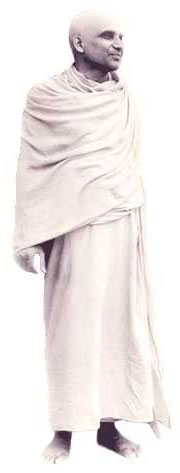
by Swami Krishnananda
Om tasaditi srimadbhagavadgitasupanishatsu brahmavidyayam yogasastre srikrishnarjunasamvade visvarupadarsanayogo nama ekadaso’dhyayah.
In fact, the whole purport of the Gita teaching is over with the Eleventh Chapter. Whatever follows from the Twelfth onwards is a kind of commentary, a kind of elucidation of certain minor details which have been briefly stated in the earlier chapters somewhere or the other. The ascent of the soul culminates in the vision of the Universal Spirit.
The lowest pedestal on which the soul was standing was the condition in which Arjuna found himself in the battlefield – everywhere fear, everywhere animosity, everywhere uncertainty, everywhere suspicion and agony, and everywhere strife and conflict. The Kaliyuga manifested itself in full force in that picturisation of the Mahabharata battle. No one loved another. Everyone hated the other. From there, the soul has to be taken gradually. From that samsaric mire of intense antagonism, conflict and fear, the soul had to be taken gradually, stage by stage. This has been done by the instructions that Sri Krishna gave, as a very good schoolmaster would give, without telling more than what is necessary under the given condition.
Apt words were used and suitable suggestions fitting to the occasion were given – not a word more, not a word less. But gradually the tempo went on rising, and we have observed how the tempo rose. The explanations became more and more clarifying, more in depth in their nature, until they reached a kind of perfection in the Sixth Chapter where the individual person was taught the art of self-integration and making oneself whole.
Unless we become whole, we cannot attain the Whole that is the Universal Reality. As we know very well, most of us are shreds of personality, fractions of the psyche, torn pieces of individuality, and none of us is complete in ourselves. We think different things at different times, and we do not know today what we will think tomorrow. There is a non-alignment of our psychological individuality. The understanding, the feeling, the willing and the emotion do not act harmoniously in concert. Therefore, unhappiness, suspicion and even sleeplessness are caused by this distracted action of the psychological organ antahkarana – mano buddhi ahankara chitta – which act as if they are independent entities while actually they are four facets of a single action of the total psyche.
For the integration of personality – to wean the person away from this difficulty of non-alignment – the art of meditation is prescribed in the Sixth Chapter. When a person is suitably fitted by this discipline of meditation, the student, the seeker, he is introduced into his relationship with the whole creation – the five elements, tanmatras, with God as the Supreme Maker of all things. God’s interference in the world becomes manifest in the Seventh Chapter, and not much of it is mentioned in the earlier chapters. Up to the Sixth Chapter, it is all psychological discipline. Then Divinity enters in the Seventh. Mere psychological discipline, social discipline, or any kind of discipline is not sufficient. It becomes sufficient only if God gives the galvanising touch to the perfection that we have otherwise attained psychologically, educationally, or socially.
Gradually, the mind of the seeker is taken up to the consciousness of the true religion of God. The true religion of humanity is impartial in its nature and considers every human being as a brother or a sister, a cooperator, a pilgrim on the path. There is a spirit of cooperation among the individuals on account of everyone wanting only one God, because it has been emphasised that outside the one God there cannot be another god.
The little gods, whom people generally worship, are the manifestations, the facets, the fingers or the more concretised forms of the Universal Being, whose worship will also bring some result. We will get some blessing even from a patwari, but that is not enough. It is not sufficient because full authority of administration is not invested with the patwari. So is the case with the little gods. They will give us some blessing, but these blessings have a beginning and an end and we will repent afterwards that the thing that we sought was not actually obtained. Therefore, it is necessary to seek the one God outside whom there cannot be any other god.
This is emphasised in the Ninth Chapter, and also it is further added that God is so kind and merciful that He shall take care of us as a kind father, as a kind mother, as a grandfather, as a great grandfather, as our very life-breath, our very sustenance – everything. In the Tenth Chapter, it is told that God is pervading in all mighty excellences; and in the Eleventh Chapter, He stands alone, and nobody else can be there in front of Him.
For the perfection of yoga, for the removal of dirt in our mind, for removing even sins and to do prayaschitta for any mistakes that we have committed, the Eleventh Chapter is generally read. The Eleventh Chapter of the Bhagavadgita is like a mantra which will purify us, cleanse our mind and burnish our soul. Students of yoga, students of true religion, lovers of God, would do well to read the Eleventh Chapter of the Gita every day, because without some kind of prop, some assistance from outside, we will not be in a position to contemplate on God independently. So, read the Eleventh Chapter every day.
The mahatmyas – which means the glories and descriptions of the importance of each chapter of the Bhagavadgita – are explained in independent chapters in the Padma Purana. That is, one chapter of the Padma Purana is devoted to the description of the greatness of one chapter of the Bhagavadgita. Thus, the twenty-four chapters of the Padma Purana tell us what is the importance and the greatness of each chapter of the Bhagavadgita. However, we need not go into all those glorifying chapters. The whole of the Gita is a textbook of spiritual practice, and devotees believe that every word of it is a gem.
The form has been withdrawn. Arjuna and Sri Krishna are sitting together as chums, in the same manner as they were sitting before. Now they can have a friendly chat or discourse. Krishna can treat Arjuna as his dear friend, comrade and equal; and Arjuna can put questions of any kind.
After having heard all this, seen all this, and understood all this, Arjuna raises a question which is very pertinent for every one of us. “You are the Mighty Lord, inclusive of all things, transcendent as well as immanent. You are inconceivable to the mind. You remain as the Supreme Absolute Brahman, but You are also manifest as a person, as I am seeing You here in front of me. You said You are manifest in various excellences, as You have mentioned to me earlier. Which way of contemplating You would You regard as better, or superior? Should I try to contemplate You as the indeterminate, infinite, transcendent, Absolute Brahman? Or, may I adore You as a manifest Bhagavan Sri Krishna, or any of the forms that You have taken in these excellences? With form or without form – which way is the better one for me to contemplate You? That is the question.”
This question is raised by every one of us also. Some say that nirguna bhakti (devotion to the formless) is better than saguna bhakti (devotion to One with form); some say that saguna bhakti takes us to nirguna; and some cling to saguna only, especially in specialised forms of devotion like the Vaishnavas, Saivas, Saktas, etc. Which way are we to follow – the saguna form or the nirguna form? The transcendent form or the immanent form? The Universal form or the personal form?”
Most of the religions in the world are devoted to personality worship. The transcendent concept, or the Universal idea, does not arise except in certain esoteric religious circles which are found in Hinduism, in Sufism, and in certain Greek mystic circles like the Orphic religions, the Neo-Platonic doctrines advocated by mystics like Plotinus or Eckhart, and in some way in the Chinese philosopher’s doctrine of Tao.