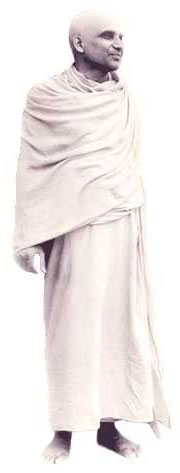
by Swami Krishnananda
A student studied all the Vedas from Brihaspati, and he was very confident that he knew their meaning. He went to Indra and asked, “How much do I know, O Master?” Indra pointed to the sand dunes on the shore of the ocean and said, “You have learnt so much, and what is yet to be known is as large as this big stretch of sand dunes on the shore of the sea.” Disciples went to Krishna Dvaipayana Vyasa and said, “Please teach us the Vedas.” He said, it seems, ananta vai vedah: “The knowledge of the Veda is infinite, so I will take infinite time to explain to you what the meaning of the Veda is.” The idea is, only God knows God.
That there is a conjoint action between purusha, which is imperishable, and prakriti, which is perishable, has been mentioned again and again, in several contexts. This is also a valid position cosmically because prakriti is perpetually in a state of mutation on account of the instability of its three gunas – sattva, rajas and tamas. Hence, the characteristic of prakriti – which is constituted of the three gunas – is perishability, fluxation, instability and, finally, unreality. Purusha is infinite consciousness and, therefore, it is imperishable in its nature. Individually speaking, the kutastha chaitanya – the witnessing consciousness in us – is imperishable, but the body is perishable.
Dvav imau purushau loke ksharas chakshara eva cha, ksharah sarvani bhutani kutastho’kshara uchyate (15.16): There are two realities in this world, one being imperishable, the other being perishable. Which one is perishable, and which one is imperishable? All visible objects, including all jivas, are perishable. Yaddrsyam tannasyam is a brief sutra of Acharya Sankara: Whatever is visible is perishable. This entire world is visible and, therefore, it has to be considered as kshara or perishable. This is cosmically true as well as individually true. But there is a kutastha Atman inside us which transcends the five kosas, which is beyond the annamaya, pranamaya, manomaya, vijnanamaya and anandamaya kosas. Beyond the physical, subtle and causal bodies there is a transcendental light shining within us; that is our real Self, that is the Atman, that is the kutastha chaitanya. It is the imperishable in us.
Thus, we have an imperishable essence as well as a perishable embodiment. As physical bodies – or, rather, any kind of body – we are perishable in nature; but as the kutastha Atman inside, we are imperishable. Hence, we seem to be living in two worlds at the same time. We live in the phenomenal world of cause and effect, bondage, suffering, destruction and, in the end, death. The subjection to the time process is one kind of experience that we have to pass through. But there is something else in us which is immortal, and it eagerly asks for perpetual existence. While the body perishes, the person inhabiting this body does not want to perish. That is why even while knowing that this body will go one day or the other, there is a longing for eternity and immortality. From where does this desire arise if we are just the body which is certainly going to perish after it is cast away? How could it aspire for immortality? The very nature of the body is contrary to the immortal. We should say, therefore, that the desire to be immortal, the aspiration for infinitude, arises not from the body that we appear to be but from the real Atman that we actually are.
The two realities are the empirical reality and eternal reality, the visible reality and the invisible reality, the external reality and the universal reality, the material reality and the spiritual reality. These are the contrasts that are made here by the words ‘kshara’ and ‘akshara’: All that is perishable is kshara, and all that is imperishable is akshara. And, as I mentioned, this analogy can be extended to any realm of being – to externality, to materiality, to sensibility on the one hand, and internality, universality, consciousness, etc., on the other hand. Thus, there appears to be a twofold reality in this world, almost amounting to the peculiar relationship between the purusha and the prakriti of the Sankhya.
Here the Bhagavadgita scores a point above the Sankhya when it says there is something above both purusha and prakriti. For the Sankhya, there is nothing above purusha and prakriti. According to the Sankhya, there are only two realities – consciousness on the one side and matter on the other side – and everything can be explained by the juxtaposition and the interaction of purusha and prakriti; so why should we want a third thing? Actually, we cannot conceive of anything in the world except consciousness and matter, the perceiver and the perceived. Is there anything else in this world? What else can be found, other than the seer and the seen? But, interestingly and very, very, specially, the statement is made here that there is a Being transcending this so-called prakriti, and is above even the purusha.
The perceiving consciousness and the perceived object are transcended in a universal consciousness that absorbs both into its original essence. The purusha and the prakriti of the Sankhya can be said to be like a universal subject and a universal object; but we cannot regard a subject as being conscious of an object unless there is a mechanism which makes it possible for purusha to be aware of prakriti. As prakriti is totally jada and inert, it cannot act on purusha; and as purusha is wholly consciousness, it cannot act on prakriti. Therefore, there is no question of there being any kind of connection between purusha and prakriti; they are total dissimilarities. If that is the case, creation cannot be explained. With all kinds of manipulated analogies, the Sankhya tries to explain how they act; but they cannot act, because of the original assumption of the Sankhya that the two have different qualities.
But they appear to be acting, like the right and left hands acting in harmony. The two hands have no connection other than through the body, of which both are parts. It is here alone, in the Bhagavadgita, that a transcendent opinion is held that there is an Absolute beyond the seeing or witnessing consciousness and the witnessed world. God is not simply consciousness; He is not simply an object of perception in the form of the whole universe. “Unthinkable Reality, Supreme Transcendence, Purushottama am I.”
Uttamah purushas tv anyah (15.17): There is a third something. The Supreme Purusha is different from both the purusha and prakriti mentioned. He is called Paramatma, the Supreme Self. We may call the purusha of the Sankhya as a kind of self, but this is a Supreme Self which includes every other kind of self, and all selves are subsumed under this universal inclusiveness. Yah loka-trayam avisya bibharty avyaya isvarah: That Supreme Paramatman – the all-pervading Self, enveloping the three worlds – supports the three worlds as the Lord of all.
In the state of Isvara or Hiranyagarbha, there are no subjects and objects, and there is no seeing and seen. The seer-seen context of difference arises only after the Virat appears as a threefold reality: as adhibhuta which is the visible universe, adhyatma which is the perceiving consciousness, and an invisible transcendent connecting link which is adhidaiva. Until this takes place, there is a total, integrated, direct consciousness which is omniscient. That omniscience which is transcendent to both the seer and the seen aspect of reality is Isvara – though He may be called by any other name.
Yasmat ksharam atito’ham aksharad api chottamah, ato’smi loke vede cha prathitah purushottamah (15.18): “Because I am above the kshara and the akshara, the perishable as well as the imperishable, I am glorified in the Vedas as well as in this world. All people cry for joy, freedom, and perfection in this world, but actually they are crying for union with Me. All the longing of this world is actually a longing for Me, finally, in a distorted form; and all the glories that you read in the Vedas are the glory of My super nature.”
Yo mam evam asammudho janadi purushottamam; sa sarva-vid bhajati mam sarva-bhavena bharata (15.19): “Arjuna, whoever is undeluded in his mind knows Me as the supreme transcendent Purushottama above both purusha and prakriti, the seer and the seen. Such a person is an all-knowing Being and he adores Me in a total fashion. He does not adore Me only from one angle of vision or from one point of view. From every angle of vision and every point of view, from what is called a total perspective of the Supreme Absolute, this great knower of Reality worships the Supreme Being.”
This is a secret. This Fifteenth Chapter is a great secret – most secret, not an ordinary secret. Iti guhyatamam sastram idam uktam mayanagha, etad buddhva buddhiman syat krita-krityas cha bharata (15.20): “It is not an ordinary secret, it is not a great secret, but it is the greatest secret that I have told you. Really you will be wise after having known the import of this teaching; and you have done what you wanted to do, you have known what is to be known, and you have obtained what is to be obtained. You become what is called kritakrtya, jnatajneya and praptaprapya, which are the signs of perfection. You know whatever is to be known, you have done what is to be done, and you have obtained what is to be obtained. That state of affairs is called krita-krtyata. O Arjuna! You will attain to that state and you will know all things, if you have grasped the essential import of this teaching that I have given to you here in this Fifteenth Chapter of the Bhagavadgita, which is known as Purushottama Yoga.”
Iti panchadaso’dhyayah: Sometimes this Fifteenth Chapter is called Purana Purushottama Yoga. It is a very, very important chapter, which people chant every day before lunch, perhaps because of its reference to digestion – vaisvanaro bhutva. Because they want to have good digestion, the whole chapter is recited.