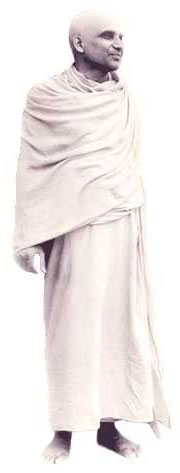
by Swami Krishnananda
This Prāṇa is the propeller (Ut) of speech (Gīthā). Hence, Prāṇa is the Udgitha Chant, together with the speech. The two form one whole.
This is a peculiar way of the Upaniṣhad that, whenever it explains a profound, a mystical or secret doctrine through an analogy or an image, it expounds it by other comparatives. Here is one instance of the glorification of the Prāṇa. There was a great man called Brahmadatta, the great grandson of Cikitana, who drank the Soma juice in the Soma sacrifice, and declared in this manner: "This Maha-Prāṇa, the Supreme Prāṇa, is the one that chanted the Udgītha; it is the one that freed all the senses from death; if anyone else be declared as the cause of freedom from death, and if Āyasya Āngirasa chanted the Udgītha through any other means, may such a proclaimer's head fall." This is a kind of vow that he takes, an imprecation that he casts by saying in a confident manner that nothing can free one from the fear of death, nothing can free one from the fear of sorrow, except this universal principle that has been sung throughout in these passages of the Upaniṣhad.
The Sāma Mantra is told here again in the context of the glorification of the Udgītha. One who chants Sāma in the manner it was chanted by the Prāṇa for the freedom of the senses from death, becomes self-possessed, becomes master of oneself and, here, in the Sāma, the technique of becoming adept in the chanting of the Udgītha, or the Svaram of the Sāma, i.e., the intonation of the Mantra, is stated. Emphasis is laid on the method of chanting the Sāma, or rather, any Mantra of the Veda. The Veda is distinct from the other scriptures in the sense that intonation is very important in its recitation, and the power of the Sāma depends upon the way in which it is chanted. It is not merely the word that is important, but also the modulation of the voice. The intonation, or the rich voice in the recitation of the chant, is itself the glory of the Sāma. What is the glory of Sāman? Svara, the intonation, is the glory, and therefore whoever is well-equipped with this art of properly chanting the Sāman is desired in all Sāma-Yajñas, which are called Soma-Yāgas. And the performers of the Sāma-Yajñas always look for one who has a clear capacity to intonate the Mantras of the Sāma, so that he can unify himself with the spirit, with the forces which are the deities of Sāma-Mantras, and all glory comes to him also, who knows this art.
So, the glory of the Veda, the glory of the Omkāra, Praṇava which is the Udgītha, the glory of the Prāṇa, and the glory that is attended here with the Veda chant – all these are described in concise in this passage of this Brᾱhmaṇa.
In connection with the meditation on the Sāma, and the harmony between the Prāṇa and speech, it was said that the intonation in the chant of the Veda, which is Sāma, is very important, because the way in which it is chanted or sung has direct connection with the meaning that is conveyed or the objective that is intended by means of the recitation. It is said further, in the following passages, that the correct pronunciation also is important, in addition to the intonation. The letters, the words, the phrases, have to be pronounced in a proper manner, with the correct accent at the proper places, in addition to, or together with the method of chant. This is the resting place, or establishment, of the Prāṇa. By this, one gets established in the power that is Sāma, which is, again, the unity between the Prāṇa and the power of speech, or to carry the meaning further to its broader or more general sense, the harmony between the Prāṇa and all the senses, so that one gets totally integrated in personality by the meditation on the Sāma. One who knows this, obtains a resting place.
Now, a very important chant is explained, which is called the Pavamānā Abhyāroha. The Abhyāroha, here, means the 'elevated holy chant'. It is all-purifying, and that is why it is called Pavamānā.
The Udgātṛ, known as the presiding intelligence over the chant of the Sāma, sings the Abhyāroha, the holy and edifying recitations of the Sāma, and recites the Mantra repeatedly in order to produce the required effect. Asato mᾱ sad gamaya, tamaso mᾱ jyotir gamaya, mṛtyor mᾱmṛtaṁ gamaya. These are the three Pavamānā-Mantras, the purifying chants, and their recitation is given in the concluding portion of this Brᾱhmaṇa. These three recitations are supposed to be equivalent to meditation, and they bring about the intended result, namely, the rise of the mortal to the immortal, and everything that is connected with this process. We are familiar with this chant, but the Upaniṣhad takes up its discussion in the context of the Sāma and the Prāṇa Vidyā of this Brᾱhmaṇa, and tells us that these are highly purifying recitations. They are Pavamᾱnᾱ-Abhyᾱroha.
What is the meaning of this chant which is recited in this manner? It is a prayer, a Japa, as well as an invocation. Asato mᾱ sad gamaya: From the non-existent, from the unreal, from the apparent, lead me to the other side of it, the Existent, the Real, the Noumenon. Here, the Upaniṣhad tells, also, what the meaning is. What we call death is itself the unreal; and what is other than death, the immortal, is the Real. So, to be led from the unreal to the Real is the same as to move from death to immortality. These words have special meanings with highly philosophical connotations. The world in which we are living is the world of death. It is called Mṛityuloka, the realm of dying, and therefore it is equated with the world of unreality. It is a world of appearances, and the prayer is: "May we be led from this phenomenal world of appearances to the realm of Reality." That which appears to be real, and yet, is not real – that is the Asat.
Asat does not mean non-existence, like the horns of a human being. Here, the unreal is not of that category, because if a thing is totally non-existent, it will not be seen, and the question of rising from it does not arise. The rise of the consciousness from one state to another becomes necessitated on account of there being an element of the real reflected in the apparent. The world of unreality is capable of being taken for reality, and therefore one gets involved in it. Certain characters of reality are visible in the world of unreality, and so there is a mix-up of two attributes. The appearance, as we call it, is not a total non-existence. It is a confusion, a kind of muddled thinking. That is the appearance. The muddle arises on account of mixing up, or juxtaposing, or superimposing, attributes belonging to different categories, or realms, by way of mutual association, i.e., the attribution of the character of one to the other. The famous analogy given to us in the Vedānta scriptures is that there is what is known as Adhyāsa, or the reading of the meaning of reality in that which is transient, and conversely, the transposing of characters of transiency and becoming to the being which is real. This happens every day in our practical life. We live as persons who are standing examples of this mix-up of attributes. Our individualities, our bodily personalities are immediately available examples of this confusion of thought, where the real and the unreal are mixed up, and we drift from one condition to another on account of not being able to judge what is what in our own cases. We have feelings which are combinations of two aspects – the real and the unreal, the Sat and the Asat. We have a confidence that we are existing. We never feel that we are non-existent, not also that we are a moving flow, or we are apparent, or we are in a condition of process. We are told that this world is in a state of perpetual motion, but we never have any such feelings in our lives. We live in a world of motion and transition from one condition to another, but, in our own lives, we feel that we are perpetual. There is a strong feeling in regard to ourselves that we are steady beings and that there is a continuity of consciousness of our being, right from birth to death.
This feeling of continuity of existence in our own selves is due to our attributing the character of reality to ourselves, because that which is, the Pure Being, is somehow made to get reflected in our own conditioned personalities. The sense of 'I', the feeling of 'being' and the certitude that we have in respect of our existence is due to the reality that is present in us. But, there is something more in us, apart from this feeling of mere 'being'. We do not merely feel that we exist. We always feel that we are limited; we are inadequate; we are poverty-stricken; we are impotent; we are grief-ridden, and we have anxieties and insecurities of every type conceivable. This peculiar other side of the feeling that is associated, side by side, with the feeling of certainty, existence, being etc., is the quality of appearance.
The conditioned form which is embodiment, the body, has one character; and the unconditioned reality has another one altogether. We bring the two together and create a personality, so that there is what is called a transient personality which 'appears' to be. The being of the personality is the reflection of reality in the personality, whereas the transiency is its real nature. We are conscious of a current, as it were, which flows, which never is steady, but the consciousness of continuity, even in the transitory process of the current of a river, is due to the consciousness being different from the process. We have two elements in us – sometimes, theologically, we say, the god and the demon principle – the Deva and the Asura. We have both elements in us, the higher and the lower, the eternal and the temporal. The eternal speaks and infuses meaning into the values of life, to which we cling so ardently, and creates in our life a hope for the future, of a better condition. We always expect something better. We never imagine that the world will be worse. It will be better than today, we think. This positivity present in our life, and the confidence we have that we shall live tomorrow, though there is no certainty about it, is the reflection of reality in us. Who tells you that you will live tomorrow? But you have a confidence that you will be alive. This is due to the presence of an eternity masquerading in our own personalities, invisible, and yet present. But yet, there is insecurity. We have a suspicion that our apprehensions may not be true, and so we sleep restlessly and unhappily. We have in us happiness and unhappiness mixed up. That is due to the Sat and Asat elements combined in us, appearance and reality, both working together, side by side, swinging us on either side, in different forms, and under different occasions.
So, the prayer here is, 'Let us rise above this turmoil of transiency of life, and move to the real which is indicated faintly in our own personal lives and in the manifestations that are in front of us.' The rise is the process of the ascent of the soul to the Absolute. Thus, the prayer is: – Asato mā sad gamaya: 'Lead me from the unreal to the real, from the apparent to the Absolute, so that we shall be steadfast in that which is free from entanglement in appearances – space, time, and causal relations.' And this is at once a prayer for further light in the process of this ascent. When we rise from the unreal to the real, we also become enlightened, much more than we are today. It is not merely 'being' that is transmuted, but also 'consciousness', side by side. The rise from inadequate 'being' to adequate 'Being', from the lower type of 'being' to the higher type of 'Being', is at the same time, simultaneously, a rise from lower understanding to higher understanding, where consciousness expands as 'being' expands.
Being and consciousness go together; they cannot be separated. Our consciousness is tied to our body, so that whatever we know is limited to this little body. We cannot go beyond. The consciousness of our 'being' is the same as consciousness of our body. There is nothing else in us. And the body is so limited, as we know very well. Hence, the expansion of 'being', or the dimension of our 'being', includes simultaneously consciousness, because 'being' and consciousness are one. This is indicated by the other prayer: – Tamaso mā jyotir gamaya: 'Lead me from darkness to light.' This world is a world of darkness. It is not a world of light. The light that we see in this world is really a form of darkness, as we studied in an earlier portion of this Upaniṣhad, that all forms of life are forms of death only. They are not realities. The sunlight is not real light, because it is not intelligent. It is another intelligence that is responsible for apprehending the value of even sunlight. Mere sunlight cannot understand, because it is an object outside. Objects are inert, and it is the subject that is consciousness. Any object that is bereft of a relationship with the subject is equivalent to darkness. It is lifeless. And so, the world of objects may be said to be a world of darkness, as it is the world of unreality. But, we have to rise to the realm of Light, the Light which stands by itself and shines as the infinite, the permanent, whether or not there are objects to shine upon.
Our understanding, today, is conditioned by the presence of objects. When objects are totally absent, we do not know what we will be aware of. Can we imagine a condition where there is nothing outside us to look at, to hear, to come in contact with? What would be our mind, what would be the state of our understanding, at that time? We will be muddled completely. A person who is incapable of perceiving anything external cannot be regarded as sane. There will be a complete reversal of the function of consciousness at that time, because the individual mind, which is the individual consciousness, is accustomed to being healthy and alive only in connection with its objects. We are happy only in the midst of things, persons, objects – not independently. It is impossible to live absolutely independently, because the mind is not accustomed to such a life. We like society because our life is tethered up to relationship outside, and from this we can draw the conclusion that our life is secondary; it is not primary. We are not living an independent life, not the original life; we are not true Existence. We are leaning upon a stalk which is outside us, and therefore unreliable. The objects of sense cannot be trusted completely. They pass like wind; they come and go; and, therefore, if our life is dependent on them, we go with them. That is why there is death for the individual who hangs upon the object which is subject to death. Hence, the world of so-called understanding, enlightenment, intelligence, is really a world of darkness, because it is not the self-sufficient, self-existent consciousness that is working, but a dependent form of mentation. So, the prayer is: 'Let us be led above the related type of understanding to the unrelated Absolute Understanding, Absolute Intelligence,' that is, Tamaso mā jyotir gamaya. This is, at once, freedom from death, and attainment of immortality.
Mṛtyor mᾱmṛtaṁ gamaya: 'Lead me from death to that which is immortal.' The world is of mortality, and the prayer is to take us to the world of the Immortal. The world is mortal because everything is dying here; everything is perishable. It is seen now, and tomorrow it is not; like a bubble does it burst. We do not know what is now and what is the next moment. Such is the condition of things here. And how can we say that anything is real? Can anything be regarded as permanent? And that which is not permanent cannot be called real. So, there is nothing real in this world, and inasmuch as the unreals are the supports of our understanding, our understanding also is not real. Nothing is real in us; everything is a phantom. So, the prayer is for a total rise from this involved, insufficient, conditioned 'being' to the absolutely independent, unconditioned 'Being' which is simultaneously Sat, Jyotir and Amṛitam-Existence, Light, Enlightenment, Consciousness, Omniscience and Immortality. No rebirth is possible there.
When the chant is taken up in the Yajña, by the Sāma Veda Udgātṛ, he assumes a power and a capacity to bestow boons upon others. So, the section in this context tells us that when the Udgātṛ, in the Soma Yāga, chants these Mantras, the Yajamāna, or the one who is responsible for the performance of the sacrifice may ask for boons, and they shall be granted. All that is required, the means and the end and the destination – all will come together at the same time. He becomes a Master of the worlds. He attains all that is meaningful and valuable in all the three worlds. There is no fear that he may lose anything. Once he gains a thing, it shall be permanently with him, not like the things that one gains here, which can be lost tomorrow. Once he gains, it is a permanent gain, because it is the gain of the real, and not of an unreal something. With this we conclude the important section of the Bṛhadāraṇyaka Upaniṣhad, which is concerned with the Prāṇa-Vidyā, the methodology of contemplation on the Universal Prāṇa through the individual Prāṇa and the function of the senses, leading up to the chant mentioned just now-the Pavamānā Abhyāroha.