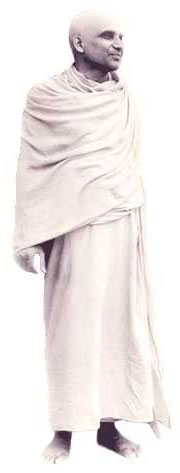
by Swami Krishnananda
The world is made in such a way that there are infinite varieties of finitude. And one set of values, which goes to make up the finitude of a particular mind, becomes the source of summoning the opposite of these values which are imagined to exist in another finitude, say, an object. So the world is said to be relative in the sense that everything is related to everything else. Unless a particular finite situation is related to another particular finite situation, which is going to be the complementary aspect of it, there cannot be a sense of fullness. The sense of fullness is the source of satisfaction. Satisfaction and sense of fullness are identical. When you feel incomplete in yourself, you are unhappy; when you feel complete, you are happy. The feeling of incompleteness arises on account of the notion that something is lacking in you. The sense of lack of something arises because there is a sudden emergence of certain notions in the mind, in respect of values, of which it becomes conscious. And so, it cannot be that a particular person will be feeling the same sense of finitude at all times. It does not mean that you will be wanting the same thing throughout your life. The idea of finitude goes on changing as you rise in the process of evolution. As the mind gets transformed gradually, day by day, stage by stage, in the process of evolution, the requirements of the mind also change, and this is why every day you desire different objects, not the same object. You cannot have one particular thing today and be happy forever. That is not possible, because the mind cannot rest in one condition. It cannot rest because there is evolution. There is physical evolution and psychological evolution. Both are taking place simultaneously. So, this perception of a counterpart of the finitude of a mind in a given condition is caused by the desirability of an object felt by the mind. Then what happens? Immediately the mind says, 'Here is the source of my fulfilment', and wishes to come in contact with it as soon as possible so that it may become a part of its being.
The desire of the mind for a particular desirable object is a desire to get united with that object in its being. So, the idea of possession is something very strong, indeed. It is actually a desire to get united with the object, so that you become physically, psychologically whole in being, and not merely in an external relation. This condition is however not possible, as you cannot enter into the being of any object. Therefore, there is not such satisfaction even after the fulfilment of a desire. No desire can be fulfilled eternally, whatever be the effort that you put forth, because it is not possible for you to enter into the being of that object. The intention is good, but it is impracticable. Nobody can enter into the existence of an object, because the object is externally placed in space and time. So, it is a futile attempt on the part of the mind to enter into any object. Then there is a struggle on the part of the mind to possess the object; become the object; make it a part of its being by assimilation of its being into its own. However it is a fruitless attempt, because the operation of space and time will prevent the entry of one into the other. That is why this world is a sorrow, and it shall be a sorrow. There shall be a perpetual effort on the part of people to grab objects and try to enjoy them. But they cannot enjoy them. There can only be a mere appearance of enjoyment, not real enjoyment.
The love that you feel in respect of an object is in fact the love that you feel towards that which is called perfection and completeness. It is not really a love for the object. You have thoroughly misunderstood the whole point, even when you are clinging to a particular object as if it is the source of satisfaction. The mind does not want an object; it wants completeness of being. That is what it is searching for. Thus, when there is a promise of the fulfilment that it seeks, through the perception of an object that appears to be its counterpart, there is a sudden feeling that fullness is going to come, and there is a satisfaction even on the perception of that object; and there is an apparent satisfaction, just by the imagined possession of it together with the yearning for actual possession. So, what is it that you are asking for? You are not asking for any object or thing; you are asking for a condition of completeness in your being. "So, my dear friend," says Yājñavalkya, "nobody is dear. No object can be regarded as lovable or desirable. It is something else that you love and are asking for, but by a notion that is completely misconstrued, you believe that the object is loved."
So, what you love is a completeness of being which is reflected in the condition felt to exist between yourself and the object concerned. You must mark this point. What you love is only the condition that you imagine to be present in the state of the possession of the object. But that state can never be reached, for the reason already mentioned. So, nothing is dear in this world. What is dear is the condition which you intend to create, or project in your own being by an imagined contact with the object. So, not one person is dear in this world, but what is dear is that condition which is imagined to be present after the possession of that object or that relationship.
Now, what are these objects? Every blessed thing. Yājñavalkya goes on with his exposition to Maitreyī: Neither the husband is dear to the wife, nor the wife is dear to the husband. What is dear is a condition which they try to bring about in their mind by that relation. That condition is always missed, and so the happiness expected never comes.
After enumerating many things that are usually conceived as dear and desirable in this world, but which are actually not the source of real satisfaction to a person, Yājñavalkya says, nothing external can give you happiness, because it is not the thing alone that is the source of happiness but something else which is always missing due to a confusion of thought – na vā are sarvasya kāmāya sarvam priyam bhavati, ātmanas tu kāmāya sarvam priyam bhavati: For the desire of the Infinite, which is the Self, everything appears to be desirable. Here, the word Ātman is to be understood in the sense of the Totality of Being. It is the Selfhood of all beings, a great subject which we have studied in detail in the Fourth Section of the First Chapter. For the sake of this Supreme Absolute, which is the Self of all things, you are unknowingly asking for 'things'. You have missed the point in asking for the things of the world. So it is a wild goose chase from birth to death, nothing coming forth, ultimately. You come to this world crying, and you go crying, because you have missed the whole point in the tremendous effort that you have put forth throughout your life, entirely for nothing – ᾱtmanas tu kᾱmᾱya jᾱyᾱ priyᾱ bhavati.
Ātmᾱ vᾱ are draṣṭavyaḥ śrotavyo mantavyo nididhyᾱsitavyaḥ: "O, Maitreyī, it is the Ātman that is to be beheld; it is the Ātman that is to be known; it is the Ātman that is to be searched for; it is the Ātman which is to be heard about; it is the Ātman which is to be thought in the mind; it is the Ātman which is to be meditated upon. There is nothing else worthwhile thinking, nothing else worthwhile possessing, because nothing worthwhile exists, other than This."
Maitreyī ᾱtmano vᾱ are darśanena śravaṇena matyᾱ vijñᾱnenedaṁ sarvaṁ viditam: "If you can grasp the significance of what this Ātman is, you have known everything; and then, you have possessed everything; you have become all things. There is nothing left to desire afterwards. And if this is not to be achieved, what is going to be your fate? Suppose you do not have this knowledge, everything shall leave you one day or the other. Today this goes, tomorrow that goes; and the history of humanity has told us repeatedly that you cannot lay trust upon anything. You have seen things coming and things going; today it is there, tomorrow it is not there. You cannot know what will happen tomorrow, and what will be the status and state of things at any moment of time. Everything shall desert a person if he is bereft of this knowledge. Because they are not a part of his being, how can they be with him always? That which is not 'you' cannot be possessed by you. That which is not 'you' really, cannot be a property of yours. That which is not 'you' cannot be with you always. Therefore it shall leave you. But why do you cry if anything goes away, and there is bereavement, loss, etc.? It is quite natural to lose them; it is exactly as things ought to be. Things which are outside you do not belong to you; therefore it is no use crying over them. What is the difficulty, what is the problem, and why are you worrying about it? If they become 'you' they cannot leave you, because you cannot be dispossessed of yourself. You are dispossessed of only those things which are not yours. This point, you must understand."
Finally the Upaniṣhad says; sarvaṁ tam parᾱdᾱd yo' nyatrᾱtmano sarvaṁ veda: Everything shall leave you if you regard anything as other than you. It is a metaphysical point, a psychological theme, and a practical truth. You cannot forget this. Anything that is outside you cannot belong to you and cannot satisfy you, and it will leave you. So, it shall bring you sorrow. It is a point which is eternally true. All things shall desert you, one day or the other. Even those things which you regard as dearest and nearest, most desirable and valuable, shall desert you and leave you, bringing sorrow, because they do not belong to you.
Yo' nyatrᾱtmano sarvaṁ veda. idam brahma, idaṁ kṣatram, ime lokᾱḥ, ime devᾱḥ, imᾱni bhῡtᾱni, idaṁ sarvam, yad ayam ᾱtmᾱ: "So, Maitreyī," says Yājñavalkya, "It is the Ātman that appears as all these things. This is the point that is never grasped by the mind which looks upon objects as independent entities. The Ātman is the one Reality that masquerades in various forms and names, but this point is not understood. The mind that is finite, located and lodged in the body, does not understand the fact that finite objects that are outside are only appearances of a single indivisible Reality. So, the finite tries to clings to the finite, not knowing this fact of infinitude that is at the background of these finite forms. If this infinitude that is at the base of these finite forms is to be understood, realised and made part of one's own being, then the realisation accrues." This Ātman is all – idaṁ sarvaṁ, yad ayam ᾱtmᾱ.
By these three illustrations, sage Yājñavalkya tells us that the effect cannot be known unless the cause is known, because the effect is a manifestation of the cause in some proportion. You cannot understand the nature of any object in this world unless you know wherefrom it has come. But you try to understand the why and wherefore of things by merely beholding them with the eyes. Whatever be the extent of your observation in the best laboratory conceivable in the world, you cannot understand things, because whatever is observed through even the subtlest instrument, even the best microscope, etc., is an effect, not a cause. It is a product of certain circumstances. The conditions that have been responsible for the effectuation of these forms that you are observing are transcendent, and therefore they are invisible. Unless the cause behind the form that is visible is perceived, the form cannot be really known. If you are intent upon knowing the nature of any object, you must know its relation to something else. And that something else is connected to another thing, and so on and so on, until you will be surprised to realise that everything is connected to everything else in such a way that nothing can be known unless everything is known. So, it is not possible to have complete knowledge of any finite object unless the Infinite itself is known. You cannot know the structure of even a sand particle in the beach unless the whole cosmos is known ultimately, because it has got infinite relationships to various types of atmosphere of which it is a product. So it will take you up to the limit of the Infinite if you try to understand the inner, inscrutable majesty of even a grain of sand.
To understand this, the great Master Yājñavalkya gives us three illustrations. Just as the sound that is made by a percussion instrument cannot be properly identified if the instrument itself is far away and not visible to the eyes, but whose sound is heard by you from a distance, unless you catch the source thereof; just as you cannot identify the rhythm produced by the blowing of a conch unless you have the capacity to grasp the totality of the sound by actually perceiving the conch that is being blown at any particular time; just as you cannot understand the symphony produced by a Vina or a stringed instrument, for instance, merely by hearing one note unless you are able to connect all the notes in a harmonious symphony, so is the case with all these things in this world. You cannot know anything. They are each like one note in the symphony or the music of the universe. How can you know the beauty of the music by merely hearing one note? That note is connected to many other notes. And when every note is harmoniously related to all other notes to which it is related, and all the notes are grasped at one stroke in one single harmonious symphony, that becomes music; it is beautiful. But if only a twang is heard or one tick is heard, it makes no sense; it is not music. Likewise with any object in this world. It is one twang, one tick, one sound which is really connected to a vast arena or gamut of a symphony that is universally expansive. Unless that total expanse or continuity is grasped by the mind at one stroke, which means to say that unless the infinite Being behind the finite objects is grasped by the consciousness, no finite object can be known fully, nothing can be understood perfectly. Therefore, nothing can give you satisfaction. There is no hope of immortality through any possession in this world, is the conclusion of Sage Yājñavalkya.
The sage Yājñavalkya says that the nature of effects cannot be known unless their cause is known. It is futile on our part to investigate into the nature of any finite object without correlating its form and context with the causes which gave rise to its present form, in a series which cannot be comprehended by the mind. Every link in a chain is connected with every other link. The pull or force exerted by the topmost link is felt by the lowermost link even if the chain be millions of miles in length, irrespective of the fact that the lowest link might not have even seen the very existence of the topmost link. The presence of that topmost link will be felt by the pressure it exerts through the age-long length of the chain, of which the lowermost link is a finite part. Even so is the nature of all finite things in the world, and we cannot understand the nature of anything, unless we are in a position to understand everything at the same time. Either you know everything, or you know nothing; that is the truth of all experience. There is no such thing as knowing something, because that something is a false aspect of the organic connection with which it is related. Minus its relation, its very existence is not worth cognition at all.
The nature of finite objects is very peculiar. They are constituted of the circumstances in which they are placed, so that you cannot separate the circumstances and the nature of the thing itself. It is not true that the circumstances are 'outside' and the thing is 'inside'. It is a false conclusion, again, which the mind makes in its untutored attitude towards things. The circumstances are a part of the existence of a thing. And these circumstances are not mere conceptual notions in the mind; they are vital energies, powers. Even space is not an emptiness, as you know very well. It is as 'solid' as a rock, for example, because under conditions which can be experimented upon, even the most 'solid' of things can be converted into an ethereal substance. So, the circumstance of space around an object is not an unimportant aspect that can be separated from the existence of an object. But, the incapacity of the senses to perceive non-physical objects and non-physical conditions creates a false impression in the mind that the circumstances are completely isolated from the existence of an object. This is why we make independent notional judgments about things, distancing them from the conditions in which they are involved, which are ultimately cosmic conditions. The point made out in the Upaniṣhad, in this passage, is that without the knowledge of the Absolute, not even the smallest of things can be understood.