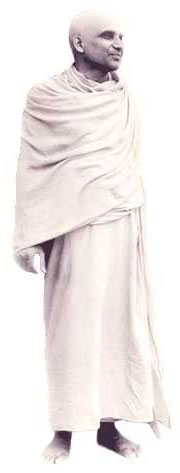
by Swami Krishnananda
I was told that there was a doubt in the minds of some people whether there is a soul for which man is searching, or there is only the soul. This difficulty, this question also arises due to a misunderstanding of the very meaning of the soul itself. A mere academic bookworm cannot answer these questions, as one cannot find an answer to these questions in books. Though there are hints in the great scriptures as to what all this means, we do not have that intellectual caliber to go into the depths of the implications of these scriptures, much less the time to study all these.
What is man searching for? All of us seated here are well-educated, cultured persons with time enough to think deeply over this matter. We cannot say that we are searching for money and status merely, though it may be one of the things that we are searching for. We have seen learned people who are not happy. We have seen very rich people who can burn money but are unhappy in many, many ways. Potentates, politically powerful, ruling a large dominion, are terribly insecure day in and day out; they have no peace of mind. There is something that everyone is missing, whatever be the acquisition of a person – physically, materially, economically, politically. Do we know that something is missing which keeps us anxious all the while? A very rich man is always anxious about something – he is brooding, thinking and scratching his head. He's not resting quietly, "Everything is fine, milk and honey, let me sleep." No rich man will sleep like that – he is worse than a poor man as far as anxiety is concerned. Similarly, every person with any kind of acquisition is insecure for various reasons. A healthy man is insecure – he may fall sick and cannot be eternally healthy.
So, there is a lacunae, unintelligibly though, felt by each person, and one would like to search for an answer to this insecurity, this restlessness, and this elusive character of that which one is searching for in life. No one seems to have got what he wanted in this life. When the time comes for us to leave this world, it appears very few will go with the satisfaction that they have got what they wanted. There was always something receding, like the horizon, and not permitting the grasp of the human being – psychically, intellectually, mentally, much less physically. We cannot know so easily what we have lost. This is the reason why we are kept in this suspension. We may concede that there is some terrible lacunae in our life; we are a hollow, a vacuum, empty inside in some mysterious way in spite of our material possessions and social status.
Perhaps every one of us may be aware there is something lacking, but it is not easy for us to know what it is that we are lacking. We go on experimenting with various circumstances in life. "Perhaps I lack material wealth." We struggle, experiment with it and get something, and find that it is not the thing that we wanted. We go on searching in various ways for various other things like power, authority and doership, and we find that we are not seeking for that, and it is not at all the thing that we expected. We have been experimenting with the location of something which we have lost in the various persons and things of the world, and to our consternation we have realised, and we are yet to realise, at least some of us, that these locations – call them persons, things, events, circumstances, situations – are not the spots in which we can discover that eluding something which we seem to have lost.
This mysterious, eluding something which cannot be confined to the body of an individual is what very, very glibly we define as the soul. Since it is an abused word whose meaning has never been understood clearly, even to this day, it is very difficult to project this word again and again as if it is very clear to the minds of people, because in all this explanation and analysis we will not forget that our soul is inside the body. "My soul, my conscience, my Atma speaks," we go on touching the chest. This Atma, this little thing we are indicating within the location of this physical body, is not what we are seeking – though it is present there also – because it is an influence, it is a force, it is to some people something like an abstraction; and yet we will find that all life finally is an abstraction. Our life is an abstraction; it is not a concrete thing. We are not living a concrete life. For instance, when we touch money, we are not touching a substance but are touching a value, a conceptual evaluation which is in the head and not in the hands.
When we are friendly, when we are inimical, we are not encountering a person or a thing; we are encountering a circumstance which cannot be identified with the physical location of a person or a body. We are face to face with some situation which cannot be identified with a solid object. When we are happy or unhappy, we cannot attribute it to the presence or absence of some physical object. It is, again, a condition that has arisen, a condition that cannot be seen with the eyes, and we use this word again and again without knowing what it means. "I am in a very bad condition." "I am in a prosperous state." These are glib statements whose meaning cannot be clear so easily. This is the reason why we cannot easily be happy in this world; if it had been so easy we would have purchased it in one minute with all the dollars and pounds that we have. That cannot be done because the physical appurtenances and configurations in the form of people and things are not the thing that we have lost. When a person has lost his power – he has resigned or retired from a very powerful position – he has lost something. What has he lost? He is the same man that he was. The retired man is the same man that he was while in position. This thing that he has lost is that which he cannot see with his eyes, but it can make him utterly restless and put him out of gear. One can even go crazy if he is demoted and thrown down from a high pedestal. This pedestal is not a physical seat; it is a concept.
So are we living in a physical world, really speaking? Consider this for a while. Or are we living in a world of concepts, ideas, notions, evaluations and aspirations? Do we believe that this is a physical world? I am not going to the philosophical aspect of the doctrines propounded by Sankaracharaya and others that the world is Maya (illusion). We will slowly open our eyes and find there is some truth in what he has said. We are seeing a table, we are seeing trees, pandal (tent), this building and this beach, and the world is there so hard and solid – how do we call it Maya or an unreal thing? We will realise one day that we are really living in an unreal world.
The people that are around us are not our people. The things that we seem to possess, we have really not possessed, and we have not been searching for them. We have only been experimenting with them as tools for the discovery of that which we have lost. These friends of ours, these associations, these family members, this money, this status, this power, this authority, this land, this building – these are not the things we are asking for, though in a terrible state of ignorance we imagine that this is the soul that we wanted to grasp in life, and we will realise one day, "This is not what I wanted." Otherwise, there could be no sorrow and bereavement. These are the tools that we have selfishly employed. We have been exploiting people and things in a very subtle manner to see whether they are the locations of that which we have lost in our lives.
We have not lost anything physical. The physical world is still there; we cannot lose it. We are sitting on it – how can we say that we have lost it? The whole earth is under us; we have not lost it. Do not say, "I've lost the physical earth." What have we lost? What are we searching for? What is it that is keeping us restless and unhappy?
In the light of what I said a few minutes ago concerning the word 'soul', I will use the word 'soul' only in that light, of course, and that evaluation is to be before our mind's eye when we utter the word 'soul'. Man is in search of a soul or the soul – I will tell you why it is a and the both. We cannot think of the soul; we are not made in this way, because we do not see it. Who can believe there is one soul everywhere in this audience? We are all independent souls. When we search for a soul in our lives, we are searching for a meaning in our existence. We are not searching for a substance; we are not asking for a thing. When we have lost the meaning in our existence, we can say, "I have lost my soul." People who are bereaved and who have lost their property and all their belongings sometimes feel that they have lost a soul. "I have lost all significance and meaning – everything." They have not lost meaning, because they have never discovered the meaning in their lives even earlier when they were physically in possession of all the appurtenances of life.
As I mentioned, the appurtenances, the physical associations, social connections, etc. which were bringing us some sort of a satisfaction and making us feel that we discovered the meaning in life, they were not the meaning in life. They were very, very unfortunate instruments that we had been utilising for experimenting upon the thing which we have lost and which we consider as the meaning, and their disassociation appears to us as a disassociation from the meaning of life. The meaning of life is a pervasive influence, a power or authority, and everything in the world is only an ideological arrangement. A deep philosophical mind alone can probe into these mysteries. Therefore, it is true that we are searching for a meaning in life. We know very well how unfortunate it is to lose the meaning in life; we will go crazy in one second if the meaning is lost. And what is that meaning? That is the soul of life.
Each person has his own concept of the meaning of life – that is what we call a philosophy of life. Everyone has his own or her own philosophy. We have an outlook of life, we have an interpretation of things and we have evaluation of all things in the world – that is our philosophy, and that is the meaning that we want to discover in things. Anything that keeps us in a state of tension and isolatedness in any level of our being is the tendency to lose the soul. Even ill-health is a tendency to the loss of what we can call a meaning in a healthy body. A soul is a force; it is not a thing. It is a force which keeps in cohesion the parts of the being we call a person, an organisation, a world, a humanity, an everything. So the soul can be a force that is keeping in cohesion the limbs of our body, and in that sense we may call it a soul, because there are other people also having such a sense of need for feeling a meaning in their own lives. There is, similarly, a necessity to keep in cohesion the organisation we call a family circle or a community, or even a larger one like the whole nation or the entire humanity – otherwise there will be no humanity. 'Humanity' is a word that we use without understanding what it means. It is not a heap of people sitting together; it is a conceptual unity that we introduce into the presence of these isolated particulars called 'people'. Humanity is one, though people are many. We can imagine that there can be one meaning in the midst of many people. That one meaning can be said to be the soul of humanity.
So it is large, and it is small. When it is large enough to comprehend the meaning discoverable in the whole of creation, we call it the soul – yes, it is true. But the process by which we discover the location of the soul or the meaning in life is by degrees. The soul may be one, that is a different matter, but it does not always reveal itself as one in our lives. There are degrees of the manifestation or descent of this concept of the soul. I do not say there are degrees of the descent of the soul itself, but the concept of the soul has a descending character and an ascending character. This is the reason why we feel that there are many souls, and each one is searching for one's own soul, which perhaps is the reason why one is sometimes impelled to become selfish in spite of the fact that there are similar souls in other people. Yet we are occasionally altruistic, we think in terms of larger circles and the welfare of many other people, and we are serviceful, which tendency in us cannot be explained if the soul is only inside our body. So there is a larger soul than our own soul, yet we are searching for our own meaning.
In our individual lives we have our own predilections and we stick to our guns, oftentimes. "What I say must be done, let anything else go to the dogs." When we speak like this and when we think like this, we are imagining that our meaning in life is conditioned by our own body, and our soul is only inside the body, whatever it be. But we are not always like that; we have a cultured attitude oftentimes to discover a similar meaning in other people's existence also, which requires us to recognise the national soul – "I work for my nation." When we work for the nation, for whose sake are we working? It is not the number of people considered as the citizens of a country that are called a nation. It is, again, an invisible thing. I am driving the point that the world is unreal, finally. It is only an idea in our heads – it does not exist physically, if we go deep into the matter. But this larger ideology of the national spirit, though invisible, is that which can shake the hearts of people; and people work day and night for the welfare of their nation, which is not merely a heap of people.
Likewise we can extend this dominion – this dimension of this concept of the meaning of life, the spirit of existence – into wider circles until it reaches the furthest limits of infinitude itself. That meaning that we discover, the one meaning that we discover in the whole creation, may be said to be the soul, because there can be many universes and many infinitudes.
There are gradations in an army arrangement, for instance. The lieutenant colonel is a soul of the group which he commands; the colonel is a soul of a wider group that he commands. Now, are there two souls – the lieutenant colonel is one soul, the colonel is one soul? And there is the brigadier, the lieutenant general, major general, and so on. Each one is a soul. I have already said that the soul is not a person, because one person cannot control so many other people. It is a pervasive influence, a larger immanence of an invisible something – call it meaning, call it authority, call it soul, call it intelligence, consciousness, whatever we like. That thing exists, pervading all. Perhaps the general's soul pervades the souls of all the lower categories. There is the immanence of the soul of the general in the souls of the lieutenant generals, and the soul of the lieutenant general is present in the souls of all the major generals; the soul of the major general is present in all the souls of the brigadiers, etc. So are there many souls, or is there only one soul? We can answer this in any way because there are gradations of the concept of organisation, the concept of authority and the concept of pervasive influence, which is the soul that we are speaking of. So there is a soul, and there is also the soul – both are correct. When we reach a larger dimension, it appears as if it comprehends the lower levels, so it absorbs the existence of the lower categories of soul in the higher one; yet the lower ones exist in their own capacity, notwithstanding the fact they are subsumed by the operation of a higher soul.