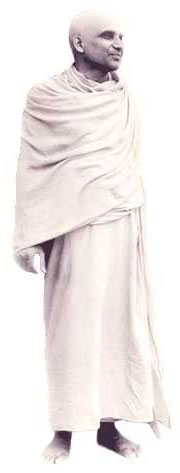
by Swami Krishnananda
We are not an organisation. Human beings are not connected to one another as brothers and sisters, as fathers and mothers, as we are presently contemplating them. We are related in a different fashion altogether, which can be precisely stated as an impersonal relationship. We are not social units; we are cosmical pressure points. We are not men and women. Such things do not exist in the eyes of God, perhapsor, at least, in the eyes of nature.
Here, yoga speaks now, and it speaks in a different language. That language is to be understood by us, and we should shed our ordinary social language. Here is a highly metaphysical, cosmological, spiritual, mystical language which speaks in terms of the basic realities of life that we are going to confront in meditation and, therefore, meditation is not some social being thinking. It is not a brother meditating, or a father contemplatingnothing of the kind. It is a very serious event that is taking place in the whole environment in which one is placed. No event is a local event. Nothing happens in one place only. Everything happens everywhere.
But, we cannot understand that a thing happens everywhere. We see things happening only in one place, and because we cannot understand the relationship of an event with other events in the world, we are shocked when such news reaches us. There is a reverberation taking place in the entire cosmical atmosphere when any event takes place anywhere. All things belong to all things. Everybody belongs to One Being; nobody belongs to anybody else here. There is no personal possession, no property. No attachment is possible. Likes and dislikes have no sense.
What we call love or hatred is a meaningless thing. It cannot obtain in this world. They are laughingstocks, yet they are hard realities for us. We are very affectionate, and very hateful, but this has no sense in the structure of things. Neither can we affectionately hug anything, nor can we kick anything. We have no right to do anything, because nothing belongs to us, and we do not belong to anybody. Our duty in this world is not in respect of one person, two persons, three persons, or this thing or that thing. It is a total duty.
The Yoga Sutras of Patanjali, in the description of the stages of the practice, tell us that we have to learn the art of meeting, facing, encountering this world gradually, stage by stageas we may face a tiger which we want to subdue or a lion which has to be brought under control. This should not be done at one stroke. We should not go and sit on the neck of the lion, thinking that we are going to control it and be the ring master. That is not the way. A long duration of time may have to be taken for the purpose of dextrously manoeuvring this art of controlling a wild relationship, which seems to be the thing between us and the world at present.
Everything seems to be wild, everywhere. Nothing seems to be under our control. We are totally unhappy. But, it can be brought under control. The very first step in the last stage of meditation, called samyama in yogaI am not touching upon this subject because it belongs to another section altogetheris the control of the elements: earth, water, fire, air and ether, which are the substances which form our physical bodies and everything else. As I mentioned, this is the first step in the last stage, not of the first stage. There are other stages yama, niyama, asana, pranayama, pratyahara, dharana, etc. You may know something about all these things. In spite of knowing all these things, and in spite of living for years practising yama, niyama, asana, pranayama, pratyahara, dharana, you would not have touched even the fringe of Reality, which begins with samyamathe control of the forces of nature.
The control of the forces of nature also implies the control of the forces of our own individuality and personality. Therefore, world-control is self-control, and self-control is world-control. They mean one and the same thing because what we are made of is the thing out of which the world is made, and vice versa. Hence, natural forces cannot be controlled unless there is self-control first, because we are miniature universes. The whole world is contained within us. We can operate upon all things by operating on the parts of the body itself. The chakras, as tantrics and hatha yogins sometimes tell us, constitute the points, by operating upon which, we can operate on the cosmos.
So, we are little universes moving here. Therefore, there is no point in trying to control anything without controlling ones own self. A restraint of the senses, the mind and everything of which we are made is the essential thing that we are called upon to perform before we try to control the world, before we try to see the gods and the angels in heaven, and meet the Creator Himself.
Self-control is the subject with which I started last time, and I am once again coming to the very same point. Yoga is self-control. What kind of self is it that we are going to control is a matter upon which we have to bestow some thought. What do we mean by self-control? Which self? I am the self. This statement sometimes refers to the body. I have come; I am here. When we say this, we mean the body has come and the body is seated here. I am hungry. When we say this, we are referring to the pranas. I am upset. When we say this, we are referring to the mind. I dont understand. When we say this, we are referring to the reason. And when we are asleep or we are unconscious, we are not referring either to the body, or to the senses, or to the mind, or to the intellect, but to something elsewhich is the residuum of our unconscious.
Therefore, when we speak of self-control, we have to understand what types of self are involved in what we call ourself. I am very unhappy because my son is sick. When you make this statement, you are referring to a peculiar kind of self. Why should you be unhappy if your son is sick? In what way are you connected? That means to say that the son, also, is some kind of self. I have lost all my property; I am very unhappy. So this property, also, is a kind of self; otherwise, how can the loss of property bring unhappiness to you? Something happens somewhere outside yourself, and you are disturbed by it. Either you are disturbed, or you feel happy or elated. Your son is occupying a very high position in society: you are very happy. Your son is dead: oh, very sorry, indeed! So, look at this; you are somehow connecting yourself with your son, and his happiness or unhappiness is your happiness or unhappiness.
That means to say that you have got a vital connection with this person called the son, which is a conscious connection. Your consciousness has moved away from your centre and enveloped that person. This self is called a secondary self. In Sanskrit, it is called a gaunatman. It is not the real Atman because, really, the son is not you; if he dies, you need not die. Your connecting yourself with him is artificial. Hence, the relationship of oneself with the son, wife, husband, property etc., is secondary. It is called gaunatmannot the real Atman, or the true Self.
There are three categorisations of the conception of selfthe secondary, the false and the primary. All this is described in some detail in a very important text called the Panchadasi, which is a philosophical treatise. The secondary self, called the gaunatman (gauna means secondary) is that with which we externally connect ourselves, as with the children, property, etc., due to which connection we are either happy or unhappy. The false self is what I have already referred tothe body, the senses, the pranas, the mind, the intellect, and this unconscious base into which we sink when we fall into deep sleep. These are called the five sheaths, five koshas: annamaya, pranamaya, manomaya, vijnanamaya and anandamaya.
Neither the son is yourself, nor the body, mind, intellect, are yourself. Yet, there is some point on which we have to bestow thought in regard to these things also. Though these selves are not the real Self, they are some kind of self. Otherwise, we would not bother about these things. So, every kind of self has to be taken into consideration when we practise self-control. Though the son and the daughter are not the true Self, and money in the bank is not the Self, and the body is not the Selfyet, they are some kind of self, though falsely imagined. Just as a person who imagines that he has swallowed a lizard vomits the entire contents of his stomach even though he has swallowed nothing, in the same way an imaginary difficulty can create a real disease.
There was a small boy who was having his dinner. He saw a lizard crawling on the wall. He was looking at it, and eating his food. He went on looking at the lizard, and after a few minutes he looked away. When he looked again, he could not find the lizard. He looked around in alarm. Where has it gone, where has it gone? Oh, I have eaten it! he exclaimed. He started vomiting everything that he ate, and doctors were called. No doctor could find any lizard in his stomach, and no medicine worked. The boy wept and cried, Oh, the lizard is moving inside! It is moving! He could feel the sensation, and it was awful. No physician could cure this boy of the lizard that was inside. After a few minutes, he again saw the lizard crawling on the wall. Oh, there it is! I am okay. I am all right. Oh, Mummy, Daddy, I dont want any medicine. The lizard is there. I have not swallowed it. I am alright! How is this? He was so sick that he was vomiting, and he could feel the sensation of the movement of the lizard in the stomach; but it was not really there.
Similarly, we can get terribly upset and be overjoyed over things with which we are falsely connected. As I told you, though they are false relationships, they are important as far as the problems of life are concerned. Finally, the problems of life may be falsely grounded; but, nevertheless, they are there, and we have to pay attention to them. Therefore, the yoga technique takes into consideration every kind of self in the practice of self-controlthe gaunatman, or the secondary self, the social self, the physical self, the sensory self, the pranic self, the mental self, the intellectual self, and the causal self, before we go to the Absolute Self.
We should not say that we are concerned with only the Absolute Self, only with God, and we do not care for anything else. This is not a proper way of looking at things, because we know very well that we experience hunger, we experience thirst, and anything happening anywhere can upset our mind. So, how can we say that we are concerned only with the Almighty? It is not true. Hence, we have to be very, very honest to our own selves, and we should call a spade a spade, as they say. The reality as it is experienced by us in the present condition in which we are now placed should be taken into consideration. Whether it is false or not false, that is a different matter. Whatever we consider as real is real for usthough, later, we may get out of this impression.
Hence, the Yoga Sutras of Patanjali very, very intelligently and dextrously consider every kind of self, every stage of self, which has to be subdued in the process called self-control reaching, finally, the control of the whole Self, which is universally spread out. This control of the last Self is also the attainment of the final Self. So, self-control is also Self-realisation, at one stage; and at every stage, also, it is a kind of Self-realisation. From the stage of the lower conception of the self which is to be restrained in self-control, we reach a higher Self which is realised simultaneously.
Thus, self-control is also Self-realisation at the same time, in the sense that the lower selfor the lower notion of the selfis subdued, overcome or transcended, and at once the higher stage of Self is realised. Therefore, self-restraint and Self-realisation are simultaneous things; perhaps, they mean one and the same thing. The going out of the disease is the same as the gaining of health. They are not two different things. When sleep goes, waking comes. Finally, total self-restraint is total Self-realisation. Thus, yoga is a graduated process of self-control.