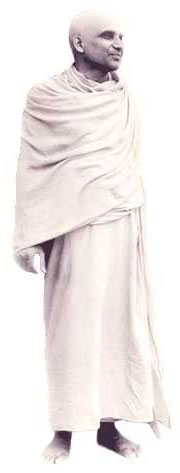
by Swami Krishnananda
The realisation of Brahman does not take the form of personal experience. One cannot say or tell that one has known one’s Self well, because everything that is known becomes an object. The Self is the knower of all, and is not known by anything. To say that one has known it is to limit it, and to say that one has not known it is, again, to limit it. The knower does not know anything other than the knower, which cannot be called the knowledge of the knower. Knowledge works on a dualistic basis. But the Self is non-dual. There is no knower other than the Self. It alone appears as the one and the many, as the experiencer, and also the experienced. The question of the knower, the knowledge and the known does not arise regarding the pure Self. In all processes of knowledge neither the subject is well known nor the object. Human knowledge is partial knowledge. Every experience of the human being is limited. The glory and the greatness of the world of experience is a distorted shadow of the Supreme Being. No manifested knowledge can be complete, because every knowledge is either of the subject or of the object, and neither the subject nor the object is really known through any form of knowledge, because the knowledge of the object is the expression of a subjective imperfection, and the knowledge of the subject, also, is thereby concealed, for objective consciousness prevents subjective awareness. Individual knowledge always hangs midway between the knower and the known, and it is capable of knowing neither, in truth. Therefore, knowledge of Brahman cannot be expressed.
It is not possible to have a little knowledge of Brahman, as Brahman cannot be divided. Either there is full knowledge of it or no knowledge of it. Limited experiences are not in any way even a little of brahma-chaitanya. Different kinds of experience, lower and higher in degree, are the results of the degrees in the manifestation of the mind. All our experiences are mental. We cannot pierce through the mind as long as we exist. Man is the same as mind, and mind is the same as desires. Even as cloth is nothing but threads knit together, man is nothing but a bundle of desires. Differences in experience are because of the differences in desires. The lesser the desires, the better and more lasting is the experience. The state of the least desires means the experience of the greatest reflection of Truth. Higher experiences are nearer to Brahman, because a greater and truer reflection of Brahman is experienced in those states, as higher experiences are the conditions of thinner needs of the mind. But, anyhow, even the highest objective experience is mental, though very near to Truth, and is not the same as Brahman-realisation. Even the nearest is not the same as that to which it is nearest. Hence, there is no such thing as a little realisation of Brahman. As long as there is even a tinge of a single desire, Brahman is not known in truth. A finger can obstruct the vision of a huge sun. A single desire can bar us from the experience of Brahman. When it is said that everything is Brahman, it is not meant that any form of our experiences is in any way Brahman. It only means that forms have no value except on the basis of Brahman. Whatever is truth in forms is a limited and reflected aspect of Brahman. But none can expect to taste even a drop of the ocean of the absolute as long as he wishes to exist, i. e., wishes to think. Every thought is a denial of Brahman, and, therefore, thought and realisation cannot exist together. Where the one is, the other is not. Experience of Brahman has no concessions to thinking. Self-realisation, therefore, is existence as the Impersonal Absolute.
The definition of Brahman as consciousness should not be mistaken to be an attempt to bring down the nature of Brahman to the level of our understanding. We say Brahman is consciousness because nothing of this world is conscious. It is just to differentiate reality from appearance that we term Brahman consciousness. It is to exalt it and not lower it. Even when we accept that Brahman is sat or chit we do not confuse it with anything that we know. It is beyond the sat and the chit which we know of. We reject everything which we know and refuse to be satisfied with anything that comes to us as an experience. We may have the highest possession of experience, but we have to abandon it. Whatever experience one may have, grand and glorious, one should not be under the impression that one’s achievement is over. It is an infinite rejection of things and states that we have to practice. There is no end for our denials. One cannot suspect whether one is in the state of Brahman or in a state of Brahman or in a state to be denied. It will be clear when one experiences it. Dissatisfaction and the awareness of ‘I’-ness will be the indicators of the imperfection of a particular state of experience. Brahman is doubtless existence and we can experience Brahman only after self-effacement. It is not easy to know it.
Consciousness should be realised as the fundamental basis of all mental experiences. It should be realised in every state of our life in waking, dreaming and deep sleep. All thoughts are heterogeneous in their nature. They are not connected with one another. But they are experienced as belonging to one person because of the unity of the Self within. Our body, senses and mind are all made up of scattered parts that appear to be a unified whole because of the underlying indivisible essence. If only the Self were not there, our personality would be thrown away into the condition of atoms, disconnected and varied. There is no difference at all between the building bricks of one body and of another body. All are made up of the same earth, water, fire, air and space. But bodies appear to be different, they act in different ways, because the actor is not the body. Differences are in the desires within. This shows that man is not the body. When we speak to a person we do not speak to the body at all; we speak to the character hidden within. Even the ultimate constituents of this inner character do not differ from person to person. The same force acts as the substantial essence of all minds. But this substance of minds whirls in different directions at different centres of existence, thus creating differences. This whirling is called the mind, and this way of whirling is called a desire. Therefore, desires differ from person to person, and consequently bodies also appear to be different, as the body is controlled by the mind. With all these distracting characteristics which a person is made up of, he appears to be a whole being, without differences at all. The external ugliness is hidden by the reflection of the inner beauty of the Self. This synthesising nature belongs to consciousness and not to thought. The states of waking, dreaming and deep sleep differ from one another, and yet, a person feels that he alone exists during these three states, without difference. He identifies himself as a single unity in all changes that take place, whether in mind or in body. Waking, dreaming and deep sleep are mental conditions, manifested, slightly manifested and unmanifested. But the Self is neither the manifest nor the unmanifest. It is immutable. It is the General Ground underlying all particulars. Particulars are deviations from the natural Truth. All particularities are self imposed, i.e., created by the individuals. But the generality of the essence is common to all. Even the particulars have no life and value without this general being, even as a pot has no value without clay.
Samyagdarshana is correct perception of things as they really are. It is a spiritual condition and not an act. It has no concern with the changes that take place in the body and even in the surface-consciousness of the mind. It is, in other words, simple knowing. All objective knowledge breeds birth and death, because knowledge of objects means an underlying desire for objects. We cannot think of anything without having a love for it, positive or negative, and every love is a deviation from the law of Self-Existence. When we love an object, we deny ourselves, or rather, we deceive ourselves, because we, thereby, sell ourselves to that object. Because the object changes itself, and because our love for that object also hunts, after it, and because our love is inseparable from ourselves, we appear to die when the object vanishes, and take rebirth in order to find that object of love. Perception of diversity means moving from death to death, because we are courting thereby self-transformation, due to our desire for identifying ourselves with the diverse forms of objects.
Self-knowledge, therefore, consists in self-identical, immediate, non-relational knowledge. Knowledge, however, cannot be an attribute of the Self. If so, what is the nature of the Self? We cannot say that the Self is other than consciousness, holding that consciousness is its attribute. Else, the Self would be unconsciousness, which, however, is not our experience. The Self is not a substance having attributes. If consciousness is an attribute of the Self, there would be rise and fall of the knowledge of the Self. It is not possible for us to say what would be the nature of the Self in essence, if it is not consciousness. Without consciousness, it would become a dull substance, ever changing, partitioned, impermanent and impure, which conclusion is, however, illogical.
The theory that the knowledge of the Self is the result of the contact of the Self with the mind is incorrect. This theory reduces the Self to unconsciousness. Several of the declarations of the srutis (Upanishads) would be contradicted by this theory. Because the Self is all-pervading, there would be an eternal contact of the Self with the mind, as wherever the mind is, the Self also is. What, then, is the meaning of remembrance and forgetfulness? There would be no forgetfulness at all because of the perpetual contact of the Self with the mind. Moreover, it is wrong to hold that the Self can be in contact with anything, because the Upanishads deny such a possibility. Only a substance with attributes can be in contact with another substance with attributes. The mind has attributes, but the Self has none. Infinity cannot be in contact with perishability. The knowledge of the Self is not the effect of its contact with the mind, as the acceptance of this theory would be to accept that consciousness itself is transient. The Self is eternal knowledge in its very essence. It does not require any contact therefor.
There is another theory which holds that the Self knows itself by itself, by becoming the subject as well as the object. This theory makes the Self perishable, because it divides the Self into two parts. The Self can never became an object of itself. If it does, it has to die. One thing cannot become another thing unless it dies to that one thing. The Self does not require another consciousness to know itself. Therefore it cannot be said that the Self becomes an object to know itself.
The theory of the Buddhists that the Self is perishable is wrong. According to the Buddhists, the Self is a constantly changing process, and not an existent being. A process is never what it is for more than a moment, and hence every process is transitory. According to this theory the whole existence is a moving shadow, a passing phenomenon without any substance in it. The absurdity of this theory is clear from the fact that no process is possible without an underlying connecting being. There is no flying without an object that is flying. There cannot be mere flying alone. And, also, something flies means something does not fly, viz., the ultimate space. Change implies changelessness. There is becoming means there is being. If the Self is perishable, there must be some imperishable being other than the Self. It is not possible to conceive of perishability except on the basis of imperishability. There must be an eternal, ever-enduring being, so that change or modification may be possible. Therefore, the theory of momentariness of existence propounded by the Buddhists is rejected.
Immortality is the experience of the central existence of the Self. This is possible only after the realisation that the Self is the sole imperishable being. Knowledge is the same as immortality. Liberation from mortal experience does not mean becoming something other than what we are at present. We can never become what we are not essentially. We have no right to demand what we do not really deserve. We cannot possess what is not ours, and what is ours we can never lose. If we are not immortal now essentially, we can never become that at any time in future, because immortality cannot be created or produced. Anything that is produced is perishable. Eternity cannot be eternity only for some time. There is no such thing as eternity now and eternity afterwards. It is the same in past, present and future. We cannot, therefore, become eternity; we have to realise eternity. We need not strive to possess anything here, because we cannot possess anything perpetually. Anything that is possessed by us shall depart from us sometime or the other. Union is always followed by separation. Nothing of this world is for us a help in our attainment of immortality. The effect of all that is done, created, produced, acted or striven for is perishable. What is imperishable cannot be had through what is perishable. If we get anything, we shall lose it. If we love anything, we shall mourn for it. If we have faith in any object, we shall be deceived by it. If we enjoy anything, we shall suffer for it later on. If we are dependent on anything, we shall have to die for its sake. If we wish to live, we shall have to die, also. This is the law of this world of change. We cannot hope to be happy by being in contact with things. All that we have shall be taken away from us. Smiles of merriment shall result in tears of grief. The earth and the heaven shall collapse. The solar system shall be smashed. Our beloved bodies and our objects shall treacherously desert us, and we shall be helped by none. Immortality we can attain, therefore, by destroying the sense of possessions, by ceasing from willing, by disconnecting ourselves from external phenomena. Immortality is attained by the Self through itself. What we want, we already have, and what we do not have, we can never get. All struggle for acquisitions shall be frustrated and shall result in the continuous stream of the painful experiences of incessant births and deaths in the rotation of samsara. Atma-tripti, satisfaction in one’s own Self, is the way to Immortality.
Self-realisation is synonymous with the attainment of unlimited spiritual strength. It is the strength born of independence, freedom in the highest sense. Power that is a result of the idea of possession is imaginary. No individual can have real power because of its separation from external objects. Worldly power is only an idea and not a reality. The power vanishes when one is robbed of the possessions. Therefore, there is no permanent power in this world. Even temporarily one’s powers in this world are only imaginary, because they depend on the trust which others have in oneself. Phenomenal power cannot overcome death, because even all the phenomena have to die. Death presides over everything that is created. Therefore, death can be overcome only by an uncreated being. This power of deathlessness is ever existent, and no other power is equal to it. This spiritual power cannot be attained through any other means than the Self, which has to be approached through cessation of all functions and not by any amount of striving. Only an eternal being can overcome the process of change and destruction. Therefore, it is said that the Self cannot be attained by one devoid of strength. It requires the greatest heroism.
This Self is to be known in this very life. If it is known here, there is meaning for this life. If one does not know it here, great is the loss to such a one. It is possible to realise the Self in this very life itself. It is not necessary to take several future births for this purpose, if only one is able to make the best use of one’s life. It is not the length of time for which sadhana is practised, but the nature of the intensity with which sadhana is practised, that is to be taken into account. It is not the quantity but the quality of sadhana that matters. A spark of fire can burn even a mountain of straw. The assiduity with which sadhana is carried on is the sole factor that determines the value of that sadhana. But the preparation necessary for the actual ultimate process is very great, and it takes practically all the time. It is possible to put an end to the process of the expression of the results of the desires by negating their values and by directing that consequential energy to concentration of consciousness. The failure to practise this kind of energetic endeavour leaves the present and the past actions free to manifest their fruits and thus continue the process of transmigration.
The spiritual hero distinguishes between the truth of the spirit and the untruth of the forms of experience in which it appears to be involved. The lack of interest shown in the forms of thought necessitates the dropping of such forms from one’s experience. This independent experience is called immortality. It is the process of Brahmabhyasa or the practice of the affirmation of the one Reality in every form of experience that can liberate the individual from its individualistic experiences. In other words, it is to feel oneself as the All, to feel that All is centred in one’s Self, that is called brahmabhavana. This results in the disentanglement of the Self from the notions of ‘I-ness’ and ‘mine-ness’, from the relationships and attitudes that bind the individual with its experiences and lock it up in the prison of its notions. There is no hope of the attainment of the highest Divinity as long as one wishes to be this or that, to have this or that experience, to care for some experience or the other. It is a total absorption of oneself, a practical death, as it were, to all the experiences of the earth and the heaven, a ceasing from living, a wanting nothing, an absolute denial of anything, that is presented as an experience internally or externally, that is required of the persevering aspirant after liberation. Knowing and being the Absolute mean the same thing. It is not possible to know it without being it. To live in the universe of experience is to desert the immortal, and to live as the immortal is to abandon the phenomenal experiences. The ardour with which the process has to be undergone is unimaginable. The greater it is, the lesser it should be considered to be. The greater the wisdom, the greater should be the inspiration for deepening that wisdom. The higher one proceeds, the still higher one has to aspire to climb, until there is the uncontradicted experience of Absolute Being. All this is possible through an intense acuteness of the means of approach and an admirable endeavour that shall break the personality to pieces. It is the Supreme Fulfilment attained though Supreme Negation. It is the burning up of love for the sake of living in the centre of the Absolute, in which love melts into experience. Desires and loves move, they proceed, and do not rest in them selves. But experience is motionless and rests in itself forever. It is the Supreme Death of all, for the sake of Supreme Living.