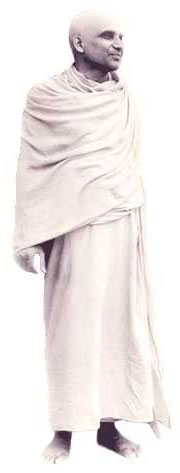
by Swami Krishnananda
Omnipresent is God; we are in one place only. Omniscient is God, and we are ignorant. Omnipotent is God; we are very feeble and weak in every way. God has no desires; we have only that, and nothing but that. God is immortal; we are subject to destruction. God has no external; for us, everybody is outside ourselves. There is no quality in us that can be compared with God’s quality. By scrubbing off these limitations which are physical, social, legal and even ethical in the social sense, we become more and more personal in our nature. We do not go on describing ourselves in terms of what we are not.
“I am the son of so-and-so, father of so-and-so, working in such and such office,” etc., are descriptions of ourselves in terms of what we are not. But can you tell me what you are, dissociated from all these connections that you have with the world – with office, with work, and with family? You will find that it is very difficult to describe. You are always something in terms of something else. This is an alienated form of description of yourself – the ritualistic type of defining one’s own self, I should say, which gradually gets weaned out in this methodological approach into the higher and higher levels of sadhana: Vaishnava, Saiva, Sakta, Ganapatya, Saura, Kaumara, or whatever it may be called.
What happens is that we become super-human, unsocial – even appearing to be anti-social. Though they are not anti-social, the unsocial character and the purely personalistic approach of these people to the realities above the world sometimes makes them look like people not wanted in this world. And their behaviour can sometimes be so anomalous, so totally different from the expectations of society, that they may not be able to live in this world at all. They may be burnt at the stake or crucified or impaled – which has happened in the case of many of Sufi saints, as we hear. They become unwanted in the world, and they want to be unwanted by the world because the more we are not wanted here, the more will we be wanted there.
But, we wish to be wanted very much here. We would like to be the rulers of this earth – head of the United Nations or king of the whole world. The instinct of self-respect, self-adoration, is so very piercingly rooted in the recesses of our hearts that we could go for many days without food more easily than bear one word of insult, because insult exactly touches the point which we consider as being ourselves.
A verse from the Narada Parivrajaka Upanishad says that a highly advanced spiritual seeker should ask for insult and detest praise. Wherever you are praised, run away from that place. Do not hear a word of any encomium or eulogy about your own self. When the ego is already fat enough, why do you want to plaster it further with more and more encomium falsely poured on you? Those who praise you are actually treacherous people because they can also cut your throat one day or the other. Therefore, lean not on the support of social wealth or self-recognition. Highly advanced spiritual seekers do not expect a weaning from society to take place by the historical process of automatic evolution; they deliberately invoke this condition on themselves by poverty, obedience and charity. These are the great points that are seen in advanced devotion, as totally distinguished from ordinary devotion.
I mentioned the five bhavas of the Vaishnavas. They are in the ascending order, where you melt completely in the end. Devotion has to be a means of melting yourself into liquid before the ocean of God Almighty, and you cannot remain as an outside something – because if you are there, God is limited. Let the unlimitedness of God swallow you completely. May you be prepared for this kind of self-annihilation in the glory of God.
I mentioned various acharas which are worth studying by any serious student of spiritual practice. These Sastras, Agamas and Tantras – Vaishnava, Saiva, Sakta, Saura, Ganapatya, and Kaumara – are so very touching, so very enlightening, so very enrapturing in their method of approach and instruction, that you will want nothing else afterwards. That is the reason why the whole text is kept as a guarded secret.
Even a book like Yoga Vasishtha, which comes under the Agama section, was kept secretively by Swami Sivanandaji Maharaj. He would not allow that book to be in the library. There was an abridged edition called the Laghu Yoga Vasishtha, translated into English by Narayanaswamy Iyengar, which Gurudev read many times and underlined sentences in red pencil, but he removed the book from the library saying that it is not to be read by everyone.
The Ashtavakra Gita was a favourite text of Sri Ramakrishna Paramahamsa, but if anybody came near, he would thrust it under the bed so that people may not know that it was there. The Ashtavakra Gita, Avadhuta Gita, Yoga Vasishtha and Tripurarahasya are all Agama Sastras because they tell us something which nobody will tell us and nobody is expected to tell us. That is the secret that Christ told on the mountaintop, to a selected few. To others he spoke in parables, but he revealed the secret to his twelve disciples; it is called the Sermon on the Mount. Buddha said the same thing to his devotees: “I know much more than what I have told you, but this is not the time to tell you what it is.” And Sri Krishna said the same thing in the Bhagavad Gita: “I know everything. Arjuna, you don’t know anything. I shall tell you something in brief.”
So here, in this approach which is totally inward, totally spiritual, totally soul-filled, totally informal, totally non-ritualistic, totally unsocial, one seems to be a child, as it were, born just now, with no cult or religion whatsoever, and not even sex consciousness. A little baby does not know to what gender it belongs. We become children before the majestic eye of God when we are cleansed completely of the biological, anthropological, and even human aspects. A baby has no such qualities at all; a baby is only a baby. We cannot describe it in any other way except that it is a baby, and we should not say anything else about it. We become like that. The Brihadaranyaka Upanishad tells us to shun all learning and become a child – which is to say, not the first childhood of ignorance and crawling in a state of helplessness, but another childhood that we are assuming, a childhood of simplicity, self-sufficiency, goodness, beauty and utter minimum of existence, minus the ignorance and other limitations of a child.
Great saints and sages are like babies: they speak like babies, behave like babies; children they are. Verily they are children of God, as a child is dear to everyone, whoever be the mother or father of that child. Would we be happy to see a little baby on the road with no one to look after it? We would not say, “It is somebody’s child; why should I bother?” We would be attracted to that little compound of existence which is called a child because of its simplicity, egolessness and perfection of presentation. Such a thing is the quality of a saint and sage. He becomes beautiful, grand, powerful, childlike. ‘Godman’ is the word to describe him.
This kind of achievement is the aim that is expected by worships that are wholly internal. In the beginning, it is an outward mode of worship through the Prabhu Samhita. It then advances to the Suhrit Samhita, as I mentioned. We want large quantities of substance to offer to God: huge temples, large bells, many books and much chanting, etc. In the beginning all these things are necessary so that we may be roused into a religious mood of the presence of God. Gradually we feel no need for these things; we require ourselves only. We can be anywhere, and we will find God there.
These stages of religious development from scriptures like the Veda Samhita, Smritis, Itihasas, Puranas and the Agamas constitute the whole gamut of religious development. The entire religion is here in what we have been discussing during these days. The original master-like, father-like concept of God, the friendly, more intimate relationship that one establishes with God, and a merger of feeling with God – these constitute the three stages of perfect religion.
While this is so, as history advanced and people became weaker and weaker, it was not easy for people to be truly religious in this sense. The opponents to religion denied God. They did not want any religion at all and felt that the religious approach is somehow or other totally dissociated from social existence in the world. Philosophical counterblasts and social oppositions arose at that time, which diluted religious development. Finally, when the masters vanished from the earth and the great saints and sages who could speak to God were no more available, and the Godmen vanished completely – when the very root of religion was threatened on account of socialisation, economisation, politicisation, etc., of the life of people in the world – it became necessary for those remaining in the field of religious practice to defend themselves. This defence started, both in the West and in the East, through philosophical arguments. In the West, the religion of Christ was defended by Saint Thomas Aquinas, and he is sometimes considered as the Western Sankaracharya. The great polemics that he discharged against all opposition to Christ’s religion through his great works like the Summa Theologica, all which were written in Latin, were necessary for proving the existence of God. In the earlier stages, proof for the existence of God was not necessary. There was a spontaneous feeling that He must exist. Afterwards, this feeling became the great necessity in practical life and, finally, it was the reality in which we are sunk completely. But now it has become a great need for us to prove that He exists, which is a great travesty indeed; but that is the state of logical, metaphysical, and argumentative philosophy.
In India, the arguments of philosophy started with Buddhist metaphysicians like Nagarjuna and Vasubandhu, and Sankaracharya highlighted it. Sankaracharya was a master logician and philosopher who lived and died for sake of proving that God is, and God only is. So is the case with Western argumentators. The philosophical systems of the West as well as the East, confining themselves to the work of establishing the truths of religion and spirituality, constitute the last phase of the development of religion. We shall speak a few words about this tomorrow.