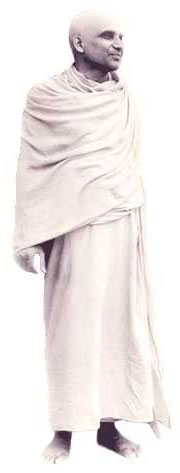
by Swami Krishnananda
This inseparability leads us to another conclusion. It is not true that there is a perceiving consciousness that is entirely cut off from the object; there is an underlying current of continuity between the perceiver and the perceived. The continuity between the perceiver and the perceived is itself not perceived because if the continuity which is the process of perception also becomes an object of perception, there will be no object of perception. It will all melt down into a single Being-Consciousness. There is no intermediary consciousness that is other than the consciousness of the subject and of the object.
This is the acceptance of a transcendent element in consciousness containing within itself both the subjective side and the objective side, and at the same time rising beyond both. Here we have practically entered the field of what goes beyond the Samkhya and the Nyaya-Vaisesika doctrines. It is the Vedanta system, which is founded finally on the Upanishads – the concluding quintessential part of the Veda Samhitas.
The Vedanta is a term that is used for a doctrine which accepts that God does not merely exist. God does not merely create and sustain and dissolve the world; God is the aim and summum bonum of all life. All philosophies which consider the realisation of God as the ultimate aim of life can be considered as Vedanta. It is not enough if we merely accept the existence of God as the maker of things, as the architect of the universe. He must have some hand in the operation of the things in the world, and we must have some connection with Him. He should be the fulfilment of all our longings. Only when God is the consummation of all the values that we can imagine in our life does He become the Ultimate Reality. Otherwise, God would be a relative reality, conditioned by the processes of space, time and objectivity; and we would be utilising God for the purpose of fulfilling a purpose which is other than God Himself.
Thus, the Vedanta doctrine is finally a doctrine of the preponderance of the God element in everything in the world. To sum up the conclusion, we live for God. The whole universe exists for God, and the process of so-called evolution is a movement towards God for the establishment of itself in God consciousness.
The doctrines of Vedanta have been classified into various categories on account of deviations in the very concept of God Himself. The differences among religions in the world arise on account of the differences in the concept of God. I feel that if we had a uniform concept of God there would be no difference among religious conceptions and the ways of social life based on religion.
What do we mean by ‘God’ when we say – accepted, of course – that God-realisation is the aim of life? Here we have umpteen conceptions of God, all differing one from another on account of the emphasis laid by the sensations, by the intellect and, finally, by an act of intuition. God-conception can be sensorily oriented, intellectually oriented or intuitionally oriented.
A famous verse which is oft-quoted by people in connection with this difference in the concept of the nature of God is the answer which appears to have been given by Hanuman to Rama when Rama queried Hanuman as to who he is. Hanuman replied, it seems, Deha-buddhya tu daso’smi, jiva-buddhya tvadambakah, atma-buddhya tvamevaham iti me nischita matih: You are asking me, Lord, who I am. If you regard me as a body, I am a servant of yours; if you consider me as a little consciousness, a jiva, I am a part of you; but if you think I am the Pure Spirit, I am yourself.
The idea is: How do we contain in our minds the concept of God? We have the predilection to see things in terms of sense perception. Many things there are in the world; and the senses conclude that diversity is a fact of reality. So the organising principle, which is the final God-consciousness, has to account for this diversity because our feeling justifies the existence of the multiplicity of things. Nothing in us tells us that all things are one. Everything seems to be different. Even the physiological organs are different, one from the other. The world is constituted of so many varieties of colours, sounds and touches that we cannot say that anything has any connection whatsoever with anything else. God-consciousness, or the concept of the creative principle, has to finally account for this duality. And God transcends and also acts as an immanent principle – accepted. It is the Vedanta doctrine that God is transcendent and immanent at the same time. Yet it is maintained, together with the acceptance of the transcendence and immanence of God, that there is a need to accept the multiplicity of things.
God permeates all things, as water permeates every thread of a cloth that is dipped into a bucket of water. A unity of the movement of the water principle through every fibre of the cloth is accepted; yet the differences among the threads and the fibres also has to be accepted, at the same time. There is unity in diversity. The cloth, the fibres, the threads do not merge into the single water principle merely because they are permeated by the water principle. The unity of the principle of water that is everywhere in every fibre of cloth is somehow or other compatible with the cloth being independent of it. The world is different from God. This is the Vaishnava dualistic concept of everything being different from everything else. The world is different from God; the individual jiva also is different from God; matter is different from God; one jiva is different from another jiva; and one part of matter is different from another part of matter.
Molecules differ from one another; one molecule cannot be the same as another molecule. This dualistic concept of the world in all its multifarious varieties went together with the idea that God is, finally, the aim of life. But what is meant by ‘the aim of life’? What do we do with this God who is somehow or other transcendent, together with His apparently being immanent? The Madhva doctrine says that we can reach God, come in contact with God, in the same way as particles of rice and sesame contact each other when they are mixed together. If a quintal of sesame and a quintal of rice are mixed together, they are all together in a state of unity – but they are not actually united. Every grain is different from every other grain. Thus, the jiva may attain God in the same way as sesame attains rice and rice attains sesame; they will not be identical. Man can never become God. He is always a created substance. Man is the servant of God; he is a dasa, a humble follower of the decree of the Supreme Creator.
The doctrine of the perfect duality was not satisfying for a long time because it looked as if we cannot have an intimate relationship with God – another way of saying that we shall be always limited. Finitude is our doom and we are damned forever to be in this shackle of existence of limitations of every kind, inwardly as well as outwardly. Then why do we have this aspiration for unlimitedness? How does this desire arise in us to become infinite, to become immortal? Immortality cannot be associated with any kind of relative existence. That which exists outside something as a localised object is perishable one day or the other because it is a visible thing. Yad drisyam tannasyam: Whatever is visible has to perish one day or the other. Therefore, it is necessary to bring about a further coordination and harmonious relation among the very particulars of the created world, with God as the Supreme One.
There is a unity of purpose between God and the world. They are organic to each other. They do not touch each other like sesame and rice, but like milk and water. Milk and water can combine, and we cannot know where the milk is and where the water is. Yet, water is water, and milk is milk. Similarly, the world is the world, and God is God; yet, there is organic connection. We have a soul and we have a body. We know very well that the soul cannot be identical with the body, and the body cannot be identical with the soul. Physically speaking, the body is material. It is unconscious in its essence and is made to appear conscious on account of the entry of consciousness through the cells of the body. The body and consciousness are two different things.
In a similar manner, God and the world are basically to be conceived as one and the same as, for all practical purposes, we consider our soul and body as one. When we eat, when we walk, when we speak, when we do anything whatsoever, we do not keep the body somewhere and the mind somewhere else. They are related to each other as if they are inseparable, though they are really not inseparable. This is the Sri Vaishnava concept of the Visishtadvaita system, where oneness is conditioned by a kind of qualification. It is Advaita, no doubt, but Visishta-advaita. It is an advaita, or a non-dual, character of the world and jivas with God – with a qualification that they are really not one. It is an organisation where every member is one with the other member, without which there cannot be an organisation; yet, we know that no member is identical with any other member.
In a parliamentary session, in a national consciousness, the members sitting together to constitute a single body of an organisation all imply a single unity of existence. Nevertheless, every part is different from the other part. We can dismember the organisation, and all the organisations can be dissolved one day or the other, and the parts can be separated.
Therefore, here again we have a difficulty. Is it organically explicable that the world is related to God in an externalised fashion and it exists externally outside God, as the body is in relation to the soul? Thus, the world perishes as the body perishes. God can visualise the destruction of the world, as the soul can visualise the destruction of the body. Does the world exist at all, finally? If the world is perishable, nasvara, and it will not be there after some time, then there will be no creation whatsoever. God alone will be there.
The perishability of the things in the world, the fragility of everything that the world is made of, shows that its essential nature of fluxation cannot be identified organically or in any sense whatsoever with God, Who is not a flux. The fluxation of things and the temporality of the world, in every way, would totally dissociate the world of relativity from God as if the world does not exist at all because the destruction of the world would mean the end of all things, and God alone would be there. Also, God must have been existing even before the creation of the world. This cannot be denied by any religious philosopher.
Before the creation of the world, where was God? He was not in space, because there was no space; He was not in time, because there was no time; He was not in creation, because creation did not take place. He existed only in Himself. Therefore, God originally existed as only God, and not as something in terms of relation which is created on account of the created universe. He is not omnipresent, He is not omniscient and He is not omnipotent, because these qualities are attributable to God in terms of what He has created afterwards; but prior to creation, He was Pure Existence.
Therefore, the unity which is God’s existence is highlighted further on in the philosophies, the seeds of which were sown by great thinkers like Gaudapada and Acharya Sankara and his followers, who spoke in such diverse ways and put forth such a multitudinous variety of arguments that it has been very difficult for people to make out what actually the Advaita doctrine means. It is not a negation of the other values of life. The so-called Advaita of Sankara, for instance, does not refute Visishtadvaita. It does not refute the Madhava doctrine of duality. It only says that there is a gradation of the perception of the unity of things, and all these gradations are to be considered as degrees of reality, ultimately converging in a degreeless Universality.
The lower is not refuted by the higher. The lower is not negated, and it cannot be regarded as untrue; it is true in its own way. Every experience is true when it is experienced. The truthfulness of an experience lies in the fact of it being experienced. If it is not there at all, we will not experience it. Therefore, the world exists conditionally. It is not illusion as people think, like the horns of a hare or the tail of a human being. Such a kind of illusion or annihilation is not attributed to the world by Sankara either, though we may say that the world is totally absent only in the existence of God. Because God is all, there cannot be any world in front of Him.
This is an acosmic concept. Acosmic means no cosmos. From the point of view of God Himself the world cannot be there, because otherwise He would be seeing a world as a dual counterpart in the form of an object in front of Him. The infinity of God would be stultified by the presence of a world in front of Him. Hence, from the point of view of God Himself, God only is. Therefore, there is no creation. But once we accept the fact of creation, there becomes a necessity to explain the degrees of evolution of consciousness from the lowest perception through sense organs and intellect until it reaches the intuitive grasp of the Absolute as one single Reality.
Thus, these are the tripartite concepts of Vedanta: Advaita, Visishtadvaita and Dvaita. There are further modifications like Suddhadvaita, Dvaitadvaita and Achintya-bhedabheda, etc. Even the Vedanta types of Saivism and Saktism also have their own predilections. The philosophical point made out in these arguments is that the intellect has to somehow come to the succour of the faith that is originally religion, because of the fear that religion can be completely wiped out from the world by materialistic doctrines that stand on argument, observation, and scientific experiment, with sensory perception being given the uppermost value; and when the senses revolt against the reason and insight of the human being, there will be no spiritual value left.
This is why religious organisations, religious philosophies and religious leaders arose. Prophets, teachers, saints and sages made it their mission to prove even to the unbelieving senses and the intellection of modern man that it cannot explain even the littlest thing in the world without first introducing into that little thing a principle of universality. Everything – even that which is only particularised, entirely finite, localised somewhere, unconnected with something else – cannot be explained except in terms of there being a universal organisation behind it. Otherwise, we cannot know that one thing is different from the other.
The difference that we see between one thing and another is a consciousness which is not to be identified either with this thing or with that thing. The thing that knows that one thing is different from another thing does not belong to either this thing or that thing; it is a third thing altogether. Therefore, there is a universal principle of consciousness involved even in the perception of duality.
Even when we say that duality is there, multiplicity is there, many things are there, we are unconsciously assuming that there is some transcendent element -because if this consciousness were not to be there, who will tell us that there are many things? The many things themselves cannot say that there are many things. There must be something which is not manifold, not differentiated, not dualistic in order that the very concept of duality and manifoldness can be justified. Therefore, ultimately, consciousness is the Reality. Chit is Supreme. God’s essence is Pure Consciousness. God knows Himself. And what does He know? He knows Himself as Knowledge only: pure chit. Consciousness is not an attribute of something, nor is it a process of knowing something else. Consciousness is an ontological existence. It alone is, and nothing else can be.
These are some of the various facets of philosophical arguments. I have touched upon the features that are especially prevalent in India – that is, the Nyaya, Vaisesika, Samkhya and Vedanta. I discussed the Mimamsa and the Yoga System here because they stand apart from these gradational arguments of the philosophical type, though we need not enter into these complications just now. Suffice it to say that religion has once again found that it is necessary for it to stand on a four-legged pedestal, as it were: the authority of the scriptures and the prophets, the great Epics and the Puranas, the Agamas and the Tantras, and the philosophies which are metaphysical in their nature.