Swamiji on Facebook Swamiji on Twitter Swamiji on Youtube

Sri Swami Sivananda and His Mission

by Swami Krishnananda

Chapter 2: Being in Tune with World Thought (Continued)

The higher mind, whatever that mind be, is that capacity within us by which we can wrench ourselves from our own selves, pull ourselves out of ourselves, as it were, and become associated with the world processes—partly thinking as the world would think. I am again reverting to the point of the way in which the world thinks, which is supposed to be the yoga of the world. What does the Upanishad mean when it says that the world is in a state of yoga and, therefore, we too have to be in a state of yoga because of the fact that we are not in the world but we are the world? We live by the world and not merely inside the world, as living in a house. Our sustenance is the world. Our vitality is the world. Our soul itself is the world. The world soul sustains the so-called souls of individuals. Then what does it mean to think as the world thinks? This methodology of our consciousness is very easy and very difficult at the same time. We have to exert a little in order to be able to align ourselves in a totally different manner. Can we imagine that the world does not see anything outside itself because the world is all things?

We are all the world, and we are in the world. The world includes all things for our practical purposes. If that is the case, that world which includes all of us will not be thinking of us, because if the world would be put to the needs of thinking of people like us, we would not be in the world; we would be outside the world. If we are in the world, if we are inseparable from the world, the world thought would not be a thought of people like us. It would not be any thought at all as we are accustomed to imagine. It would be thinking itself. Here we are required to exercise the will to be able to think in this manner. Why is it not necessary for the world to think of anything outside itself? The answer is very clear. That which we would like the world to think of is in the world and, therefore, is the world. Hence, the world does not think of anything; but it does think, in the sense that all thought is world thought. All thoughts are in it, and it is the thought. This is the world’s pratyahara-action taking place.

We have heard of the abstraction of the forces of the senses, the withdrawal of the mind and all that which yoga scriptures speak of by way of instruction: withdraw the senses, restrain the mind, and so on. In a broadly spread-out universal fashion, the world does this and it does nothing else, while we may be doing many things side by side with a yoga activity. We know very well this is what we are doing. We have a few minutes of yoga, a few hours of religion, but there are many other things in our life which we seem to consider more important—very, very unhappily. If that is the case with our yoga, it is not the yoga that the world is thinking of. Yoga is the only thing that the world does. It has no other function to perform. It has no other activity, in the same way that the physical organism has only one action to perform—the maintenance of the health of the system. It has no other intention at all. The balancing of the whole system to maintain its perpetual health is the central intention of the whole physical organism. This is the yoga of the body; so is the yoga of the world.

Thus, the centrality of the features of yoga may slowly land us in a new discovery, namely, that it is a kind of thinking which does not require anything to be thought—not because there is nothing that is to be thought, but because there is no necessity for the mind to think of that which is to be thought. The need to think of objects, as we call them, arises because we have an anxiety that they are not with us. There is no necessity to think of that which is already with us—not merely with us, that which has already become us—just as we do not go on feeling anxious that the limbs of our body will drop off. They are very secure indeed. We are anxious about our wallet, our watch, our land, our house, because there is a feeling that they are not ours—and really, they are not ours. As they are not in our possession and, much worse, they have not become ourselves—they are not us—there is a need to think about them.

But that which is already with us, and that which is ourselves, need not require thought. It was pointed out that the world has no need to think in this fashion, because all that is required to be thought of is part of its being. The world includes all things. This will throw some light on to how it is possible for the world to be in a state of yoga—and how it is imperative on the part of every one of us, everything in the world, to be only in a state of yoga. If the world does nothing other than being in a state of yoga, and that is the only thing that the world has to do, can do and must do, and if it is also true that we are one with it and we cannot be outside it, we also have to follow the same path.

There is no duty except to be in a state of yoga. The question of other duties should not arise. There are no other duties, because the so-called others that we have suddenly and unnecessarily insinuated are a part of this yoga of the world. Here comes the importance of karma yoga, which is the converting of so-called other duties into the very substance, the very self and soul of the participation required by our minds in respect of world-thinking. So we should not say, “I have other duties—duties other than study, other than meditation and other than japa. I have office work.” These are irrelevant ways of understanding the situation of life. There are no other duties in the world, as there is no other. The word ‘other’ should not be used here, because that so-called other is that over which we have no control, over which we have no say whatsoever, which is not us, and over which we have, therefore, an anxiety that has to be brought into alignment with the thought of yoga, which is world thought. This process is karma yoga.

The whole teaching of the Bhagavadgita is only this much—that our so-called other duties, vocations, performances, activities are not actually activities, duties, works, performances, drudgeries, etc. Nothing of the kind are these. They are part and parcel of the needs of the world and, therefore, they are included in the thought of the world. Hence, if we are wise enough to be in tune with world thought, we shall be taken care of. The world shall protect us, and our so-called other duties also will be taken care of without our sweating as much as we do. These are the fundamentals of what we may sometimes call philosophic thinking, spiritual thinking, yogic thinking, higher thinking, religious thinking, divine thinking—thinking that will make a mortal an immortal.

The world was finding it difficult, inscrutably though, we are not able to fully ascertain the manner of this difficulty in the present mood of our minds. When there was a shake-up in a non-aligned fashion in the inner components of the world psyche—or the stuff of the world, we may say—necessity arose for rectifying media or corrective forces to rise into action, because the law of life is health; and, it is the health of everyone. There is no greater treasure than health, no greater requirement on our part than health. If we are healthy, we have everything. We need not ask for anything else. Health is an attainment by itself. It is an end in itself, and not a means. It is a great blessing to be healthy—mentally and physically, and in every other manner. Thus, yoga is also the science of health. It is the science of the health of everything that is connected with us in the world, in creation—anywhere. Yoga is the science of health in the sense that it is the way of coordinating the inner parts of the whole of human life, the life of the world, so that a yogi is not an individual person. It is not somebody doing yoga in some corner. It is not an individual affair. This wrong notion has to be given up.

“I am doing yoga.” This is not a correct statement. We are not doing yoga, because when we do it, we cease to be the ‘I’ that we are. We have begun to participate in a world process. As a river enters the ocean, we have gone into the depths of the sea of the world. In this sense, we may say that being in the state of yoga is the greatest service that we can render because to enter into people and to be what they are is the greatest service that we can do for them. Hence, when this was lost sight of—when this ideal of world health was difficult to maintain in the process of time, through the passage of history—when such a situation arose, difficulties also arose. Whenever we are not healthy, we have some difficulty; and any number of problems can arise from that, one after the other. There is no end to the problems that can arise when we are sick in our core.

What I intend to present during these days is the role which saints and sages play in this divine purposive action of maintaining the solidarity of the world, contributing to the well-being of everyone, and injecting into the whole of humanity that mighty relieving medium which will stand us in good stead forever. Even centuries after these incarnations came, their impact was felt. Even today, after ages of the departure of these incarnations and masters from the world, we feel a secure and comforting atmosphere around us when we remember them. Even a thought of these great masters is a satisfaction for us. We pray to the gurus, the masters, the incarnations, and to God Almighty. Even the very thought of them sustains us. That is the way in which they spread their aura around themselves. Not merely outside in the physical world, their aura spreads itself even through the passage of time, and it maintains itself for ages to come.

There is a short biography of a great saint who is remembered by devotees of God as a siddha purusha. One of his disciples showed the great master’s horoscope to a group of astrologers. “For how many years will my Guruji be alive?” the devotee asked. The Guruji was also present. One of the astrologers said one hundred years, another astrologer said three hundred years, and a third astrologer said seven hundred years. “How is it that you great astrologers say different things—that my Guru will be alive for one hundred years, three hundred years, and seven hundred years?”

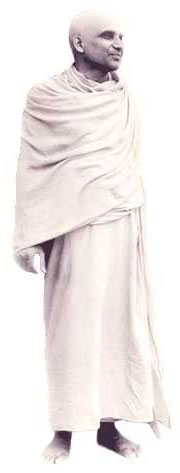
The Guruji, who heard the pronouncements of the astrologers, said, “They are all correct. This body will live for one hundred years, its writings will be known to people for three hundred years, and its force will be felt for seven hundred years.” I am referring to the great Raghavendra Swamiji, whose samadhi is in Mantralaya. It is said that he made the statement that his presence would be felt for seven hundred years, his writings would be read for three hundred years, and he would be in the body for one hundred years. This is the glory of the great masters. The aura of the great master Swami Sivanandaji Maharaj, who was amidst us, is sustaining us, and his physical absence is not a spiritual absence. And if spirit is more than matter, we have lost nothing.

With these words I conclude today, and hope to tell you something more about the very magnificent, interesting and stimulating life of this great master, Swami Sivanandaji Maharaj, and his wondrous message to mankind.