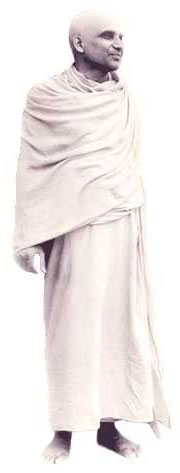
by Swami Krishnananda
Personal God: Though the Upanishads are absolutistic in their approach, they are not lopsided in any sense of the term. Together with their lofty proclamations of Brahman beyond the range of understanding, they provide for the emotional aspiration of man by their concept of God, who creates, preserves and destroys the Universe as a divine play. At this stage we should not try to introduce the later logical formulations of Vedanta worked out by teachers like Sankara and Ramanuja, for the Upanishads belong to a time and period of thinking when such logical deductions were unnecessary, and it was enough for the sages to fly into an ecstasy of divine perception in all creation, a tendency of the Rishis of the Vedic hymns, and there was no need to argue out an intellectualistic difference between the concepts of Brahman and Ishvara. If Brahman is everything, it is also the creation, and its might can be seen in the processes of the Universe. The stages which the logical system of Vedanta would call Virat, Hiranyagarbha and Ishvara are comprehended within Brahman, and to the Upanishads it would be immaterial whether Reality is addressed and envisaged as the indeterminable Be-ness, or the powerful Creator, Sustainer and Transformer of all things.
The Brihadaranyaka and the Mandukya Upanishads regard Reality also as the Indwelling Presence (antaryamin), the Ruler of all (srveshvara), the Lord of all (sarvadhipati), the King of all (bhutadhipati), the Protector of all beings (bhutapala). He is described as Omnipotent, Omniscient, All-pervading, the Source, Beginning and End of all things. This is the incipient stage of the concept of Ishvara in the Vedanta. The Svetasvatara Upanishad refers to God as the Supreme Lord of all lords, the God of all gods, the Ruler of all rulers, who is neither cause nor effect, and who has no equal. He is endowed with an eternal Power (parasakti) which works in creation as Knowledge (ichha), Energy (bala) and Action (kriya). He is the great God who has no defining marks of identification, is not affected by the vicissitudes of the world, as the sun is not sullied by the defects of the eye. He grasps without hands, is fast in movement without feet, sees without eyes and hears without ears. He knows everything, but there is none who can know Him. He is the great Purusha shining like the sun beyond the darkness of the separatist consciousness. By knowing Him alone does one overcome death, there is no other way of attaining Him.
Ethics: The ethics of the Upanishads is metaphysical and spiritual. They affirm that human life, which can be graded into a period of studentship, householdership (in which can be included one's social and political career), and retirement from active participation in world-life, is a preparation for the realisation of Brahman. In this realisation every aim of life gets fulfilled and it is the culmination and purpose of all desires and aspirations. Those heroes who have such realisation rise above the desire for sex, wealth and worldly gain, whether here or hereafter, for to them, Brahman, the Absolute, is itself the world and the Self, all in One. Knowing this Truth, these heroes want nothing from anyone or anywhere, and live in the joy of Brahman, which is their Atman.
But such lofty spiritual experiences are open only to those who are endowed with tranquillity of mind (sama), self-control (dama), freedom from compulsive activity (uparati), fortitude (Titiksha), faith in the Ideal (sraddha) and power of concentration of mind (samadhana). The Upanishad affirms that when all the desires lodged in the heart are liberated for ever, then the mortal becomes immortal and herein does he attain to Brahman. When the knots of the heart are all rent asunder, then does the mortal become immortal. This is the supreme teaching, says the Upanishad. But it is hard for all to keep this lofty goal as their ideal in life, because the world has also the pleasant, in addition to the good, and mostly people go after the pleasant rather than the good, choosing rather the delights of sense than the good of the soul. It is only the highly refined spirit that chooses the higher blessedness after rejecting the temptation of the sense-world. Sreyas which is good is unfortunately not as easily available as Preyas which is the pleasant to sensation. It is the dictum of the Upanishad that unless one ceases from evil conduct and has reached composure of mind, control of senses, acuteness of concentration and is settled in true tranquillity of thought, emotion and will, one cannot realise the Absolute merely with the help of intellectual understanding.
The concise teaching compressed into the words, 'Damyata' (be self-controlled), 'Datta' (be charitable) and 'Dayadhvam' (be compassionate), in the Chhandogya Upanishad, supposed to have been addressed respectively to the gods, human beings and the demoniacal natures, sums up the ancient ethical concept of an all-round necessity for restraint of the senses, self-sacrifice and love for creation as the moral prerequisites for the higher reaches of the soul towards spiritual perfection.
The convocational address of the teacher to the students says: "Speak the truth, practise righteousness. Do not neglect sacred study. Do not neglect worship of the gods and the Pitris. Let the mother be your god. Let the father be your god. Let the teacher be your god. Let the guest be your god. Practise only noble deeds; not others. Give with faith. Give in plenty. Give with modesty. Give with respect. Give with sympathy." This is, indeed, the height that any ethical principle can reach.
Universal love is declared not merely as a possibility but a real achievement. When one sees himself in all beings and all beings in himself, he does not shrink away from anything. As children sit round their mother with affection, so do all beings crave for him who sees all beings in his absolute Self. He who loves all, is loved by all. The woman and the man, the boy and the girl, are He; He it is that, as an old man, totters with a stick, thus deceiving the human eye; for He is in all things.
Psychology: The individual is envisaged in the Upanishad as a composite of the conscious, subconscious, unconscious and the absolute aspects of consciousness. In the waking state of the mind and the senses the individual is engrossed in an externalised consciousness of physical objects, while in the dreaming state there is an externalised consciousness of mere psychic objects projected out of memory. In the deep sleep state there is a complete overpowering of consciousness by ignorance of everything, a causal condition in which the seeds of dreaming and waking are latent. Transcending these three empirical conditions of the soul, hails the Absolute, Brahman or Atman, which is also immanent in the individual and the cosmos. The Absolute is neither externalised consciousness as in waking, nor internalised consciousness as in dream, nor a negation of consciousness as in deep sleep. The Mandukya Upanishad declares that the Atman is beyond this threefold state of consciousness which is in relation to the gross, subtle and causal bodies of the individual. It is the invisible, non-relative, ungraspable, indefinable, unthinkable, ineffable something which can be designated only as the Atman or the Self, where world-perception ceases and an entirely new perception, impossible to understand, takes its place. This is what is called the fourth state of consciousness in comparison with the three relative states mentioned. It is the aim of the relative to reach the Absolute. The principle of 'I' which asserts itself in all states is the Atman, which is transcendent, but which also pervades everything in the individual and the cosmos. The bearing of the waking, dreaming and deep sleep states of consciousness, called respectively, Vaisvanara, Taijasa and Prajna in the Mandukya Upanishad, to the corresponding cosmic conditions of Virat, Hiranyagarbha and Ishvara is developed in the later systematised Vedanta, which need not detain us here. The Atman transcending the three individual states is declared to be identical with Brahman transcending the three cosmic states. "Tat Tvam Asi"-"That (the Universal) art thou (the individual in essence)." 'This Atman is Brahman', says the Mandukya Upanishad.
The Taittiriya Upanishad makes a further classification of these states into the physical (annamaya), vital (pranamaya), mental (manomaya), intellectual (vijnanamaya) and blissful (anandamaya) sheaths of consciousness. The first sheath operates only in the waking state, the second, third and fourth in the waking and dreaming states, and the fifth in all the three states, though primarily in deep sleep alone. The first sheath constitutes the gross body, the second, third and fourth together form the subtle body and the fifth is the causal body of the Jiva, or the individual soul. The Atman is beyond the five sheaths, though it vitalises every one of them with its presence.
Eschatology: The Upanishads openly describe the passage of the individual soul, stage by stage, after its shedding of the physical body. It may be mentioned here that, after death, the soul bound by karma may (1) return to this earth, (2) take birth in some other plane than the earth, (3) hang on as a discarnate spirit in any intermediary region (a condition called Preta), (4) go to the region of Pitris (Pitriloka), (5) reach heaven (Svarga), (6) fall into hell (Naraka), or, if it is a highly advanced spiritual seeker, (7) pass through the region of the Sun (Suryadvara), to Brahmaloka, and then attain moksha. This last mentioned way of attainment is called Krama-Mukti (progressive salvation by stages). Only the absolutely desireless soul (Akama or Nishkama) attains Brahman here itself, without moving to any place, says the Brihadaranyaka Upanishad. This attainment is called Sadyo-Mukti (immediate salvation).
The soul with desire of some kind or the other departs through the various nerve-passages of the subtle body, while the spiritually illumined soul passes through the Sushumna nerve-current and reaches Brahmaloka, via the shining region of the Sun. The Chhandogya Upanishad describes the stages of the passage of the soul on its way to Brahmaloka. The statements on this subject scattered over through the Upanishads, when grouped in an order, amount to the following description of the path, called Devayana or the path of the gods. The soul reaches the deity of flame (fire or light) and then rises gradually to the deities of the day, the bright half of the lunar month, the six months when the Sun moves to the north, the year, the region of the celestials, Air, Sun, Moon, lightning, the region of Varuna, the region of Indra, the region of Prajapati, and finally Brahmaloka. At the stage of the region of the deity of lightning, the soul is said to be received by a superhuman being (who it is the Upanishad does not say), and he leads the soul to the four higher regions. These gradations are difficult to understand, except as possible stages or grades of the manifestation of the Supreme Being in the individualised contents of the various relative planes of existence.
The soul that is not destined to reach Brahmaloka and has merits enough to go to Pitriloka alone, is said to rise by stages to the deities of smoke, night, the dark half of the lunar month, the six months when the Sun moves to the south, the sky (it does not go to the deity of the year), and the Moon. From here the soul returns through the sky, wind, smoke, mist, cloud, rain and enters grains, herbs, trees, etc., which are consumed by individuals on earth.
The Upanishads hold that the future of a person is determined by his actions, the actions by his volitions and the volitions by his desires. Thus it is evident that on one's desires depends the nature of one's future life. The ignorant are said to reach dark regions devoid of all happiness. Those who are ignorant of the true nature of the Self go to sunless realms covered over with darkness. The doers of good deeds enter into birth in nobler species, while the doers of bad deeds may fall into the wombs of animals or depraved characters. karma, then, decides one's future life. But, as mentioned already, those who are free from karma, due to realisation of the Atman, have no rebirth; their pranas do not depart into space; they become Brahman, here and now.
Practice of Yoga: The Upanishads regard the senses which are extrovert as obstructions to spiritual experience. The senses have to be subdued and turned inward for the purpose of Yoga. When the five senses of perception, together with the mind, stand in tune with the intellect, and the intellect is not distracted by any kind of objectivation, then one is said to be in the highest state of Yoga. Yoga is all-round self-control, and this state does not last long, for it comes and goes, and hence the student is very careful. This is the instruction of the older Upanishads on the art of Yoga. The Svetasvatara Upanishad goes to details and advises a steady seated posture, and thereby an attempt to restrain the turbulent senses and the mind which have to be brought from their aberrations outside in the world back to the centre within, the Universal Atman. This is to be achieved by regulation of prana in breathing, and persistent effort in directing the thought rightly, as one does in restraining restive horses. This calls forth tremendous energy and understanding on the part of the student in Yoga and no moral weakling can hope to succeed in it. Though in the higher stages meditation can be practised anywhere and at any time it is beneficial in the initial stages to choose a suitable place for commencing the practice of Yoga. The place suggested is one that is even, pure, free from gravel, fire, and disturbing features such as noise or sound of any kind, and from annoying elements like mosquitoes, and the like. The place should be pleasant to the feeling, secluded and not tempting to the sensuous urges of the lower nature. As one advances in meditation, visions like those of mist, smoke, sunlight, fire, breeze, light of firefly, lightning, crystal, moonlight, and so on, are possible. These visions are indicative of spiritual progress. When one masters in meditation the natures belonging to the five elements - earth, water, fire, air and ether - one rises, says the Upanishad, above the torments of illness, old age and even death, on account of his having acquired a flaming spiritual body. Then it is that qualities like lightness of body, perfect health, non-covetousness, resplendence of body, fineness of voice, fragrance of personality, etc., manifest themselves. This is said to be the first stage of realisation in Yoga. Higher stages are further above. The Yogi, by degrees, unites his soul with Brahman which is unborn, eternal and omnipresent, by knowing which one is freed from all bondage.
Liberation: The soul that is freed from the bonds of world-existence traverses through its physical, vital, mental, intellectual and causal vestments and rejoices in the ecstasy of the realisation of Brahman. Here comes the knowledge that the experiencer, the experiencing process and the experienced object or condition are all one. In the words of the Upanishad, the realised soul, in a particular stage, exclaims: 'I am the food and the eater of food; I who am food, eat the eater of food. I have encompassed the whole Universe.'
In moksha or liberation all the principles and powers that were confined to individuality get released into their sources or divine essences, which again are merged in Brahman. The individuality, together with its Karmas, gets dissolved in the Supreme Imperishable One. As rivers enter the ocean, casting off their names and forms, the knower enters the Supreme Being, released from bondage. The liberated one enters into the All from every side, and becomes everything.
It is often thought by scholars of oriental learning that there is a note of pessimism in the Upanishads and that no pessimistic way of thinking can be regarded as a healthy trend of life. From the short account of the spiritual philosophy of life in the Upanishads that we have presented above, it would be obvious how far removed this charge is from truth. The life of the sages of the Upanishads was buoyant with the joy of the recognition of divinity and sacredness in the world, and the Upanishads laid the foundation for what is commonly known as 'Hinduism' today. The spirit of the Veda Samhitas and Upanishads, as we have observed in this survey, is one of life and not death, of health and not illness, of joy instead of pessimism and sorrow or a sense of world-weariness, which is never the aim and fulfilment of any religious or philosophic view of life.
The criticism is evidently levelled against certain passages in some of the Upanishads which speak of the impermanency of things, the transitoriness of the world and the impossibility of attaining the Absolute by the perishable acts of the mortal individual. If pessimism means the recognition of the inadequacy of empirical knowledge and the observation of the relativity of all things, then, obviously, all philosophy is pessimistic. But, then, this dissatisfaction with the surface view of things is the beginning of wisdom, for reality is not appearance. The Upanishads, thus, constitute the zenith of human thinking, a height it never reached either before or after, and are the glory and treasure of the culture, not only of India, but of the world.