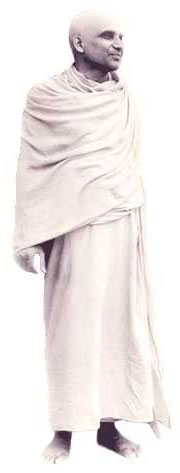
by Swami Krishnananda
Anything that is separable from consciousness is an object of consciousness. Now, this separability may be merely notional; it may not be factual. Whether it is an imaginary concept of difference or a factual distinction that is there, as long as the mind or consciousness cannot accept its unity with that particular context or thing, it remains as an object. In meditation, the consciousness is enabled not by exertion of any force from outside, but by an education introduced into it from within to effloresce into a wider comprehension of facts wherein its notion of objects gets changed and transformed.
It is not that things actually change in meditation, but our idea of objects changes. To give a common example, we have the phenomenon of the difference that we make between dream objects and waking experience. The objects in dream are totally disconnected from the perceiving subject. We are the dreamers and we do not know that we are such, while we are actually dreaming. The question of dream does not arise when we are actually in that condition. It is as good an experience as anything else. The things that we see in dream are disconnected from us and, therefore, we have pleasures and pains in dream, also.
There are all kinds of things in dream as we have in waking life. There are hills and dales, persons and things, experiences that are pleasurable and miserable. All these objects of the dream world causing pleasures or pains are disconnected from that particular degree of consciousness which experiences them; and that is the reason why there is pleasure or pain. Pleasures and pains are caused by reactions set up between the subjective consciousness and its relation to the object concerned. When we wake up from dream, what happens? The objects which we saw in dream, which were the causes of our pleasures and pains, have vanished altogether. Since they have vanished, the pleasures and pains connected with the objects also have gone. Where have these objects gone? Where have they vanished into?
The objects in dream, which caused us pleasures and pains, were notionally distinguishable from the experiencing consciousness, but factually not. This is known by us when we wake up from dream. The tiger that pounced upon us in dream was not really outside us. It was a particular modification of our own mind which concocted a spatial and temporal difference between itself and the content called the tiger, or whatever it is, and the pleasures and pains were due to the space and time difference between the experiencing consciousness and the object. If the dream-space or dream-time were not to be there, we could have no pleasures and pains there. The cessation of pleasures and pains in waking, after the dream, is entirely due to the cessation of the space and time which operated in dream. When the dream-space-time has gone, the dream-objects also have gone. Earlier, we have noted that space-time and objects go together. We also observed the hint from the discoveries of modern physics wherein science has come to the conclusion that objects in the world are indistinguishable from what we call space and time. They are rather configurations of space-time themselves. There are no objects. There is only space-time.
By the dream analogy, we come to the awareness that objects may appear to be outside us and cause us pleasures and pains even though they are really not so. We may have a large fortune in dream and we may feel very happy. We may earn a million dollars in dream by lottery. We may fall from a tree in a dream and break our legs and feel pain. But what are these experiences? They are nothing but the effects of space and time in which we are involved. Our dream-consciousness has got involved in the notion of the difference between itself and the space-time in which it is perceiving the objects.
When we wake up, what happens? The space, time and objects of dream get absorbed into our own minds. A so-called objective world of dream gets assimilated into the mind which is now awake, which contains within itself all the factors that went to constitute the dream experiencer as well as the dream objects. This analogy will give us an idea of what is going to take place in meditation. If we are consciously to wake up from dream, i.e., if we are aware of the very process of getting up from dream into the world of waking experience, if we are going to be aware of the involvement as well as the disentanglement, that would be the series of processes through which we have to pass in yoga meditation.
Instead of getting suddenly stirred up into waking by some phenomenon of which we have no knowledge, as it happens usually, if we are to be aware of every step and every stage of the working of the psyche by which it wakes up from dream, that would be a sort of analogy which can explain the process of meditation. And the comparison is this much: when we wake up, the objects of dream get absorbed into our minds and that is why they do not cause us pleasure and pain and they do not bother us afterwards. Because, they do not exist at all. They are 'we'. The objects of dream, and the space and time of dream have become what we are. The object has become the subject. Hence, there is no pleasure, no pain in connection with the things that we saw in dream. Now, this so-called 'we', which has absorbed into itself the whole of the dream phenomena, should be regarded as inclusive of both the subject and the object of dream; we had reduced ourselves into the dream-experiencer and separated a part of ourselves into the objects in the dream-space-time. And when we wake up, they get withdrawn. This process of withdrawal is like the process of yoga. In yoga, the process is a conscious and deliberate one. It is not an unconscious occurrence or a sudden kick that we receive from somewhere. We are enabling the mind to educate itself into the true situation of things. The world outside us is connected with us in the same way as the objects of dream are connected with the dream-experiencer. The buildings that we see outside, in which we are seated, are all connected with us, even as the dream-room or the dream-buildings are connected with the dream-experience. These analogies can explain themselves.
The connection in dream was inseparable because the things were not really outside. This reference will also explain why meditation should not be considered as an activity or a business that we perform. It is not a job that we are hunting after, so that we may get tired of it. Meditation should become a source of satisfaction and relief from tension rather than a source of exhaustion and fatigue. The more we become ourselves, the more are we free from tension. A tension is an alienation of oneself into something other than oneself. There is an unnatural distinction drawn within the function of our own psyche, a pressure exerted upon it by conditions over which it has no control and which it somehow regards as outside itself.
The withdrawal that we speak of in yoga practice is not a painful activity. It is not to be considered an activity at all. It is the regaining of the health of consciousness from the diseased state in which it is in its individualised state. If we can consider dream as an unfortunate nightmare and not a healthy state of the mind, then this objective world-experience can also not be regarded as a spiritually healthy state. That is why the sage Patanjali regards all perceptions as unnecessary activities of the mind in respect of things with which it should not concern itself. They are vrittis, obstacles to be overcome. In the subjugation of the vritti, or vrittis-nirodha, in yoga, every notion of objects gets transformed into a higher subjectivity. Here we have to underline the word higher subjectivity. It is not the empirical subjectivity we know.
The consciousness of waking is a subjectivity which is higher in dimension than the subjectivity of dream. That is why we are more free in waking than in dream. Otherwise, we would be sorry that we have woken up from sleep. We do not so feel, but are rather relieved that the nightmare has gone, the bugbear is no more, because the waking consciousness is a larger dimension of comprehension than the one in which we were as dream experiencers. So, to withdraw ourselves from objective consciousness into the subjectivity we are speaking of here does not mean an introversion in the sense of the Freudian or the Jungian psychology and psychoanalysis. We hear of extroverts and introverts, a distinction drawn by Jung in his analytical psychology. We are not talking of this kind of introversion.
Many times, people consider yogis as introverts. It is a bad name like the one we give to the dog in order to hang it. The yogis are not introverts in the psychological sense. We may call them introverts in the same sense as we have become introverts now after waking up from dream. It is a metaphysical inwardisation of being. We introvert in this particular sense as the objects of the dream-world go into our subjectivity in waking. But, then, we do not say that we are in a morbid state when we are awake. The psychological introversion is a partial expression of the mind towards itself, bifurcating itself from extrovert activities. Jung advocates a blend of the extrovert and the introvert. Any kind of overemphasis on one side is supposed to bring a psycho-pathological condition. Yoga is far removed from it.
We have great psycho-analytic teachers like Patanjali, but their teaching is quite different. While it is true that meditation in its higher reaches is an attempt at self-withdrawal, it is not a withdrawal into this cocoon of our individual personality. yoga is a healthy remedy that is prescribed for the illness in which the mind finds itself by alienating itself into the false notion of an outsideness of objects, which is not really there. The pratyahara spoken of in the yoga system, the withdrawal of the senses from the objects, does not mean a cutting oneself off from the realities of things. If this wrong idea persists in the mind, one has to be unhappy in meditation. The mind will say, "When will this meditation be over? I shall get up and go for a walk." This, because we feel that going for a walk will be an entry into the reality of things from which we have withdrawn ourselves unnaturally in meditation.
The mind has a notion that, after all, the reality is outside. "I have forcefully severed myself from reality in the meditation hall, so I want to get up from this place as early as possible." This is a sorry state of affairs. Meditation is not a withdrawal from reality, even as waking from dream is not a waking from reality into some unreality. One knows very well that waking is a greater reality than dream, and the subjectivity into which the objective consciousness withdraws itself in meditation is not the individual subject of a Mr. or a Mrs., a Tom, Dick, or Harry. Here what is considered is a larger subject which includes our present idea of a subject in ourselves and the objects outside, in the same way as the dream-subject and the dream-objects get both subsumed in the waking subject. Even when we listen to it and hear that this is going to be the true achievement in meditation, the mind will jump into it as if it is going to enter into a river of nectar. "Oh! It is this! I am going to become a larger being in meditation than what I am today, just now! I will be more vitally connected with all things than I know now!" If the mind is convinced by an educational process, in the yoga sense of the term, it will not open its mouth afterwards.
You will forget your breakfast and lunch and dinner, you will be weeping, "When will I enter into this state?" rather than feel, "When will this meditation cease?" People have a wrong notion about meditation, about yoga, and about God Himself, an erroneous idea about themselves and their relationship with things. Before we enter into any serious attempt at meditation we have to clear our minds of all the cobwebs and the dirt and the rubbish of sentiments and prejudices which have been thrust into us by the social conditions into which we are born and remake ourselves for the purpose of the practice.