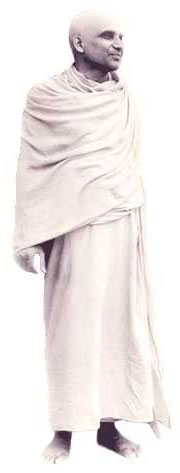
by Swami Krishnananda
The illustration of experience in the state of deep sleep sometimes advanced in the Advaita system as an evidence of the existence of an absolute being, is not without substance. Reversing the Cartesian proposition, "I think, therefore I am", the analogy cited is an adventure in the direction of the conclusion, "I am, therefore I think". Would there be a need to bring a proof that one's own self exists? Obviously, it is not hard for one to realise that proofs proceed from the fundamental experience of there being such a thing as self, and if the self itself were to be an object of doubt, there would be no worth-the-while conclusion in life, which would be free from the defect of the same doubt. If there is anything at all that cannot be doubted, it has to have a base which itself cannot be doubted. All this would be commonplace to any sensible point of view.
Now comes the question, what happened in deep sleep? This is one of the great analyses made in the system of Advaita philosophy. While in the waking state the body seems to be the whole of the reality of oneself, in dream one's existence is proved to be possible without association with the physical body. The point that comes to relief in deep sleep is that one can and one does exist there in a condition wherein even the mind does not operate, and one's existence in the state of sleep is free from association of every kind, physical as well as psychological. It is no great feat of discovery to make much of the psychological difficulty involved in understanding the nature of the memory that remains subsequent to sleep, of one's having existed in the state of sleep. That the physical and the psychological embodiments are not the reality of a person is the essence of the discovery which is made from one's existence in sleep. Whether sleep is a biological condition, or is brought about by this factor or that, is irrelevant for the purpose. We need not go into the details here as to how and why one enters the state of deep sleep. The Upanishad has something to say about it, while the medical man or the psychologist and the scientist may have something else to say from their own points of view. These considerations, however, do not touch the essential point made out in the study of the self in sleep, that it is impossible to set aside the conclusion that the self is basically of the stuff of consciousness. While the experience of joy in sleep is attributed to different factors and can be explained in several ways, it is impossible to believe that there can be satisfaction in a state of unconsciousness. No doubt, sleep is a state of unconsciousness and it should be a contradiction for anyone to believe that such sleep should have any value. Is it not strange that the value of sleep seems to outweigh any other value, even if it is to be considered only as a reminder, though occasional, that man is evidently something other than what he appears to be in his much-adumbrated waking activity?
It is said that the condition of sleep cannot be regarded as an experience because this condition is an 'event' and all events are not experiences. To this it us to be pointed out that it is difficult to understand what an 'event', can be if it is not existent, and what can existence mean if it is not something that is known to exist? Precisely, an experience is the knowledge of existence, it may be the existence of an event, a condition, a situation, a thing, or whatever it be. Then, why should not sleep be an experience, if it is an event? Further, the argument that in order to call an event an experience, it must be an event of which someone is the subject, does not in any way affect the issue on hand; for, how could sleep be an experience or an event if it is not an experience to someone or an event occurring in respect of someone or something? In fact, what exists, or, precisely, is, in the state of sleep is the pure subject alone. In sleep there is an indication of subjectivity, free from traces of all objectivity, if only we are not to consider the state of unconsciousness as an object counterposed before a subject. The definition of consciousness has also to be made a little clear. Consciousness cannot be considered as something happening to someone, whether it is noticed or not. Philosophically, the term 'consciousness', when it is applied to describe the pure metaphysical subject, is to be understood as denoting something more than even what is usually called self-consciousness. It is the basic presupposition of any meaning whatsoever. Hence, such a subliminal base of the very meaning of anything, the primary being or existence of whatever can be regarded as meaningful, has to be something not only not associated to any other primary being which may be its subject, but should be not even a state of self-consciousness in the sense of one being one's own object of awareness. It is pure universality, consciousness as such, which cannot be distinguished from being as such. Thus, consciousness need not mean noticing, seeing or any kind of happening to anyone. This latter empirical characterisation of consciousness may have the utilitarian value of a grammatical subject, or sensorily conditioned individuality localised in space and time. But consciousness has to supersede space and time, since the former knows the latter as its content. The suggested pure subject indicated by the experience of sleep is not an ego, which latter is a self-conscious, localised, embodied something, but a general state of reality which encompasses all that can be anywhere or at any time. The subject indicated in sleep is not the enjoying or suffering subject, for it is prior to every psychological condition, since, here again, psychological experiences are its contents.
Experience is not 'doing something', for the fact of doing anything would be the object of a consciousness prior to it. Thus, we find that consciousness cannot be associated with anything other than itself, neither an event nor a thing. The Advaita argument of the presence of bliss in the state of deep sleep, as evidenced by a subsequent memory thereof, cannot be just brushed aside as totally irrelevant. There is certainly a great point which the Advaita makes out here. It is logically impossible to conceive of memory or remembrance except as a conscious recollection of a previous experience. Since experience cannot be dissociated from a consciousness of it, the conclusion that consciousness is not absent in the state of sleep cannot also be ruled out. As regards the experience of happiness in sleep, it is up to anyone to prove it or disprove it. An intense subjectivity to which consciousness is driven in sleep should be considered as the explanation for the happiness mentioned. The nearer one moves to oneself, the truer one is, and, hence, freer; and, is not freedom a state of happiness? It is entanglement in objectivity that distracts the attention of consciousness by making it appear as something other than its own self, which may safely be called a sort of metaphysical schizophrenia. The utter subjectivity which everyone craves for as an emblem of total freedom is demonstrated by man in the process of history. No one would like to be other than oneself, or involved in what one is not. Such empirical involvements are not present in sleep, and though this not-being-present is a kind of negative freedom and an entry into pure subjectivity through the back door (this, incidentally, differentiates sleep from Samadhi, or universal consciousness), there is no doubt that this apparent negativity becomes at least a suggestion of the possibility of positive subjectivity, even as the reflection of an object, which may be said to be the negative presentation of the object, indicates the nature of that object itself. In studies of this type, one may have to be dispassionate and honest, as far as one's own feelings arid experiences are concerned, and not allow an empirical logic to interfere with its validity, for, as we have noted, logic is not a permanent friend of the very source of logicality. We need not identify this source entirely with the Transcendental Unity of apperception of Immanuel Kant, but here is certainly its elder brother, as it were, and the presence of it none can deny without denying the denier's existence itself. In a way, the true self is reflected in spatio-temporal involvement in the state of waking and, evidently, philosophers are right when they opine that the world is a dream, if it is true that all spatial and temporal experience is a shadow cast through the screen of objectivity by that which is the archetype transcending the space-time network. Plato's analogy of the cave is profound and pertinent, and it is a happy augury that in a more explicit manner this truth is coming to light through the discoveries of modern physics, into whose findings we need not enter here.