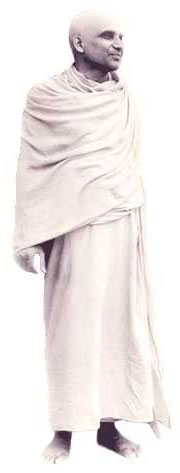
by Swami Krishnananda
Yet it seems to be impossible to fulfil them. Our difficulties are many a time of a very silly character. To properly react to these simple situations of life is the test of yoga. If we want to know the inner stuff of a person, we have to watch his daily, small works and not just the big things that he does. He may be wonderful in the big public things, but if we watch him in the small things he does—like taking a bath, eating lunch, speaking to a person—these may all seem unconnected to his spiritual life. We can know a person and also know ourselves more from these things than from the university degrees that we have or the offices we hold. We can slip when it comes to the small things, while we may be very cautious as regards the bigger things.
Maya, if at all there is any such thing, tempts us and catches us in the small things. The devil catches us only in the smallest of things and not the big things. He knows that we will be very cautious in the big things. The enemy comes from the back—but never from the front—because he knows that with the things right in front of us we will be cautious. Why not then come from the back? This is how maya, avidya (ignorance), ajnana (lack of knowledge), nescience and the world work. Whatever we may call them, it makes no difference, because our problems are of a uniform character. We have to be cautious in our immediate circumstances, and not just in the more rarefied relationships.
We may not know what is just under our own skins pricking us from within, while we may be very careful to see what is far, far beyond. With a telescope we may be seeing what is happening on Mars, but we may not know what is happening next door. Yoga tells us that these oversights may be our doom, and therefore we must be wise in these immediacies of life. God is an immediacy and everything of true importance is also an immediacy. That which will help us is very near, and that which will trouble us is also very near. Our friends are not coming to us from thousand of miles away, nor are our enemies coming from such a distance. Our troubles and our solace are all immediately near us. Our ‘friends’ will speak to us from within, and our ‘enemies’ also may speak to us from within. “I am here,” both will say.
The student of yoga should be concerned with the larger philosophical aspects. However, while these issues have their own importance, there are other things which are also important, and which we are likely to neglect. I am going on repeating all these things, because I have tried to explain why we are unhappy in the world. Our unhappiness is not due to our religious attitude or because we lack education. Perhaps we are all well-educated, but despite that, we can be unhappy due to small maladjustments in the personality. For instance, we may not be able even to speak to a person without hurting their feelings. There are some people who are like that. It is impossible for them to meet with other people without causing some sort of negative response to be elicited. They may not be deliberately doing that, but it is almost second nature to them, and they always say the wrong thing at the wrong time. They shouldn’t speak things which are not necessary or things which are harmful, or conduct themselves in an anti-social or unsociable manner, but yet they do it time and again. Why should this be? These are some of the smaller difficulties in life which have not been dealt with properly, and which have much to do with yoga. We will be surprised that these things have something to do with yoga. I have said, God is nearest to us, and God will see what is nearest, because He is nearest. He is an immediacy. God is also called the ‘Atman,’ and this is a very significant word.
The word implies that God is not far away. When we say God is the Atman, we mean that God is our Self. We can understand what the Self can be. What can be nearer to us than the Self? When God is the Atman, it means God is nearest to us, and therefore the Real can manifest itself in what is immediately here and near to us. All reactions are immediate. Perhaps I’m saying something new today. All the while we might have been under the impression that the world is big, the cosmos is so immense, creation is so wondrous and God is Absolute. That is so, but today I am trying to point out another thing, namely, that they are also something quite unimaginable, and that they can be in a place, a condition or a situation that is so very immediate to us—more immediate than we could even dream. God is not merely Ishwara, but He also is the Atman. When we say He is Ishwara, we speak of Him as the universal Creator—very big and awe-inspiring. When we say He is the Atman, He is very immediate. He is internal even to our own hearts. Nearer to us than our own breath is that Reality.
We have to learn in our study of yoga that the whole world can set up reactions—inside rather than just outside. We should not expect reactions always from the outside. While reactions can take place from outside, because God is also in a certain sense outside, He is also inside. He can set up reactions from another corner altogether. Whatever is outside is also inside, says the Chhandogya Upanishad. The text says in a very beautiful language that just as there are thunder and lightning, sun, moon and stars outside, these things are also inside. Everything outside in the universe has a counter-correlative in one’s own personality.
Therefore, our caution about the world outside is not enough. This is the wisdom of yoga, which is for us also the wisdom of life. This is why we are often told, “Know thyself and be free.” It is difficult to know this truth. We may know many things of the world, but not this simple thing, because the most difficult things of the world are the simple things. The complex things can be analysed, but indivisible, unitary and simple elements cannot be resolved further. The most indivisible and unitary element is our own Self, and everything is connected with it. This fact is very subtle and easy to forget, and it eludes our grasp, but this is the significance of the path of yoga. Yoga is external as well as internal. It is a macrocosmic as well as microcosmic approach, and our vigilance must therefore be twofold. Yoga is both a father and a mother in showing affection to us, but it is also like a double-edged sword which can cut both ways. Such is this wondrous and difficult path of yoga. I am confident that most can find access to its subtleties. There is absolutely no doubt that these ideas which have been implanted in our minds are going to help us in our practical lives. What is the use of anything, if it is not going to help us in our lives? Everything must also be helpful in relation to our day-to-day lives, and this knowledge is going to help us in our day-to-day lives.
It is going to make us a full human being—a human being in the sense of a happy being. This happiness will be a part of our nature. We will be radiating joy, and all the apparent reactions of the world around us will cease. In the beginning though, there will be opposition from inside as well as outside. Persons, things and conditions may terrify us many a time—outwardly as well as inwardly. The first thing that we get when we churn the ocean is vinegar and not nectar. In the Puranas there is the story of the churning of the ocean. The gods and the demons churned the ocean for nectar, but what they got in the beginning was not nectar but poison. The poison choked their throats, but then later no doubt nectar came. In the beginning though, what came was not nectar, so we shouldn’t expect nectar to come in the beginning in our practice. What we will get instead are disturbances, reactions and unpleasantness of various types, but we have to bear up to them.
All this is not merely a story of the churning of the ocean in the Puranas; it is also an analogy for the lives of all the saints and sages who tread this path. We will know this if we read the lives of saints—the most outstanding being the life of Buddha himself. We see what life he lived, what reactions he had to face, and what difficulties he had on the path. Many people would be intimidated by these problems, and they wouldn’t be willing to go through them. Fortunately for us we have the lives of these great people to encourage us, so that we will not be deterred by the initial obstacles.
When homeopathic medicines begin to act, they sometimes aggravate the illness which we are trying to cure. It looks as if we had become worse, but soon thereafter the illness ceases completely. Perhaps, all human processes and all things in the world follow this rule of aggravating first and then dying out completely. There is a particular section of the eleventh chapter of the Srimad Bhagavad Gita where everything seems to be ‘at sixes and sevens’—all confusion and disorder where nothing at all is clear. The eleventh chapter of the Gita is precisely the situation of the initial step in yoga. Everything will be hard in the beginning. We won’t know what this is or what that is, which is exactly the situation in which Arjuna found himself in the eleventh chapter. In the beginning we will have adverse reactions, which come because of an interference with the system of living to which the mind has long been accustomed. There seems to be a sudden upset of forces from all sides which may terrify us, because the mind is now being introduced to a new method of thinking to which it has not yet been initiated. The mind will not agree, and it can easily turn away from the path. The mind sets up reactions, and when the mind sets up reactions, it looks as if the world also is up against us. When we take the initial step in yoga, there will be a feeling of being lost. All this will happen to us only if we practise—not merely when we read or talk about it. When we really start contemplating, meditating and seriously taking to yoga, then it is that these experiences come to us.
One need not be afraid of these things. While these poisonous vapours may try to suffocate the efforts in yoga, later we will have a flood of nectar flowing towards us, as was the case in the story in the Puranas. What is this story? It is nothing but the spiritual evolutionary process described in images and symbols. The path of yoga is both difficult and also wonderful. It is the path to God. While God is most compassionate and loving, He is also a hard taskmaster. God is both of these. He is a loving mother and also a very critical father. He can punish us and also save us. The path of yoga, being the path to God, is of a similar character. These are the watchwords that I have offered as a kind of guidance in our day-to-day lives, which again I want to emphasise, should become a part of our nature and a part of our being. Yoga should be our own selves. We are yoga, ultimately. We are not to practise it as something outside us. To live yoga is to live a godly life, and it is to bring God into our own lives. Yoga means to be happy even in adverse situations. It is difficult indeed, but success will come, and it has to come, if we have honestly heeded the call. May God bless you all. Hari Om Tat Sat.