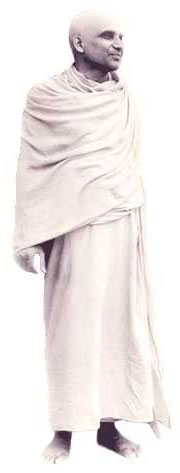
by Swami Krishnananda
The setup of things is nothing but a particular stage of the evolution of the world; and we are a part of the world. Therefore, at any given level or stage of evolution, we are obliged to follow the law or rule of that particular stage of evolution. Yesterday, I was speaking to a friend and mentioning this point that when we go to Rome, we should be Romans. It is an old saying, which means to say that we cannot apply the law of a realm to which we do not really belong and in which we are not placed. When we are in the physical level, the physical laws apply to us. When we are in the social level, the social laws apply to us. When we are in the psychological level, the psychological laws apply to us. When we are in the spiritual level, the spiritual laws apply. But we cannot apply the law of one realm to another realm while we are not placed harmoniously in that realm; otherwise, there will be misplacement of values, and chaos will take place.
In the basic principles of Indian culture especially, this necessity to adjust oneself with a particular level of life is insisted upon. We use the famous complex term known as dharma, artha, kama, moksha. Material values, economic values, vital values, ethical values and spiritual values are all important. We cannot say, “I am a lover of God, and I care a hoot for this world of matter.” Such talk and such feeling are misplaced. There are misplaced religionists and enthusiastic seekers who do not understand themselves properly and say, “I care only for God, and not for man and the world.” There are other people who say, “I don’t care for God. I care only for man and the world.” Both these are on the wrong path because the God that we are seeking is not a God outside the world; and the world which we are seeing and the people in whose midst we are staying are not outside God. Neither are people and the world outside God, nor is God outside the world and people. It is so easy to make this simple mistake of bifurcating the visible from the invisible and vice versa.
Desires, passions, anger, greed, etc. are erroneous movements of the mind. The reason behind them is having a misplaced emphasis on certain aspects of life, while ignoring other aspects that are equally important. We do not know where we stand. We have a wrong assessment of our own knowledge, power, capacity, etc.
If, in a war, the general of the army has no proper understanding of the power of his own men and no comparative knowledge of the power of his enemy, there is a great doubt whether he will win victory in the war. It is no use simply going ahead into the battlefield. “I shall win victory in the war.” Merely because we are rushing into the battlefield, it does not mean that we will win victory. We must take into consideration many, many aspects of the battle into which we are entering: firstly, our own powers, our own associates, our equipment, etc., and the corresponding powers of the opposite side. We are facing the whole world in our spiritual attempts. Whose power is greater, the world’s power or our power? If we have even the slightest feeling that the world is more powerful than us, and we cannot face it, then our duty would be to rise to the level of the world and then face it, rather than go headlong and then get defeated, which is not a virtue.
Many seekers of truth fail. All sadhakas are basically good, but they are not always very wise. A good person need not be a wise person, and may make mistakes in spite of his goodness. So, though the intention is pious and the heart is good and pure, the intelligence is lacking, and so he receives a kickback from the world. The result is a frustration of feeling, a reversion to the original mode of living, a sense of hopelessness of all pursuits, and coming to a conclusion that perhaps nothing is worthwhile and no good is going to come out from this attempt. There is nothing wrong with the attempt, but we have wrongly manifested that attempt. Viveka, or understanding, is supposed to be the first prerequisite of spiritual pursuits.
Again, I come to the point of a Guru. Who can have understanding in this world? Who can have such wisdom? We are all muddle-headed people, confused and confounded. We get irritated, upset, and disturbed by sights, sounds and events that take place around us. Even if something happens in America, we can be disturbed here though we are not concerned with it, because of a peculiar psychological feeling that arises in us – again, by misplaced values. Understanding of a pure nature, with all the pros and cons duly considered, and consequences also duly weighed, is very essential: “If I do this thing or take such a particular step, what will be the consequence?”
There are some people who think: “I will go to the forest and meditate from tomorrow onwards. I don’t want to see anybody’s face. I will search for God in the jungle.” Very good idea! Nobody can say it is wrong. But what are the consequences? If tomorrow we go and sit in the jungle, what consequence follows? Will God come tomorrow? Immediately? Well, God may come or God may not come. If He comes, it will be for a reason. If He doesn’t come, it will also be for a reason. That reason should be clear before us.
Wholehearted devotion to God is unthinkable. Nobody’s heart can be wholly turned to God, though we may sometimes think that it is so. Again we are making the mistake of not taking into consideration our subconscious mind. Consciously, we may be thinking of God wholly, perhaps. Just now, who is thinking of anything but God? But yet, it is not true that your entire personality is steeped in God even now, notwithstanding the fact that you are hearing about God and thinking about him consciously, because your personality is not merely the conscious level. Psychologists tell us that our conscious personality is the smallest part of our personality. The larger parts are buried deep. So, unless and until the larger part which is deeper, subconscious or unconscious, or whatever we may call it, is also brought to the conscious level, which is the work of psychoanalysis – unless that is brought up and made a part of our conscious activity, our whole personality cannot be said to be involved in any activity. None of our activities is connected with the whole of our being.
Always only a partial aspect of our being works in any one of our activities. The whole of us never goes into action. Very rarely do we act wholly. But unless the whole thing comes out, the Whole Thing will not come to us. God is the Whole, and we are asking for the Whole, and so the whole of us must go there. It is the whole asking for the Whole, and not only a fragment of our being.
When we mistake a fragment for the whole, passions arise in our minds. In the eighteenth chapter of the Bhagavadgita, Bhagavan Sri Krishna says that the lowest kind of knowledge is that which regards a finite as the Infinite; it mistakes one thing for everything. That is called attachment. When we think that one thing is everything, that is called attachment; and that intensified becomes passion, that obstructed becomes anger, and that defeated becomes frustration. All things follow from this basic mistake of regarding one thing as everything.
For a miser, money is everything. But money is only one thing. Then how does he regard one thing as everything? Very strange! Fame or power is also one thing, but there are people who regard it as everything. That is a mistake. There are many other objects in the world which can attract our attention wholly, as if they are all things, but they are not all things. So kama krodha lobha – intense desire or passion, anger, greed, etc. – follow from the basic mistake of regarding one thing as everything. It is mentioned precisely in a very short form in the eighteenth chapter of the Bhagavadgita. Sri Krishna says that this is the grossest, lowest and worst form of knowledge, where one regards one thing as everything and clings to it. This is called attachment.
A higher form of knowledge is where we do not regard one thing as everything, but we regard other things as equally important as this thing; and one thing is also related to every other thing. Everything is equally good. One thing is connected with other things. One becomes a more expanded social personality.
But the highest kind of knowledge is that which does not even relate one thing with another thing, but regards existence as an Indivisible Being. Here there is no question of relating one thing with another thing, because such things do not exist.
Thus, the lowest knowledge is finitude of consciousness, clinging to only one thing as if it is all things. The higher knowledge is a relativity of things, where we bring all things into consideration in our thoughts, actions and feelings, but yet the multiplicity consciousness persists; we regard one thing as different from another thing. The highest knowledge is the indivisibility of consciousness, where it has no need to move at all for any purpose; everything that it needs is here and now.
Thus, what I told you today is a sort of commentary on what I said yesterday, which again would emphasise the difficulty of following the spiritual path. Rare indeed is the person who can contain this idea in the mind, maintain it for a long time, make it a part of his or her personality, and live according to this idea. Very difficult! He is a wonder indeed!
The Upanishads as well as the Bhagavadgita tell that all this is a miracle. That we can hear such things is a miracle; that we can appreciate such things is a miracle; that we will be able to stick to this principle is a miracle; that we will be able to practice it is a greater miracle: Ashcharyavat pashyati kashchid enam ashcharyavad vadati tathaiva chanyah, ashcharyavac chainam anyah shrinoti shrutvapyenam veda na chaiva kashchit (Gita 2.29). But He has given a last warning. With all this hearing, finally, we will find it is difficult – very, very difficult. It won’t enter the head. “I understood, but it is not going deep.”
Why is it not going deep? It is because proper effort is not made. We have to brood upon it every day. Our understanding has to sink into feeling. Our difficulty is that feelings are going one way, and our understanding is going another way. We understand everything, but we cannot feel it. Our feelings are moving in another direction altogether. Meditation is the act of fusing the understanding with feeling, of getting the understanding absorbed into the feeling. The union of the understanding with feeling is called intuition.