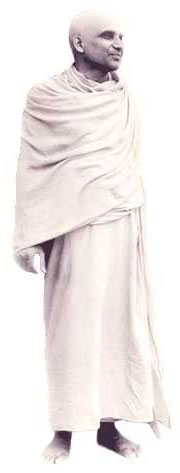
Swamiji on Facebook Swamiji on Twitter Swamiji on Youtube

True Spiritual Living

by Swami Krishnananda

Chapter 4: Withdrawing from Objects of Sense (Continued)

So, what does the individual do now, in this state of fall?  “I shall create an artificial universality in order that I may get happiness, though it is artificial.” All our happiness in this world is artificial, not real. Therefore, even when we are happy, we are subtly sorrowing. We are smiling outside and grieving inside; this is our life. When I can laugh outside, I can also weep inside. This is man, this is woman, this is everybody. We are all laughing outside and weeping inside – everyone, without exception. But even when we weep inside, we want to laugh outside because mere weeping is not possible. It is very difficult to get on with mere weeping. So let there be little laughing – outside, at least. This is our life in this world.

But how can we laugh when we are actually weeping? We create this laughing by projecting ourselves sensorily into a condition of counterfeit universality, which is called love of objects and attachment to things. When I am attached to a particular object, I am a little happy. Otherwise, why do we get attached? Why do we love an object, unless it brings us joy? But how does it bring us joy? Why is it that love for an object brings us joy? Do you know the reason?

It is because we have artificially expanded our individuality into a little touch of Universality. When we exceed the bodily limitation, even by an inch, we are touching the border of the Universal. The Universal is very large; we have not gone so far, but at least we have gone one millimetre length outside the body. We have exceeded the limitation of our body by loving something outside the body; and that little gaze of the Universal, a little peep of it, a little touch, a little hint, the slightest indication that we are prepared to go out of our body and exceed the limitation of our body, even if it be by love of something which is there outside – that gives us joy. That is why love of objects gives us happiness. Why does it give us happiness? Because of an apparent reflection of the Universal. “Why is it called ‘the Universal’?” you may ask me. “How is it the Universal?”

I have already given the definition of the Universal. The Universal does not necessarily mean the Supreme or the Absolute Universal. Even a tendency towards it can be regarded as a universal, just as a student studying in the third standard is called a student undergoing education, the same as an Oxford post-graduate. Whatever be the class in which we are reading, we are regarded as undergoing education. Likewise, we are moving towards the Universal even if we have taken only half a step, or even less than that. Badrinath is 160 miles from here, but even if we take one step in that direction, it is a movement towards Badrinath. Badri is so far, but we have taken a step towards it. We have moved only two inches, but yet we are happy. “I am moving towards Badri. That is my destination.” Likewise, the consciousness feels joy. “I am moving towards the Universal, though I have clung only to one object which I regard as dear and near and lovable.”

Now, while there is some meaning in this, there is also an absurdity in it. Because of the meaning in it, we are happy; because of the absurdity in it, we are bound by it. What is the meaning behind it which gives us the joy? The meaning is the movement of consciousness towards the Universal, because it is the indication of consciousness that it is exceeding the limitation of the body. Therefore, we are happy. But what is the absurdity in it? What is wrong about it? We are not really moving towards the Universal.

What is the difference between +1 and -1? Both are 1. +10 and -ten – are they identical? Both are 10. I have +100 rupees, or -100 rupees; are both identical? I have -100 rupees with me, or someone has +100 rupees – can we say both are equal, on a par, because both include the word ‘hundred’? The -100 is so far away from +100; we know it very well.

Likewise, this universality that we are trying to achieve by contact with objects is a movement in the minus direction, not in the plus direction. Therefore, we are entirely wrong, and we are going to be caught and punished for it one day or the other. The minus looks like a plus merely because the word as a counterpart – the ‘hundred’ – is mentioned. When I say ‘minus one hundred’, at least I utter the word ‘hundred’. But we forget that there is a ‘minus’ also with it. Hundred – wonderful! But it is minus, don’t forget!

Likewise, this universality that we wrongly try to achieve by sensory contact with objects is a blunder – and a very terrible blunder. But the soul has no other alternative: “I have fallen. Let me be happy. I will rule in hell. Here I am, ruling hell.” We are happy somehow or other, and this is the happiness that we have. This is the mistake that consciousness has made – a blunder worse than entering into the body – by moving out of the body into the objects of sense, establishing relationships with things, and complicating these relationships by scientific logic which is created by the senses themselves for their own satisfaction. Even the devil has a logic of its own.

Yoga is the process of awakening consciousness to its true aim, true purpose, and so this sort of universality will not do. This sort of happiness is no happiness. This so-called satisfaction, so-called freedom, this apparent independence that we seem to have in this world is no independence, no joy, no freedom, nothing! It is a terrible deception. Yoga is the very, very difficult art of bringing the consciousness back from this meandering through the objects of sense, bringing it back to the body once again – from where it has gone out through space and time into the objects.

Even if it is brought back to the body, it is not a complete achievement, because that is also a fall. Though we have not gained health, at least we are free from disease for the time being. The temperature has come to normal; it is not 105. It is coming to 98.4, but yet we are in bed. We cannot get up, we cannot go out. We are not healthy, not normal really – though clinically it appears that we are normal because the temperature has come to 98.4. This is what we are trying to do by abstraction of senses from objects by the practice of yama niyama, as the great sage Patanjali puts it. By the practice of yama especially, we bring the temperature to normal, 98.4; otherwise, it is 105. It is terrible! Now we have a 105 temperature – we are in fever, completely out of order – because we are thinking everything ‘outside’. All that we think is external. So we are in a state of fever, completely gone out of gear.

The practice of the yamas and niyamas brings the mind back to the source from where it has gone out, and after it is brought back to the source of individuality, the system of yoga tells us it has to be roused up to its original condition by asana, pranayama, pratyahara, dharana, dhyana, etc. So while yama and niyama are the processes by which we withdraw our externalised movements into the source from where these movements started, by the other practices of asana, pranayama, pratyahara, dharana, dhyana, etc., we rise up – vertically, as it were – to the Absolute, gradually. It is a very difficult process of yoga – from the bodily encasement, we rise up stage by stage. In the system of Patanjali, especially, all these stages are very beautifully described.

Even when we come to the state of perfect concentration of mind on the ideal of the Universal which is to be attained, from where we have fallen, the attainment is not complete. Patanjali tells us that even after the dhyana state is attained, there are various stages – savitarka, nirvitarka, savichara, nirvichara, sananda, sasmita, and so on. Even in samadhi there are so many stages. All this is terrifying even to hear.

Thus, the system of yoga is a wonderful art of regaining spiritual health, returning to our Supreme Father, from where we have fallen by a mistake, abstracting ourselves from the externalised consciousness of space, time and objects – leave alone attachment to objects – coming back to our own source, and entering into the consciousness of the Virat. Then what will happen to us? God only knows; we need not bother about it. Such is the Great Whole before us. This is the destination of the journey of the soul on earth.