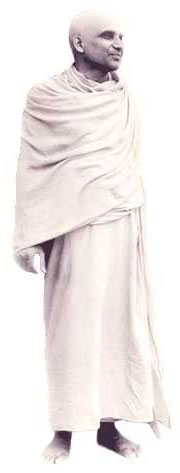
by Swami Krishnananda
Psychological non-attachment is a difficult thing, because while social pressure and social law and regulations can prevent physical contacts with unwanted centres or objects, nobody can prevent our mind from thinking; and our thoughts are our personality. What constitutes our strength or weakness is the way in which we think. The physical conditions are not our strengths, and also they are not our weaknesses. What is in our mind, that is what we really are; that is our strength, and that is also our weakness.
It is, therefore, very futile on the part of anyone to think that one can lead a life of internal attachment while there can be an outward detachment. Bhagavan Sri Krishna warns us against this in the third chapter of the Gita. While all our physical organs may be detached from objects of sense, the internal senses may be in contact with the objects, setting up a reactionary force with a more violent contact with objects than we would have entered into merely by physical contact.
Psychological contact is worse than physical contact because the mind shakes up the entire personality and churns the bloodstream of our body. Bhishma speaks to Yudhishthira in the Santiparva of the Mahabharata, wherein he says that the moment the mind thinks of a sensual object, the entire bloodstream is affected – a thing that we are unaware of. It is similar to the way milk curdles by a touch of acid; there is a breaking up of the indivisibility of the milk. The strength of the milk goes, and it is no longer milk at all. It becomes curd. It is spoiled, and it cannot be converted back into milk. So also, an intense thought of a sensual object is like acid poured into the bloodstream of our body. It breaks up the indivisibility and the health of the blood, and the energy of the blood is isolated from the blood like butter coming out of milk due to curdling. The vitality of our system is isolated from the bloodstream, and this vitality that is so cut off from the blood is forcefully diverted or directed towards the object which the mind has been craving. We know what happens when vitality is diverted to an object. We become weak mentally and physically; and even as curd cannot be converted into milk, so also the energy that is lost is lost forever.
It is no use, therefore, thinking that thought of sense objects is harmless, says the Upanishads. Poison is not poison; the thought of sense objects is poison. Why? Snake poison can destroy only one life, but the poison of sense contact or sense thought can destroy several lives. It can cause repeated births through the cycle of metempsychosis.
All these have to be brought into the mind in seclusion, and the causes of attachments should be discovered. A thorough diagnosis of the case has to be made. The causes of attachments are misconceptions that we have in regard to things of the world. We have a wrong notion about things, and therefore we are attached to them. We do not understand things properly; therefore, we are made to cling to objects.
There are many things that can attract us – hundreds and thousands of things and conditions – but as far as spiritual practice is concerned, one has to be very, very cautious about three important prongs of human desire, which are the subjects of study in psychology and psychoanalysis, and are also mentioned in the Upanishads as the eshanas. Vitteshana, putreshana and lokeshana are the terms used in the Upanishads. Interestingly enough, hese subjects are studied by Western psychoanalysts Freud, Adler and Jung. These are our weaknesses. These are the weak spots in human nature, and the moment these weak spots are touched, the personality comes out like a hissing snake. These weak spots are always covered by us with great care, and we put on an artificial personality which is itself a kind of disease, on account of which we are never happy at any moment of our life.
We have what we call a sense of self-respect, which is inseparable from our individual being. We have a sense of importance. This is lokeshana, or love of good name and fame, and it materialises itself into power later on when it gets intensified. Even an idiot has a sense of self-respect. This is the precise character of the ego. It is an attachment to the body that we regard as self-respect. What is our importance? If we analyse ourselves carefully and remove the fibres of our being individually, we will find that there is nothing inside us which can be considered of real importance. Whatever is of importance in us has come from somewhere else. The great words of Sri Swami Vivekananda come to my mind. In a lecture he said, “If there is anything worthy in me, it belongs to Sri Ramakrishna. If there is anything wrong, that is mine.” Well, this is a tremendous attitude of humility and wisdom, which is unknown to us.
Really speaking, an individual personality has no importance of its own. The importance that it assumes, or that it appears to have, comes from the element of universality that is inherent in it. This is not known to anyone. It cannot be known because the ego repels a consciousness of the presence of even that element of the Universal in itself. We resent the Universal so intensely that we would not even like to think about it, because even to allow a thought of it is to reduce the importance of the ego, which is very painful to us. We are important, and sometimes it looks that our importance is not recognised or known to people. Then we try to publicise it by various means, and the ego knows the ways by which it can announce itself or advertise its importance.
To free oneself from this evil of false self-respect, which has really no substance in it, masters of yoga, teachers of spiritual life, tell us that we should live under conditions of humility. We should live a very, very simple life so that the ego may not swell up unnecessarily. When sitting in an audience, we should occupy the last seat, not the front seat. We may even sit near the shoes. Even if we are geniuses, it makes no difference.
I was reminded of the goodness of the late Dr. K. S. Krishnan, formerly the director of the National Physical Laboratories in New Delhi. He was a very famous man, a great personality in the field of science in India, perhaps even in the international field. He came here once with some other friends, looking very simple, wearing a dhoti. Swami Sivanandaji Maharaj had asked people to place a chair for him in satsang. One of the brahmacharis was sweeping and putting a dhari, and he put a chair there saying, “This is for Dr. Krishnan.” By chance, Dr. Krishnan happened to come there, and nobody knew that he was Dr. Krishnan. By some freak, he came and sat on that chair, and immediately the brahmachari said, “Ay! This is for Dr. Krishnan. You should not sit here.”
“Oh I see. Sorry!” he said. He got up and sat down on the floor.
Then Swami Sivanadaji Maharaj came, and said, “Hey, you are sitting on the floor! Sit on the chair.”
“No, it’s all right,” he said.
“No! No!” He pulled him up and made him sit on the chair, and then all looked up. This is the same man! The brahmachari felt so ashamed. Anyone else would have given a retort or shown a sign of resentment, but he did not though he was an important personality, really speaking.
The greatness of a person does not depend upon outward publicity or even recognition by others. One’s greatness is a self-sufficient qualification which is self-existent and can shine by itself, like the sun in the sky. It is absence of real importance that makes us feel that we are small, and it gets annoyed when it is not recognised. The more is our vidya, the more also is our vinaya. The greater is our knowledge and wisdom, the deeper is our sense of humility. The bigger we become inwardly, the smaller we look outside in the eyes of people, so that when we are the largest inside, we may look almost nothing to the public eye. This is very important to remember. The characteristics of a true spiritual life are the other side of ego-centricity of any kind. Lokeshana – love of name, fame and power, and self-affirmation of any kind is contrary to true spiritual aspiration. The complex of superiority, which is really not there, is a bane on human nature. This has to be avoided.
There are other features which are our weaknesses, which we have to look into later on.