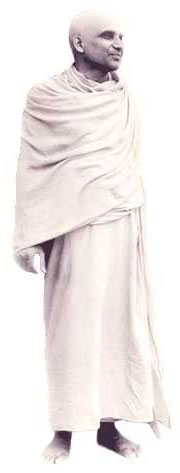
by Swami Krishnananda
We should sit erect. If we sit in a crouched position like a hunchback, or if there is any kind of distortion of the body, we will also have a kind of distorted feeling in our mind; we will feel a sense of uneasiness. The purpose of this physical posture is to enable us to gradually forget that we have a body. The consciousness that we have a body increases by the pain that is felt in the body, or any kind of illness that is in the body. A very healthy person does not know that he or she has a body. It is only a sick person who always feels that there is a body. A jubilant, healthy body will not be conscious of itself. That is the sign of good health. In yoga, the purpose is to ultimately rouse the consciousness out of attachment to the body for a different aim altogether. Now the consciousness is tied to the body. It is tied in such a vehement, impetuous way that it is almost unthinkable how we can extricate it out of the body. The consciousness or the mind has become one with the body. It is the body for all practical purposes. We and the body are one. We are the body; this is what has happened to us.
This is a very unfortunate state of affairs. We have regarded our body itself as ourselves, as there is nothing else that we can think of as being ourselves. It is very difficult to loosen the contact of consciousness with the body. It is a herculean task. No one should think that it is so simple a matter as one can imagine. It is like peeling the skin off our body. Who would like to peel the skin? It is horrible. But this is exactly what will happen. When we try to extricate our mind or consciousness from the body, even a little, we will feel a shock. We will feel a creeping sensation like ants crawling through our nerves, and there is a tremor, perspiration, and some such awkward sensations. We will feel this even when we are merely sitting for a long time without any concentration, without thinking anything in the mind. Try this and see what happens. For one hour, continuously, sit in one erect posture without even thinking anything. Do not meditate, do not do japa only sit. You will find a creeping sensation, a subtle feeling inside, as if some sort of wavy motion is going on inside the nervous system. That is the sensation created by the movement of the pranas. The purpose is very clear; there is no need to expatiate upon this point.
So, be seated in one posture. It is advised by teachers of yoga that we must face the east or the north, because of the magnetic influences of these directions. The sunrise is the cause of a magnetic force in the eastern direction, and the North Pole is supposed to be the centre of magnetic force which runs from north to south. Hence, these two directions are regarded as very helpful in generating psychic electricity within us in the act of meditation or concentration. Face the east, or the north; be seated in one posture with the head, neck and spine erect. Keeping the head, neck and spine erect is difficult in the beginning; you will feel pain in the spine. So, in the earliest of stages, you may have a backrest. Use a cushion, or sit near a wall which is perpendicular to the ground. That will help in the beginning to keep erect. Whatever is helpful to us in this practice, we can resort to.
Now, having seated ourselves in this posture comfortably, what follows? What are we going to do by sitting like this? Here starts the real investigative activity, which is the beginning of yoga. Our mind starts working, and it starts working in a very comprehensive manner.
Many have suggested that before we actually start thinking on any particular issue of yoga, it is better that we take a deep breath. Many types of pranayama are prescribed, but we need not go into all these details, because they have one purpose ultimately to harmonise the flow of the breath. Just as all the asanas, or the physical exercises hatha yoga prescribes, have one purpose ultimately to keep the body in a perfect position, a single chosen position the purpose of the different breathing exercises is also to finally systematise the process of breathing, instead of breathing heavily as we do when we are running or exhausted, etc. The more we are composed, the slower is the process of our breathing. It is only in a disturbed condition that we heave heavy breath either when we are in ecstatic joy, or in great grief. So, when we are seated in a posture, the best thing would be to take a very slow, deep breath, and exhale slowly as slowly as possible. This, continued for a few minutes, coupled with Om chanting in a sonorous, mild tone, will prepare the mind for its further work.
But we can neither take a deep breath very slowly, nor chant Om with peace, if our mind is disturbed for any reason. This is another essential factor. If we are agitated for some reason or the other, we should not sit for meditation; that is not the time for sitting. Every one of us has an occasion or several occasions to get disturbed in mind. Something happens either within us or outside us which puts us out of gear, and we are not happy. We are morose and moody, and do not know what to do. At that time, there is no use sitting in a posture or breathing, because it is not good. That is why there is the very cautious advice that we must be adequately established in the practice of yamas. It is because there is no practice of yama that this disturbance comes. Why are we moody and melancholy and dejected? What is the matter with us? Something is wrong in our way of thinking. We have not been able to adjust ourselves properly with society, or with our desires, and so on. These all come under yamas. We have not laid the foundation properly, and now we are sitting in asana. We are not ready for asana itself. Well, this is a very important thing to remember. Are we agitated, frustrated? This is a question we must put to ourselves.
Also, it is proper or advisable to review in ones mind if there is any deep attachment to anything in the mind something which compels us to pay some attention to it. Mild attachments do not matter; there may be many like that. But, is there any deep-rooted attachment which is inseparable from our normal emotional feeling? Everyone has some attachment or the other, and if there is something very severe and inescapable, that has to be dealt with in an effective manner. What prevents us from concentrating the mind on things spiritual is attachment to something or the other in this world.
What is attachment? It is nothing but the concentration of the mind on something. And now, we are here only to concentrate the mind on something; that is the very purpose of yoga. But what is it that we are concentrating upon, or trying to concentrate upon? We have got some peculiar idealistic notion of what we have to meditate or concentrate upon, for which we are now sitting in the name of yoga. But the mind has already concentrated itself on something else, different from what we are now idealistically conceiving as the object of concentration, and so there is the tussle between an idealistic picture that has been placed before the mind in the name of yoga and a realistic attachment with which it is very much concerned.
Now, this is a very serious matter for the students of yoga, for people who live a spiritual life; and this is so serious that we cannot simply close our eyes to it, because if deep-rooted attachments are not dealt with in a proper way, and without paying the requisite attention to them, we force our will to concentrate on something else in the name of yoga, and it will be harmful to the system. It will violate our personality, insult our mind, and cause various thoughts of complexes and illnesses physical, as well as mental.
Therefore, after you are well seated, review in your mind if you have any strong emotions inside, either of intense affection or intense resentment, because either of these is dangerous. If you find that it is hopeless the mind is so much agitated on account of this attachment or resentment that it is no use sitting for meditation well, stop your meditation for the time being: My dear friend, enough for this day. Today I am not going to meditate. I am very much upset.
What to do now? Again comes the need for a psychological analysis. A deeply upset person cannot conduct any psychological analysis. You must do this analysis with the guidance of a superior if you have not got a Guru, at least somebody who is better than you. I am very much disturbed! What to do? He is not your Guru, but you can consult him: Something is very seriously wrong with me. What can I do? He may give some advice. Two heads are better than one, as they say. So, if you do not have a Guru, some such collaboration from your co-brothers on the path will be helpful because you cannot analyse yourself when you are completely out of order due to deep attachments or anger, etc.
The love of God is a deathblow to all our earthly emotions, and a deathblow is the severest of blows. Nobody can tolerate it. It is painful. An awful pain; we cannot bear it. Though we use the word love like a honeyed term, the love of God is a terrific thing. Here is an occasion, an instance where love, which ordinarily is a source of joy, becomes a source of sorrow and repulsion and painful, as if it is venom. The love of God is not, at the outset, a source of joy. It is an axe that we deal at the root of all our joys. This is the reason why most of us cannot take to a serious practice of meditation. A daily review of the mind, a constant assessment of the conditions of the mind, a regular check-up of what is happening or going on in the mind even in a subtle, invisible manner would be necessary before taking to actual practice of pratyahara or dharana.