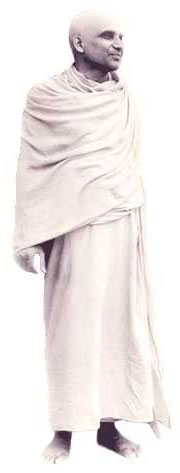
by Swami Krishnananda
The world is not outside us, because the very idea or the notion of ‘outside’ is an erroneous effect produced by a kink in the mind; and, therefore, yoga again and again points out that the only thing that we have to do is to set right the mind – yogah chittavritti nirodhah (YS 1.2). There is nothing else that is to be done, except to set right the mind. We are trying to set right the world instead of setting right the mind, as if something is wrong with the world. What is wrong is in the head, in the mind, in the way of thinking, in the movement of what we call the psychological apparatus in ourselves. That which has made us feel that we are in a world of externalised space and time – that has to be set right. Yoga does not, therefore, concern itself with setting right the world or covering the whole earth with gold sheets etc., because all these things are not necessary. What is necessary is to remove that disharmony between ourselves and the world or the universe, on account of which we are not only miserable in our own selves in our personal lives, but also we have wrong notions about other people and the other things in the world.
This mind, which is a mischief-maker, has created such havoc that it has created in us a perpetual wrong notion about our own selves and a consequent wrong notion about everything else. We think something is wrong with us and something is wrong with everybody else in the world. All this is due to the absorption of our mind in a peculiar un-understandable feature called the notion of diversity. It is very difficult to understand what it means. The mind survives only by creating this confusion. If everything becomes clear, the mind cannot exist. There are many people in this world who somehow or other get on by creating a state of confusion. They create such confusion that it becomes a source of strength for them. They do not allow others to think correctly by either shouting loudly or bringing about such a state of affairs that people’s minds are sidetracked and they cannot think about the actual problem on hand. That is the source of their strength. Many politicians do that. And this mind is the master politician. It has simply thrown everything in a state of confusion.
Not only it has done that, but it has also created a feeling in everybody that what it has done is right and that is the only correct state of affairs. So, there is no chance of our even retracing our steps from this confused condition, because we have already assumed that what steps we are taking and the condition in which we are is perfectly okay. If there is a state of confusion and we are convinced that this state of confusion is the right thing and the proper state of affairs, this is what is called ‘confusion worse confounded’ and, therefore, there is no remedy for this illness of the mind except an internal rearrangement of the pattern of thinking itself.
We have heard this sutra yogah chittavritti nirodhah: Yoga is the procedure adopted in restraining the modifications of the mind. All this is only a kind of slogan for us. We go on reading it a thousand times, but it makes no sense because neither can we know what mind is, what vrittis are, what modifications of the mind mean, or how they can be controlled. All these things are beyond ordinary people’s approach. And when we come to the actual serious practice of it, we will be repelled by it because it looks terrifying.
In the beginning, yoga is a terrifying something. It is a fearful object, very painful. But that pain and the terror is on account of our inability to adjust ourselves with it. Yat tad agre visam iva pariname’mritopamam, tat sukham sattvikam proktam atma-buddhi-prasada-jam (Gita 18.37): The happiness or the bliss that yoga brings is that which brings ultimate satisfaction to the reason and the soul, but which looks bitter in the beginning though nectar-like in the end. This is real, pure, and unmixed happiness. It is very unpalatable in the beginning – otherwise everybody would have taken to a serious practice of it. It is unpalatable because it is repulsive to the desires of the senses. And we live in a world of the senses. We are slaves of the senses. There is nothing before us except a sensory world. So, anything that is a little different from what the senses regard as valuable or pleasurable for them is bitter, unfavourable, not desirable. Therefore, very few people can take to this. Manushyanam sahasreshu kaschityatati siddhaye (Gita 7.3): Among thousands of people, one may take to this path; and even among those who have taken to the practice of it, very few alone succeed in it. Merely because we have filed a petition for election, it does not mean that we will be elected. Very difficult it is! It requires hard effort.
And hard effort is precisely, for the time being, regularity of practice. Whatever be the extent of our understanding of the practice, let it be regular. In all successful endeavours, regularity is to be made an essential – or the essential, the most essential – feature. Even if nothing else is possible, at least sitting alone in a fixed posture or asana must be possible. If nothing else is possible, will this at least not be possible? The mind and the body will both get adjusted to this discipline that we are imposing upon them. Seatedness in a posture for a period of time is a great discipline, because the mind is averse to every kind of discipline. Any kind of system is disliked by the mind. It always likes confusion, and the least discipline that we introduce into it produces in the mind a reaction and resentment. Even for ten minutes it won’t allow us to sit in one posture. We will change our posture, and look this way or that way. Even when we walk on the road, we want to see all the shops. We have nothing to purchase from the shops, but we look this way and that way. This is a distraction of the mind.
It has already been mentioned that for this aim of success that we are seeking through practice, a conducive atmosphere is necessary; and we already assume that we are in such an atmosphere, where factors which are too distracting are absent, and facilities for the practice are available. An ashram is of such a nature because distractive forces are absent and facilities for practice are available. We are in such an atmosphere. Now the will is necessary. What is required now is a determination, a power of thinking, and a decision that has to be made by one’s own self.
But, as the making of this decision is not an easy affair by a mind which has been used to pleasures and comforts and distractions, diversions etc., easier methods of practice should be taken resort to in the beginning, rather than severe practice. We must be able to find out what is the kind of practice or what aspect of yoga will be suitable to the present condition of our body and mind, and be firm in that for a considerable period of time. And then we will find that, like the gradual ripening of a fruit from inside, there will be a strengthening of the personality from within and a maturity of the whole being from inside, gradually expressing itself, manifesting itself outside. The ripening of the fruits commences from inside; it is not always seen outside. It takes a lot of time to be seen outside, and many seekers may be dejected or feel a sense of melancholy because the ripening is not visible outside. They will say, “I have been doing so many things for so many days and months and years, but nothing is coming out.” We cannot always know if anything is coming out at all, because even when success is apparent, it will not be strongly visible outside. It will not be visible outside always – until, of course, it comes to the highest.
Therefore, patience is one of the watchwords in yoga. We should not go on feeling a sense of diffidence in ourselves. We may remember the great advice of the Bhagavadgita – karmany evadhikaraste ma phaleshu kadachana (Gita 2.47): Don’t go on looking at whether the fruit is coming or not. The fruit will be taken care of automatically. We do our duty of practice from the bottom of our heart, with the best of our knowledge, with the greatest discipline possible, and the fruit will come in due time.