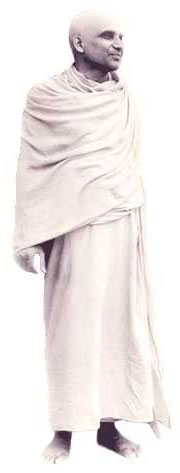
by Swami Krishnananda
The yogi, therefore, is not concerned with the world outside, because all the worlds are inside him. This is a very essential point to remember. He does not run about like a busy body here and there, setting things right and putting things in order. There is no need to do any such thing. He can put everything in order within himself and, correspondingly, everything else outside will also be set in order. This is an important thing to remember in yoga practice. The yogi is not concerned with the outside world, because the outside world can be operated from within, and it is connected with him even in the minutest of details. The world is not connected with him merely in a general way, but is connected even in details. Every atom of the universe is connected with the cells of the body. We can imagine what powers we have, what capacities are hidden within us, and what are our potentialities.
Einstein's equation E=mc2 says that an enormous amount of energy is contained in even the smallest quantity of matter; and, analogically, it is said that two pounds of ordinary coal, when converted into energy, would be equal to all the energy that is continuously produced by all the dynamos in the United States for two months. We know the power of the atom bomb – how small it is, though it can devastate half the earth. If one atom can contain so much energy, what will be the energy of all the atoms in our body? So why do we look like small monkeys when there is so much strength within us? We can simply blow away the mountains, if we want, but we cannot digest even one pav [1/4 litre] of milk, so much is our weakness. This is because we have become exiles from our own realm. We have been banished from our own kingdom, like culprits, and we have lost our heritage. We are not citizens of the very land to which we belong. Wonder! This is really a wonder! The world, which is our mother, is regarded by us as a stranger and, therefore, the mother feels sorry for the state of affairs that we are in. The energy that is to come to us from the whole creation outside is cut off from its entry into our body on account of the egoistic affirmations with which we have identified ourselves.
The yoga system is the final blow that is dealt at the root of this egocentric personality. To lay this final stroke upon the centre of the problem, so much of preparation is made – like a huge ceremony, celebration or function which may take place for one hour, but for which we go on making preparations for a month. For one month we work for a celebration that will take place for one hour only. Likewise, some great function is to take place in the form of yoga meditation, and for that so much preparation is being made. It is the glorious consummation that is called meditation, towards which we are moving; and the beauty of the function, and the perfection thereof, depends upon the meticulous care that we take in the preparations we make for it. There is no use laying too much stress on merely the achievement – only the function, only the dinner or the lunch that is to be given that day. Well, that is important enough, but how much effort is to be put forth for it!
The niyamas mentioned by Patanjali are, generally speaking, the necessary disciplines of body, speech and mind. We are averse to discipline, because we have been brought up in an atmosphere of enjoyment of the senses and too much social contact. This is how we have been brought up by our parents, by our teachers, by our friends; and this education, this culture, this civilization, which has gone into our blood, makes it impossible for us to follow any system or any kind of discipline. It is therefore necessary to awaken ourselves into the seriousness of the matter. We should forget the past – it is never too late to mend – and earnestly take to this practice.
Purity of body, speech and mind, is emphasised by Patanjali, which he refers to in a single word, saucha, which includes pure thoughts, pure words, pure diet, pure physical contact, and pure sensory activity. We should not see anything that is disturbing, we should not hear anything that is disturbing, and so on. Nothing that is going to defeat our purpose should become the object of the senses, the body should not come in contact with things which are going to stir up passions within us, and we should not speak what is not going to affect either ourselves or others in a positive manner, and the mind – of course, the supreme factor of all – is to be kept in perfect control. The Bhagavadgita has a beautiful description of this discipline, called manasika, vachika and kayika tapas, which will bring us the needed satisfaction, contentment, santosha, without which tapas or austerity is not possible – all which are brought together in what is called kriya yoga. Kriya yoga, according to Patanjali, is this combination of some of the principles of the niyamas.
To make it possible and easy for us, the system also prescribes certain adventitious practices like the study of holy scriptures, and a perpetual remembrance of the presence of God. The practice of the presence of God is ultimately the key to success. Sa hanisthan maha chidhram sa ch antha jada moodatha, yan muhurtham kshanam vapi vasudevam na chinthayeth(70) says the Pandava Gita, which means that all sorrows befall us, calamities come upon us, everything becomes difficult and the whole horizon looks dark before us as if there is no hope at all, the moment we forget the existence of God. And one of the main teachings of the Sufi school of mysticism is that what we call samsara, or the life of earthly bondage, is not merely the world that we see outside. Samsara is not merely this world in which we are living; samsara is a name given to the forgetfulness of God. The moment we forget the existence of God, we are in samsara. Merely because we are living in a world of trees and mountains, it does not mean that we are in samsara. Samsara is an entanglement of consciousness, and it is not merely a physical location of our body in the world of this astronomical wonder.
All these are regarded by Patanjali in his Yoga Sutras as a combined necessity to bring about an order in our life – saucha, santosha, tapas, svadhyaya, isvara pranidhana, as he calls it – which can be interpreted with the necessary intensity, each one for oneself, according to our own conditions of living, strength of mind, and so on; but what it finally means in essence is that there should be a stipulated method of thinking, speaking and acting. We must know what we will do at what time, and then we will see that success is not far to seek even in the ordinary life of this world, not merely in the spiritual field, because method or system is the way by which we focus our energies, and wherever there is a focusing of energy, there is strength – just as a focused beam of the sun’s rays can burn things, while the sun’s dissipated rays cannot.
It is, therefore, necessary to have a systematised daily routine. We must know when we will get up in the morning, what we will do after getting up, whom we will see, how much work we will do and in what manner, at what time – including even such minute details as bath, walking, food, the time of going to sleep, what we do before going to sleep, what will be around us and what should not be there. All this should be at the tips of our fingers. This is method, this is system, this is niyama. And when this system is introduced into our life, we become ready for the higher practice. Each succeeding step becomes easy of approach and practice when the preceding step is firmly placed.
We are again to remember that we should not take an advanced step unless the earlier step is well-placed. Hurry and too much enthusiasm are not called for. What is required is pure understanding of a dispassionate character, by which we know our strengths as well as our weaknesses. Whatever our weaknesses are, they must be overcome by the strengths that we have. One has to be very dispassionate about this because we are going to open our hearts before the Truth of all truths – the Great Reality before us – and nothing can be hidden from its eyes. Thus is the preliminary introductory remark which the great sage Patanjali makes for the glorious destination ahead of us.