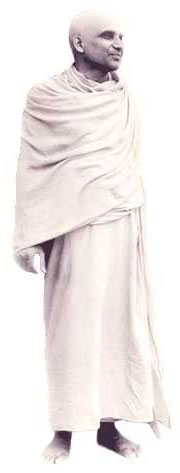
by Swami Krishnananda
All this is a precaution that masters of yoga, adepts, give us so that we may not get caught up by the very same forces from which we try to gain freedom, because freedom is an inward adjustment of consciousness towards the natural order of things, as we were discussing in the previous chapter. Our harmony with the universe is real freedom, and the absence of it is bondage; and to cling to the objects – whether outwardly in their physical form, or inwardly by way of mere conceptual thinking – would be, once again, bondage. Inward reveries are more dangerous than outward clinging, because the inner desires of the mind, by which it subtly enjoys the pleasures of sense, can be more vehement than the outward clinging – as the Bhagavadgita, in one place, tells us that even if we are physically away from objects of sense, the taste for objects will not leave us: rasavarjam. Rasavarjam means we are free from everything, no doubt, but not free from the taste for things; and it is this taste for things that catches us. ‘Taste’ means the feeling of pleasure in an object of sense and the belief that the object of sense can bring us pleasure; and this taste is present in the mind in a very subtle form – like a highly potentised homeopathic dose, very invisible indeed, but very powerful – and it can grossen itself into actual action when outward conditions become favorable. Once again, we repeat that any kind of diverting the mind from objects of sense is not the remedy for its cravings, because it cannot forget that there are objects of pleasure.
The yoga process is a process of education, which means to say, a gradual enlightenment, an awakening into the daylight of knowledge, and not merely groping in the night of darkness, though it may be that we are moving from one place to another place in that dark night. Any amount of movement in the dark night is not going to give us light. Shifting of the position of the body in darkness is not a solution. The solution is the rising of the sun.
And so, in the sutra in Patanjali’s aphorisms which I was referring to, he says: drsta anusravika visaya vitrsnasya vasikarasamjna vairagyam (Y.S. 1.15). Vairagya, or the spirit of renunciation, is a mastery that we gain over the objects of sense, and is not merely a forgetful attitude of the mind in respect of objects of sense. What are the objects of sense? Drishta and anusravika are the words used: that which is seen, and that which is heard – both these are objects. We can cling to objects which are seen with the eyes, and also cling to things which are only heard by our mind. When we see a thing directly, physically, of course the mind will begin to read a tremendous gorgeous significance in the object, and jump upon it. Not merely that, even by hearing of the glories of an object of sense, the mind can become restless and ask for its possession – like the joys of heaven, for instance. The celestials in Indraloka are supposed to be enjoying pleasures far superior to the pleasures of the earthly senses.
Our senses can be worn out by repeated enjoyment, we may get exhausted, we may fall sick, we may enter into old age, we may die; but scriptures tell us that the pleasures of the celestials – the devatas, the gods in the heavens, in paradise – are qualitatively more intense. Their senses will not be exhausted; they will not be worn out. They do not get exhausted, they do not become old, and they will not die. So, the mind can crave for such things also. “Oh! Such things are there. Why should I not go there?’ This is a desire that arises in the mind by merely hearing things which we have not seen with our eyes; but when we actually see it, of course we are completely put out of order. All the ratiocinations of the intellect cease, the best brains stop functioning at that time when an object of sense is presented directly. No brain will work at that time; the brain stops.
What is vairagya then, which the yoga speaks of? It is a vitrshnata, or a feeling of inward desirelessness, towards everything that is seen or capable of being seen, and everything that is heard of, even through the scriptures or by other sources. In one of the writings of Acharya Sankara, he says: abrahma stambha paryantam vairagyam vishayeshvanu yathaiva kakavishthayam vairagyam tat nirmalam. His definition of vairagya is terrifying. What does he say? Even the pleasures of Brahmaloka are to be despised by a desireless mind, as they are mere dirt which have no essence in them. But who can imagine what the pleasures of Brahmaloka are? They are not like the pleasures of the celestials. They are far superior to even Indra’s pleasure, because that is the description of the subtlest condition of sattvic enjoyment. Even this is only an enjoyment, though this enjoyment is effected not through the physical senses, not even by an ordinary psychological process, but by a subtle instrument called the anandamaya kosa. They say that in Brahmaloka the physical body is not there, and not even the ordinary subtle body is there; there is a subtler-still body which is comparable only with what we call the causal body in us. Sanaka, Sanandana, Sanatkumara, Sanatsujata, Narada, and such others, are supposed to be living there. They are all unthinkable things. These pleasures also are not to be coveted in comparison with a greater joy still, which is identical with the Self.
The joy of the Atman, the Supreme Self, reflects itself in all these manifestations – right from the delight of Brahma, or creator, down to the grossest physical object of sense – in various degrees. What is giving us joy, pleasure, is this Atman present in things. We are happy wherever the Atman is manifest. Where the Atman is not manifest, we cannot feel joy. Even in the grossest object of sense, the Atman is manifest. That is why it attracts us. It is a great wonder how the Atman can manifest itself in an object of sense. Is it possible? Yes, it is possible, and it is because of this mystery that is revealed through the objects, that the senses run after the objects. The Atman is not an object, of course, and yet it is capable of getting revealed in some degree through the objects.
The Atman is a symmetry of perfection, a well-arranged pattern which reflects completeness; and wherever this arrangement of completeness or pattern or symmetry is visible, the mind begins to feel that its object is present. Anything that is symmetrical attracts us. Anything that is confused or chaotic does not attract us. Symmetry is also a very difficult thing to understand. It is not merely geometrical symmetry that we are speaking of here, though that also is there as an element of this superior form of symmetry.
Completeness, or an absence of any kind of want, is the character of the Atman. Many features are there in the Atman, not merely symmetry. It is difficult to explain what are the qualities that are discoverable in the Atman. Exuberance and buoyancy, force and symmetry, of course perfection, and a freshness. The object of sense looks fresher and fresher every day. The more we see it, the more we like to see it. It does not look old. We do not say, “I have seen it hundred times.” Every day we would like to see it as many times as possible, because freshness is one of the characters of the Atman. We cannot know what this freshness is. It is not the freshness of a ripe fruit, like an apple. It is something that pulls our whole being. Every day, the sun rises in a beautiful manner. We are happy to see the rise of the sun. We never feel that it is a dull sun that has been rising for centuries. Every day it is fresh, invigorating, and exciting. The capacity to excite us into a tremendous activity through every part of our body, the senses and the mind, is the capacity of the Atman; and wherever such inordinate capacity to stir the total personality is seen, upon that the mind jumps, and it goes towards it.
But, it forgets that what attracts it is not this vehicle called the physical object, but something that is revealed through it due to a peculiar placement of that object in a certain atmosphere, in comparison with a peculiar and particular condition of our own mind in a certain stage of evolution. Attraction is impossible unless both cooperate – the object and our own mind. The object has to be placed in a proper context, it must reveal certain characters, and those characters and that context should be the very same thing that our mind is lacking at that particular time. Then we are attracted by it. That is why we cannot be attracted by the same thing always, because the mind changes when we advance in age or in experience.
Knowing all these things, the viveki, or the man of discrimination, gets disillusioned: “Oh! This is the state of affairs. I am very sorry. I was totally mistaken.” Parinama tapa samskara duhkaih gunavrtti virodhat ca duhkham eva sarvam vivekinah (Y.S. 2.15). For certain reasons which are to be explained, the whole world is full of pain only. It is not a place of beautiful enjoyment or an occasion for exciting pleasures. There is something very terrible about things. This sutra that I quoted just now tells us what it is.