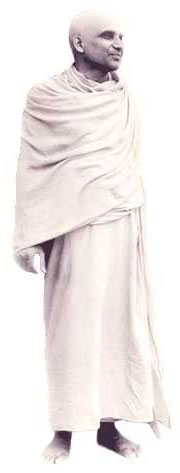
by Swami Krishnananda
So, there is some mystery in this world. We can call God only as a mystery, and nothing else; and we are involved in this world of appearances. We are a part of this world; therefore it is not given to us to completely reject the law of the world. A complete carelessness towards the rules that are prevailing in the cosmos would be to the doom of the individual, and that foolhardy aspiration for God would be paid back in its own coin as sorrow. Sri Ramakrishna Paramahamsa used to say that the devotee of God is not a foolish man; he is a devotee, but he is not foolish—he is wise. What is wisdom? Wisdom is nothing but an understanding of the nature of life. To understand what life is would be wisdom, and to mistake life for what it is not would be unwisdom.
Religions often have made the mistake of a transcendent ascent of the religious spirit, overcoming the laws of the world, facing God in the high heavens and preaching a renunciation of the things of the world to the extreme point, the breaking point we may say, until it would be not tolerated by the laws of the world. The person who renounces the world is a part of the world—we forget that, and there lies the mistake. The suffering of the seeker is due to a mistaken notion of himself in relation to the world outside. He has not yet become a part of God, though he is aspiring to be such, and the hands of God work through the forms of the world—that cannot be forgotten. Just as the power of the president or the prime minister may work through a small official, and we cannot ignore this official merely by saying that we are not concerned with him in any manner inasmuch as we are somehow or other placed in an atmosphere over which he has jurisdiction, the world has jurisdiction over our individuality.
The world is made up of several grades of density, to which we have already made reference. There are the various lokas—bhu-loka, bhuvar-loka, suvar-loka, mahar-loka, jana-loka, tapo-loka and satya-loka. The ascent of the spirit is through the ascent of these various densities of manifestation, the lokas; and we are in the physical realm, not in other realms. We are not in jana-loka, tapo-loka, satya-loka—we are in bhu-loka. The earth pulls us by its gravitation—water can drown us, fire can burn us, air can blow us, which means to say we are strongly conditioned by the physical world. In passing, I may mention the various samadhis mentioned by Patanjali in his sutras—savitarka, nirvitarka, etc. are nothing but the ascent of the soul through these lokas, savitarka being the ascent of the soul from the physical realm. How difficult it is to overcome the clutches of the physical world can be gathered from the importance that Patanjali gives in his Yoga Sutras to the preparations that have to be made for reaching the state of the first ascent of the soul. The first step in the ascent of the soul, which is savitarka, is the real beginning of the divine ascent, for which so much preparation—yama, niyama, asana, pranayama, pratyahara, dharana and dhyana—has been made. We are not suddenly jumping to the skies, and any mistake in the understanding of these intricacies would be to our ruin and grief.
So we pass our life in Aranykapurva for years in search of light; but the honesty, the sincerity, the asking is paid its due. Though God enforces discipline upon the individual, He does not forget to reward him for having passed through the difficulties. Reward comes. Devas—Indra, Varuna, Rudra and others—take pity on the Pandavas, and unasked help comes. Rudra gives pashupata, Indra gives his vajra, Varuna gave pasha, and Agni his agneya,and what not. The powers of the Pandavas get enhanced by the help they receive from the gods.
The gods are watching us. They are seeing us even now. They are not non-existent myths, as people may imagine. They are as real as hard brick before us, and the Yoga Vasishtha tells us in a beautiful verse that when a person becomes completely surrendered to the law of the world—he is egoless, in other words—it becomes the duty of the rulers of the cosmos to take care and protect this individual. As the divinities take care of all the quarters of the cosmos, so the seeker is protected by all the angels in the heavens—gods in swarga, divinities all over, to whom we have paid scant respect earlier due to the affirmation of our ego. God Himself descends in a magnificent form, and to recollect what we have studied earlier in the Udyogaparva of the Mahabharata, divine forces get gathered for the help of the Pandavas.
Yet everything has not been done, and everything has not been said. There is much more to be done, much more to be said. We know very well that the great glory in which the Pandavas found themselves in the midst of powers like Sri Krishna in the Udyogaparva was not the end of all things. There was suffering yet to come because, again to recall to memory the samadhis of Patanjali—savitarka, nirvitarka, savichar, nirvichar—they are not enough. There is great struggling on the path; every moment there is an encounter. At every moment, at every step, there is a power that is facing us as an opposite, as an object. The object opposes the subject at every level, and objects change their colours every moment, at every stage, like a chameleon. If today people are the objects, tomorrow the five elements are the objects, and they stand before us. What will we do to them? It is in the savitarka process of Patanjali that we encounter the five elements. The people have already gone; we do not have any more trouble with people afterwards. The dealings with people are over in the earlier stages of yama, niyama, etc. We have no fears from human beings or any other living beings; we have fear only from the five elements, and we do not imagine that they can give any trouble to us. Really speaking, they are the masters. The five elements are the rulers, and we can do nothing to them. We cannot please them easily, because to comply with the law of physical nature is hard enough.
So it is naturally a surprise to the unsuspecting seeker to be faced with such realities, and to be terrorised once again in the same manner as before by forces unseen and unexpected. When we face in battle any power, it pushes forth all its energies to the maximum extent. Our energies come to the forefront only when we are opposed; otherwise no one can know what one’s strength is. When everything is failing and our last resort is to save ourselves, then we unleash all our strength. So it is that the Pandavas had to face a set of forces which encountered them with all their might and mane. At that time there is a peculiar sorrow of the soul, which catches it by the neck, as it were, and the soul retaliates. “Not this, and it is not for me,” says the soul.
Here we find Arjuna at the very beginning of the Bhagavadgita. All the supports and all the weapons that we have in our hands do not seem to be sufficient to meet the powers that are arrayed before us in battle. The soul recoils from the fact of its having to come in opposition to the powers of the world which are vastly arrayed before it. Then doubts arise. I mentioned to you something about the nature of the havoc that doubt can play in our minds, and doubts will not leave us till the last moment of our lives. There are varieties of doubts; when one doubt goes, another one comes that was not there previously. Doubts shake us from the root, and we become diffident at that moment. Perhaps there is a mistake—this is what we begin to feel. Various arguments were thrust forward by Arjuna to discount the justice of the war. “What is the point in facing Bhishma, Drona and others who are our venerable ancestors?” The regard for elders, the regard for people, love and affection for kith and kin is so strong that a violation of this law is usually regarded in society as an unpardonable mistake. He becomes a renegade in society. “Is this practical, and is this ethically permissible?” is the query of Arjuna. “No, not permissible,” he himself gives the answer. “To cut the throat of those people who have taken care of me from childhood, from whose hands I have eaten food, to strike a blow at their own heads would be a heinous sin,” says the ethics of the world. This would not be permitted. The other argument is: “Where is the guarantee that this battle is going to end with success on our side? May be somebody will win—may be the other side. Why should it be only this side? And all our efforts will be in vain. We will be doomed and destroyed, and will be seeing only bloodshed. What will be the fate of those people who we have harnessed for battle and who have dedicated their lives for our sake, and who have left their mortal coil in our name?” This is another argument—there is no certainty of the consequences of war apart from the fact that there is a mistake in encountering people who are our own. Thirdly, there is a doubt: “The world is not as bad as it appears, and there is something worthwhile in it.” The rejection of the world for the sake of God is involved in a subtle error of not recognising the values that are present in life.
These questions are the sum and substance of the first chapter of the Bhagavadgita. Doubts and doubts and doubts—at least three different doubts are mentioned. The retort of Sri Krishna to it, in the second chapter, is that we have no correct understanding of the matter. We have no samkhya buddhi. Samkhya buddhi is correct understanding; that Arjuna lacked. These are the words that Sri Krishna utters: “All this logic, ethics and morals that you spoke of in favour of the world and against the justice of the war—all this that you have said is an outcome of a lack of understanding. You have not understood what Truth is. There is a necessity for clarity of the power of reasoning before you begin to reason. A muddled reason cannot bring correct results. Therefore samkhya, understanding, is the first thing that you have to strive for, and not merely employ this ruptured weapon of unintelligent reason to justify erroneous notions.”
“Well, is it so?” says Arjuna. “Am I mistaken? There is diffidence in my heart. I cannot face this world, and there is a sense of the human in me which always speaks its own language, and the human sense cannot always reconcile itself with what the battle of the spirit expects it to.” We are human and think human, but Sri Krishna wants us to be divine. How is it possible for a human being to be divine? That is possible only if there is the capacity in the individual to rise to the understanding that is equivalent to the character of the spirit. That understanding, which is the light of the spirit, is samkhya buddhi; that is the higher reason, the higher self also, in this way. “What is this samkhya, what is this higher understanding which I lack? Why is it that you say I have no samkhya buddhi, that I am faulty in my arguments? What is wrong?” This will be taken up in further chapters.