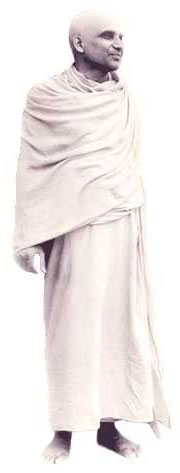
by Swami Krishnananda
But, in our stupidity, we are not prepared to accept that God is the only actor. We do not wish to be so charitable even in respect of God Himself. “Why should He do all things? I shall also do something. I am also doing something; it is not true that God only does everything.” What can we speak of man when he has such notions as these? As Shakespeare puts it somewhere, “Man, puny man, plays such fantastic tricks as make the angels weep.” Angels are weeping at our fantastic tricks in the form of our glories on earth. We are not prepared to accept that God is the sole doer, because we think a little of our greatness goes if this concession is given. Such is the wonder of man’s wisdom. The Gita tells us, “Do not be unwise, because this unwisdom is not going be for your good.” The great karma is God’s karma; it is that activity of God, that action, that very will of God which projected—visargah is projection, emanation, ejection, bringing forth. This act of bringing forth the whole universe on the part of God, which is bhuta-bhavodbhava-karo, which is the origin of all beings, that is karma, and you can call only that as karma—nothing else can be called karma. What we do with our little egos cannot be called action. The real karma is That. To the question, “What is karma?” this is the answer: Bhuta-bhavodbhava-karo visargah karma-samjnitah.
Adhibhutam ksaro bhavah: The objective universe which is perishable is adhibhuta—all material things, everything external. All that is in space and time is adhibhuta. The object of consciousness is adhibhuta. Anything that we regard as external to our consciousness, or external to consciousness as such, is adhibhuta. Anything that is so conceived as external to consciousness is perishable—adhibhutam ksaro bhavah. The perishable character that we observe in things is the externality of things, so the perishable character that we see in our own self is also the so-called externality of our true being. As individuals, as bodies, as minds even, as social units we are objects because we can be seen—we see our own selves. With our own senses we can see our bodies and also the bodies of other people. This aspect of ours, which brings us down to the level of objects, is the adhibhuta aspect. That is the perishable aspect, and therefore our bodies are subject to death and our individuality is subject to destruction. All that is subjectively or objectively spatial or temporal is subject to destruction, transience, and therefore it is adhibhuta.
Purusas cadhidaivatam: The purusha that the verse speaks of here is the presiding divinity behind all individuals. Sometimes in modern language it is called the Overself, or in Sanskrit terminology it is called the kutasthachaitanya. Our deepest essence, which presides over us, is the purusha, God speaking through man and enlivening even our intellects and enabling us to exist, to be conscious and be happy. Adhiyajno’ham evatra: The incarnate God speaks, “I am the adhiyajna.” When God incarnates Himself, not necessarily or merely as Krishna or Christ or such incarnations, but any kind of incarnation, the whole universe is filled with the powers of God, which are all capable of being regarded as incarnations in their own ways. What else can be there in the world but God, and who can be doing anything here but He? In that sense, how can we say that He is not present here even today as an incarnation? So, “I as the incarnation,” says Sri Krishna in the Bhagavadgita, “stand here as the adhiyajna, the receiver of all the fruits of action.” Sarva-deva-namaskaram keshavam pratiga chhati: Any prostration offered to anyone goes ultimately to that Supreme Being, as all rivers go to the ocean.
Thus any action, being God’s action, all fruits of action go to Him. He is the supreme bhokta—enjoyer of the fruits of all actions. Any sacrament is an offering to Him. Any charitable act that we perform with the goodness of our heart is a consecration done to God. God is pleased even with the smallest of our charitable deeds. So, here is a wonderful concept of the Bhagavadgita cosmology, mentioned in some manner in the seventh chapter and stated in a different form in the eighth chapter.
What I have told you now is very little. These little verses contain a world of meaning, and all the aspects of every school of philosophy is embedded in these two verses. The cosmic, the individual, the social and the Absolute—everything is there, explained in a few words, not even sentences which are pithy in their own way. Contemplating this God throughout one’s life, one is enabled to retain this memory even at the time of passing—antakal, the end of this time. When we are about to leave this body it should be possible for us to entertain God-thought.
But many a stupid person, under the impression that God-thought is to be entertained at the time of death, thinks, “Well, that time has not yet come. If our liberation is determined by the thought of God that we entertain at the time of physical death, that time has not come because we are not going to die today. We have to think of God as the last thought when the time for departure comes.” This is a futile idea of an immature mind, firstly because the last thought cannot be God-thought if the thoughts that you entertain throughout your life have been extraneous or irrelevant to God’s thought. You cannot sow the seeds of thistles and expect mangoes or apples to come out of the plant of thistles. What you have sown, that you shall reap. If you have sown God-thought throughout your life, the last thought which will come to you there as the fruit of the tree of your life will be God-thought, no doubt. The last thought is not an isolated thought—we have to remember this very well. It is not one thought among many thoughts. The last thought is the cumulative effect of all the thoughts that we have been thinking throughout our lives, just as the fruit of a tree is the culmination of the maturity or the fructification of the growth of the tree for years together, right from the seed onwards. So you should not say that the tree will yield a beautiful, sweet fruit. The tree will yield a sweet fruit after some time, whatever be the seeds that you have sown. So brush aside the idea that you will have God-thought at the last moment merely as a gift that has been bestowed upon you irrespective of what you have been thinking throughout your life. Only a godly life led will yield the fruit of God-thought at the end.
You may be wondering why it is that the last thought should determine the future. It is because it is at that point that our personality gets concentrated automatically and the mind converges into a single point. The various energies of our body-mind complex become concentrated spontaneously at the time of death. The senses are withdrawn—you need not put forth great effort at the time of death to withdraw your senses. You will not see, you will not hear, and you will not speak. The senses cease to operate. When a man is about to die, people come and ask, “Do you see me? Do you know who I am? Who am I?” He cannot say who they are. He has ceased to see, he cannot hear what is spoken, and he cannot utter a word. At that time, this state of affairs supervenes because of the withdrawal of the power of the senses. The scripture tells us that the deities depart and cease to control the sense organs. The sun operating in the eyes and the other devatas of the senses withdraw themselves and allow this bodily vehicle to go to putrefaction. The powers of the senses therefore get converged in the mind and the mind enters the prana. All this is told in the Upanishads and Brahma Sutras, etc.
We exist there, the ‘I’ exists there as a spark of consciousness, like the small flame of a match, or something smaller than that—like a star, or something inconceivable. It is said that at that time the whole personality gets fixed up in a point, like a star, like a dot that is luminous. That is what you may call the ‘soul’, if you like, wherein merge the pranas, the senses, and the mind. So you become automatically a yogi, in one sense, forcefully driven into it even without your will. At the time of death you become a yogi by compulsion, but unfortunately you become unconscious because of the desires that you have not fulfilled in life. The unfulfilled desires prevent the awareness of this concentratedness of the personality. A person who has been a fool throughout his life, dies a fool and is reborn a fool. He will not be reborn as an angel. So the last thought has to be a conscious awareness, an awakening into a point which is bestowed upon you automatically by the laws of things. If you have been a true and honest devotee of the highest values of things, if you have been a true devotee of the Bhagavadgita, a follower the yoga of the Bhagavadgita and a practitioner of it, what happens? You maintain an awareness; you do not go deluded—undeluded you pass. There are many cases where people passed away having good thoughts, uttering a divine name and giving a blessed message. There have been cases like these.
An honestly led life of divinity and charitableness, of devotion to God, purity and dedication of spirit to the highest aim of life, purushartha moksha, will take care of itself. When your whole personality is that concentrated, you can be a yogi in a moment. Anta-kale ca mam eva smaran muktva kalevaram, yah prayati sa mad-bhavam yati nasty atra samsayah. The eighth chapter gives a little description of the yoga that one practices at the last moment, the anta-kle yoga. Bhishma was supposed to have practiced this when he was on a bed of arrows. He withdrew himself from all external awareness after the long gospel that he delivered to Yudhishthira in the Shantiparva of the Mahabharata. He withdrew himself after a magnificent prayer that he offered, which goes by the name of Vishnuswaraja in the Shantiparva. So do all yogis depart, and so can you also depart from this world, and so can anyone depart from this world.
As a matter of fact, it cannot be called a departure at all. We are not going anywhere by plane, or helicopter, or any kind of vehicle. The idea of going has given rise to the doctrine of moksha by gradual stages. We always imagine that there is a passage to God, there is a movement of the soul towards liberation or moksha. The Upanishads speak of it, and the Bhagavadgita also speaks of it in this very chapter. The stages of the ascent usually go by the names ‘the Northern Path’ or ‘the Southern Path’, as you all very well know—the uttara marga or the dakshina marga, the path of light and the path of darkness. The path of light is supposed to be the path of liberation which the soul pursues on account of the yoga that it has practiced in this life, and which is practiced even at the moment of passing. The Bhagavadgita says, “Concentrating oneself on the point between the eyebrows, chanting the mantra Om with deepest feelings welling from the heart, devote oneself entirely to the supreme purusha.” Kavim puranam anusasitram anor aniymsam anusmared yah, sarvasya dhataram achintya-rupam ditya-varnam tamasah parastat, says the Bhagavadgita—beyond the darkness of the ignorance of the universe, It shines like a brilliant sun. One who concentrates on the Supreme Being at the time of death by a whole-souled devotion to It is in a state of yoga, and such a person departs by the Northern Path.