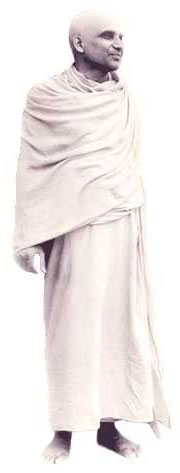
by Swami Krishnananda
The significance behind this chant is, again, not merely to utter a word or make a sound, but to set up a vibration. And what sort of vibration it will be can be known by each one of you by actually resorting to this practice. The chanting has to be done with a calm and settled mood. The personality has to be felt as if it is melting away into the atmosphere, so that the vibrations that are the sum and substance, or the material of the things of the world, become in tune with the substance of our own body or personality. This means to say, we reduce ourselves to the Ultimate Cause from which the effects have come forth in the form of the various bodies of individuals. All bodies can be reduced to a single vibration, a universal continuum of energy, whether it is the body of a man, the body of an animal, the body of a tree, or the body of a stone—it makes no difference. Any substance, any body, any embodiment can be converted into an energy which reduces itself into the minimum of reality, inseparable from this very same minimum of reality forming the essence of every body in this world. So, psychologically, mentally and by effort of the mind, we dissolve ourselves gradually into this universal energy.
Om is more a vibration than a sound. There is a difference between sound and vibration, just as energy is not the same as sound, because while energy can manifest itself as sound, it can also manifest itself as something else, such as colour, taste, smell, etc. Just as electric energy can manifest itself as locomotion, as heat, as light, etc., the various configurations in the form of bodies or things in this world are expressions locally of this universal vibration which is the cosmic impulse to create, the creativity or the will of God that is identified with a cosmic energy. Om is the symbol of this comic force.
Nada, bindu and kala are the terms used in some of the systems of thought to designate the various stages of development of this energy into grosser and grosser forms. From a single point it expands itself into the dimension of this universe in space and time, and from being merely an impersonal, unthinkable, supernatural power, energy or vibration, it becomes visible, tangible, sensible, thinkable and reasonable when it manifests itself as this gross universe and our own bodies. In this yoga practice, we concentrate on the aspect of the dissolution of the physical body in the subtle, the subtle in the casual, and the casual in the cosmic substance. So the chant of Om is not merely a word, but also an effort of the mind in the dissolution of the personality in the causes thereof, and this is what is advised in this verse of the Gita: Om ity ekksaram brahma. It is said it is the Absolute itself. It is saguna and nirguna—it is with form and without form. The vibration can be conceived as identical with the Absolute in its original causative aspect. It can be also conceived as the seed of the cosmos. Therefore it is called saguna and nirguna both. It is absolute Brahman because it is all-comprehensive; there is nothing outside it, just as the continuum of energy, the force that is the source of this world, cannot be regarded as having anything outside it or external to it. Brahman is that, outside of which, nothing is. That which comprehends all, which includes everything, into which everything is absorbed, wherein anything can be found, any form, at any time and under any circumstance—that completeness is called Brahman, and Om is the symbol which represents the supreme Absolute.
This yoga is therefore combined with the chanting of Om in this prescribed manner: Om ity ekaksaram brahma-vyaharan mam anusmaran. It is not merely a chant or a recitation in a verbal form that is prescribed, but also an inner attunement of our feeling, mind, reason, and consciousness. The thought of God is essential, together with the recitation of the chant. The mind should not wander. When we chant Om we must also feel what we are chanting, and not merely feel, but also understand what it is. The whole being is there; that is called yoga—the union of the totality of being with the wholeness of the object. Such a person who departs from this world by the practice of yoga in this manner reaches the supreme state. He is not reborn; he does not come back to this world of mortality—yah prayati tyajan deham sa yati paramm gatim.
All this may look very terrific, almost impractical for people living in this humdrum world of activity and business. “Is this yoga meant for me?” The great Teacher says: “Do not be afraid; I am very easy of approach. I am not a difficult person, as you may imagine Me.” Ananya-cetah satatam yo mam smarati nityasah, tasyaham sulabhah partha nitya-yuktasya yoginah. “I am easy of attainment by those who are united with Me, who want Me and want nothing else.” The great qualification that is expected of a devotee or a yogi is the asking for God, and not learning or study of scriptures. We need not hold a degree or be an academic master in theoretical philosophies—no qualification is necessary on the path of God. Even rustics, unknown persons who never went to school or had any field of training could become vehicles of the expression of God, as the history of religion demonstrates to us. The whole soul should require God, and this requiring God is the qualification. The mind should not affiliate itself with anything other than this supreme object. This is called ananya-cethsa—the mind not engaging itself in any other thought. There should be one thought.
This one thought is the most difficult thing for many of us, because we have never known what this one thought could be. The difficulty arises because the soul does not ask for God. The reason may be asking, in its logical manner, but the soul is beclouded by the dark longings of the senses which, when they are not fulfilled, remain like a cloud covering the light of the Atman. We cannot concentrate on one thing, because we do not want that thing, really speaking. Our asking for God is not an asking by the mouth—a prayer that is uttered by the chanting of a song, or a linguistic prayer. It is a surging of our feelings and an impossibility to exist without God. Great saints and sages have passed through this crucial hour and difficult moment when they began to feel that even death is better than the loss of God’s consciousness, because the soul writhes and wriggles to catch That, without which it cannot even breathe. For us who have not been accustomed to this whole-souled devotion, the practice of yoga remains a kind of alien instruction.
Ananya-cetah satatam: Tremendous conditions are laid, though it is said that the whole attainment is very easy. It appears, if we try to understand the meaning of this sloka, that the Teacher, the Master of the Gita is telling us that He is easy of approach, provided that something is done. This provision is a very difficult one again; the whole mind has to be united—we have to be ananya-cetah. This ananya-cetah or the unitedness of our thoughts or feelings, the mind and the reason with the Supreme Being should be continuous and not be with remission of effort. Satatam: The whole day and night we should be thinking of That only. Ananya-cetah satatam yo mm smarati nityasah: Daily we should resort to this practice—continuity, daily practice in the unitedness of all our being with God. Tasyaham sulabhah: To such a person I am easy. Nitya-yuktasya yoginah: To the yogi who is united with me perpetually, I am easy of approach. Tasyaham sulabhah partha nitya-yuktasya yoginah.
After attaining God, there is no rebirth. Mam upetya punar janma duhkhalayam asasvatam, napnuvanti mahatmanah samsiddhim paramam gatah: Reaching all the planes of existence lower to God, there can be a reversion of the soul to those conditions where its unfulfilled desires can manifest themselves for fulfillment. When God is the sole object of desire, when desires fulfil themselves entirely at one stroke, there remains no other desire to pull the soul back to the earth or any lower plane of existence. Punar janma, rebirth, as I mentioned earlier, is not necessarily a rebirth in this world. It is a rebirth in any condition of being, any plane of existence anywhere in creation, any part of the cosmos—which are supposed to be infinite in number. Any state which is less than the realisation of God is a rebirth; it may be in any lower plane. But the whole process of reincarnation is rent asunder, cut at the root when the cause behind rebirth itself is plucked out from its very roots. The cause of rebirth is the sense of individuality, the isolation of oneself from God, the assertion of the ego and everything that follows from it as a consequence. The whole of samsara, the whole drama of life is the affirmation of the ego personality of the jiva, as if it is all-in-all and the master of its own self, reigning supreme in this world of mortality, in this world of desires and their fulfillment of the same. This is the sorrow of man.
But no desire can be fulfilled in this manner. The ego is futilely attempting to fulfil its desires by grabbing things in this world. The more it desires, the more are the multitudes of desires that crop up, like the raktabeeja we hear of in the story of Devi Mahatmaya. The more we shed the blood of that rakshas, the more he multiplies himself into a large army which takes up weapons in the field of battle. This raktabeeja in the Devi Mahatmaya is nothing but desire itself. Desire cannot be rooted out completely; its fulfilment is not its destruction. On the other hand, any kind of pampering of a desire by merely satisfying it in an externalised form intensifies it. The samskaras or the impression that is created in the mind at the time of the so-called satisfaction or fulfilment of a desire forms a groove in the mind, and that groove becomes a source for further impulse from within to repeat this experience, and desires continue like a chain reaction, without cessation.
Desires cease when their root is pulled out. The root is the affirmation of the ego. The ego cannot absolve itself from attachment to its own being unless it dedicates itself to God. The ego will never turn to God, because it is also an affirmation—an affirmation contrary to the All-being of God. While God is All-being, ego is individual being; that is their difference, so one does not go with the other. The dedication of the ego to God-being becomes difficult, because the ego does not accept the fact that its desires can be fulfilled by an abolition of itself. The greatest sorrow of the ego is its feeling that its existence is going to be affected by the devotions of religion. People are afraid to turn towards God because of the feeling that they will lose things of this world. Religious devotees sometimes have a subtle suspicion at the back of their minds that the gain of God may imply a loss of things of this world. Now here we are in a difficult situation. Nobody wishes to lose anything that is worthwhile, and who can say that the world does not contain worthwhile things. The world is grandeur, and it contains riches that can entertain anyone in this world indefinitely and infinitely. The individual soul, which recognises the values of the grandeur of the world, feels that the absorption of itself in the Being of God would be not merely be a loss of things, but a loss of its own self.
It is foolish to imagine this, because gaining God is not losing all things, but gaining all things. The things of the world are reflections of reality—they are not originals. God is the origin of all things. The trees that we see, the mountains, the sun, moon, stars, you and I are all reflections. And therefore one shadow is running after another shadow, as it were; there is no reality here in this world. The originals are in a superior realm, and the highest original of all things that are reflected here in the form of perceptions and experiences is God the Absolute. So it would be stupid on the part of anyone to imagine that to move towards God would be to lose things in this world. We are losing only stupidities, unreality, shadows, reflections, imaginations and chimeras. But the mind is not tutored and educated properly in this manner, so it clings to phantoms in spite of instructions repeatedly given to it by the masters, sages and scriptures.
We have to instruct ourselves adequately into the great truth that the movement of our soul to God is our only duty in this world. We have no other duty here. All our duties—family duties, national duties, public duties and private duties—are summed up in this all-consuming duty of the movement of the soul to God. But again, the mind will not accept it. To make it accept and to make it understand is to educate it in the proper manner. The Bhagavadgita is a great instruction, a great education provided to the soul in the matter of enlivening and illuminating it in the direction of what is truly good for us. Mam upetya punar janma duhkhalayam assvatam, napnuvanti mahatmanah samsiddhim paramam gatah. Great souls, blessed ones who have realised the truths of life, resort wholeheartedly to this fulfilment and performance of the great duty of all duties—the love of God, devotion to Ishvara and a continuous practice of meditation—whereby the whole of us is consecrated as a sacrament at the altar of God.
This world is full of sorrow, dukhalayam. Everyone knows what this world is made of. Whatever we touch becomes pitch and coal. We are frustrated at every step; we are defeated in our endeavours to grab the satisfactions of this world. All the fruits of life which we put into our mouth appear to turn to dust and ashes, which we realise only too late in life. In hot-blooded youth and the energy of jubilant enthusiasm when we are young, we do not realise what is going to be our fate when we grow old. All our desires become emaciated. The things of the world look insipid and tasteless. All that we run after looks ugly and meaningless when life wanes like an evening flower—its beauty goes in a minute Therefore we are admonished again that it is a world of sorrow, dukhyalaya, and it is impermanent—it is not a permanent existence. To this sorrow-ridden world we will not return having attained God through this practice of the unitedness of the entire spirit with the Supreme Being of God.