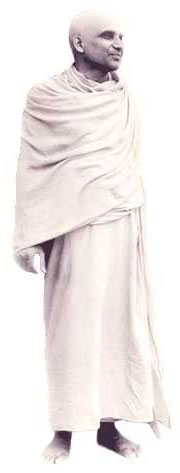
by Swami Krishnananda
But there is a more enigmatic declaration yet to come—na ca mat-sthani bhutani. It also cannot be said that the world is in God, though it may be said in one way that it is in God. Inasmuch as an effect has to have a cause, and the world reveals the characteristics of an effect, it has to be based on a cause that is wider than itself, vaster than its expanse, and we posit the existence of a Creator as the cause of this world, this universe. So in this sense we may say that the world is rooted in God—mat-sthani sarva-bhutani. But the omnipresence of God excludes the possibility of anything getting rooted in Him, because to imagine the rootedness of one thing in another is to assume the difference of one thing from another, an indirect refutation of the omnipresence of the Supreme Being. Nothing external to God exists, He being the all-comprehensive Infinite, and That, external to which nothing is and nothing can be, cannot be regarded as a cause of an effect which has to be rooted in it as if it is an outside something. So immediately the Teacher of the Gita assumes a role which is quite different from the one in which He declared that the whole world is rooted in God.
Look at the mystery and majesty of God—pasya me yogam aisvaram—behold the grandeur of the Absolute. We will be stunned even to think of it. The hair will stand on end, the mind will get stupefied, the senses will get blinded, the speech will get hushed and the whole personality will melt even at the thought of this majesty of the supreme Absolute, wherein nothing can be found that is in this world, while everything here is also to be present in the Supreme Being. Everything is there and nothing is there. The sense in which everything is there and the sense in which nothing can be there has also been explained. “Where something is seen outside, something is heard outside and something is understood outside, that state of affairs is to be regarded as finite,” says the great Teacher Santakumara in the Chhandyoga Upanishad. The Infinite is described in a different manner: It is that state where nothing is seen outside, nothing is heard outside and nothing is understood outside. “On what is It rooted?” Narada puts this question to the great Teacher, because we are accustomed to think in terms of rootedness of something in something else. “What is the basis for everything?” he asks, because we cannot think except in terms of basis, the relatedness of the effect to the cause. Everything has to be connected to something else, so Narada asks, “On what is this Absolute rooted?” The great Teacher laughs, “You always think of connecting one thing with another thing. A person may be located in some thing, in some status, in some position. But here, on which everything is based, which is the position of everything else, how can you conceive of a position in respect of It? It is It’s own basis. It is neither a cause nor an effect of anything. It is not an effect, because It is not anything finite. It is not a cause, because It does not undergo any modification.” Causeless and effectless, superb is that Being—pasya me yogam aisvaram. Look at this great yoga of God!
But human beings are frail in their understanding. Avajananti mam mudha mamusim tanum asritam, param bhavam ajananto mama bhuta-mahesvaram. Our God is a human God. Human beings worship a God who looks like a human being, and even when we conceive of God as an all-comprehensive universal Creator, we only magnify His human personality. The anthropomorphic idea does not leave us, because human thought cannot become a superhuman faculty. To regard God as a human being is to apply a derogatory epithet to the supremacy of His infinitude. Avajananti mam—”Insult Me,” as it were. “People talk to Me as if I am a human being, not knowing the transcendent infinitude of Mine”—param bhavam ajananto. So what is available to this finitude of human intellect under the circumstances of this inaccessibility of the infinitude? A humble surrender of oneself—mahatmanas tu mam partha daivim prakritim asritah, bhajanty ananya-manaso. The mind, ever united with That, knowing that God is the source of all beings—jnatva bhutadim avyayam—great souls resort to Him only as the ultimate refuge.
We have small refuges everywhere. We have a bank which is our refuge or an office as a refuge, a little land and a house and social relationships—these are all refuges in times of difficulty. But they cannot be called ultimate refuges; they can desert us one day or the other. The props that the world provides to us are unreliable in the end. They cannot be trusted fully; everyone knows this. But there is a refuge which can be trusted wholly. There is a friend who will follow us ever and ever. The great souls resort to this ultimate refuge which will take care of them under any circumstance—satatam kirtayanto mam yatantas ca drdha-vratah, namasyantas ca mam bhaktya nitya-yukta upasate. They become restless without the company of God. They feel homeless and homesick on account of their dissociation from God’s Being. They are like children who have lost their parents. They are agonised in their hearts and are crying for union with That which they have lost, worshipping Him in various ways.
Here is a psychic knot, in a verse which the Bhagavadgita gives us, revealing the universality of its approach in the matter of religion. Jnana-yajnena capy anye yajanto mam upsate, ekatvena prthaktvena bahudha visvato-mukham: By the sacrifice of knowledge people worship God in three ways—as the One, as the all-inclusive, and as the variegated. These central points, mentioned in three words here, perhaps become the seed of what later on develops as the schools of philosophy known as Advaita, Vasishthadvaita and Dvaita—the school that emphasises unity, the school that emphasises all-inclusiveness of variety, and that which emphasises variety alone. We can approach God in any manner, and at any point in the world, in any form and in any attitude, provided that this attitude or approach is exclusive and fully dedicated to the cause.
We live in a sense world, in an intellectual world and also in a spiritual world. We are sensory beings, rational beings and spiritual beings—all things put together. When the sense world is sitting hard on our face as a phenomenon of diversity and differentiated objects, we are likely to admire God as that which is present behind this variety, and worship symbols, isolated forms as channels for our entry into That which is behind these forms. This is the significance of the worship of symbols, forms, idols, images, etc. Even our concept is only a symbol—an idol or a symbol is not necessarily physical and visible to the eyes. A concept in the mind is also an idol, because it has a form and a shape and is localised. But this localisation, this channelisation and this idealisation are intended to take the mind above itself to That which is transcendent and lies behind it as the principle conditioning it. So these schools of thought, whether it is Advaita, Vasishthadvaita or Dvaita are not self-contradictory—they are complementary, one to the other. One emphasises one aspect; another, another aspect. God manifests Himself as this variety of things—it is true. It is also true that this variety is interrelated in a universal completeness and it is not just a distracted variety. It is an organic completeness, ultimately.
But it is also true that there is no such a thing as relatedness in the Absolute. It is one indivisible mass of being. So the great Teachers are all correct. They emphasise various layers and stages of experience or realisation, and the Bhagavadgita endorses as correct these approaches as the One, as the interrelated, and the diversified. Further on we will be told, in this very chapter, that every conceivable thing in the world is a direct manifestation of God-Being, whether it is visible to the eyes, tangible to the senses or merely conceivable by the mind.