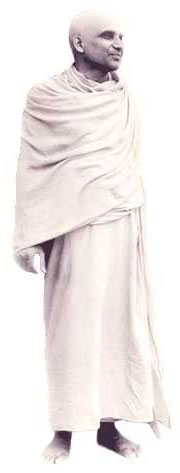
by Swami Krishnananda
Yet the great Teacher of the Bhagavadgita tells us that the others of a lesser category, who cannot come up to this level of the supreme devotion of self-identity with the Absolute, are also practicing religion in their own manner. Ye’py anya-devata-bhakta yajante sraddhayanvitah: They also worship God in one way or the other. Because of the faith that they have, they can be regarded as worshippers of God. They worship, not according to the rule of ideal devotion, but deviating from this rule, they meander in various abysmal regions due to the desires that they have not fulfilled. They are finally seeking God. The images that people worship and idols that they adore in the various religions of the world are temporarily taken as God Ultimate, and the wholeheartedness of divine devotion by these temporal idealists to the gods that are worshipped will justify that devotion. It takes a long time to reach the Supreme God on account of the error that is involved in their devotion, the error being that they consider their god as one among the many and distant or away from them. Hence this universal religion of the Bhagavadgita includes all faiths, whether they are of a lower degree or a higher degree, and each one is rewarded according to the nearness that characterises that particular devotion in respect of the presence of God. The nearer one’s consciousness is to the all-pervading God, the greater is the value of that religion. The more distant we feel God is in the worship of the religion, the lower is that category of this religion.
The absoluteness or supremacy of God is again asserted, in spite of this concession that is made towards lower categories of religions, when it is said that even the least of offerings can satisfy God. God does not ask of us rich presents, gorgeous articles or decorated things. Anything that we offer as a symbol or insignia of our inward feeling is enough to satisfy. What satisfies you is my attitude towards you, and not what I physically or materially hand over to you—that cannot be regarded as a correct demonstration of my feelings. The feelings of people are capable of speaking in a louder language than the words that are uttered through the mouth. Many a time people may be under the impression that they can hide their feelings, and with the veneer of language they can live an apparently social existence in a cooperative manner. But feelings are recorded in realms that are subtler than the physical one, and they shall come to the surface of experience one day or the other. The feelings that one entertains in one’s own heart are the real language that one speaks. The language is not necessarily the words that are uttered. The mind is the speaker, and the words are only outer expressions or forms that the thoughts or the feelings of the mind take. If the feelings are there, the words may not be there, yet the feelings shall work when words are uttered. The gestures are performed as visible expressions of the inner attitude that one has towards anything.
God is omniscient and sees all things with millions of eyes. God looks to the feelings rather than the words that are uttered, the prayers that the lips offer and the materials that are placed before the symbol of God as the sacrament, the prasad or the gifts. There is nothing material that we can offer to God, because nothing really belongs to us, and what does not belong to us cannot be offered as a gift. And so our offerings to God are a misnomer again, and they have a value only in the sense that they are the expressions of our feelings. As we offer a light or wave a lamp before the brilliance of the sun though the sun is not in need of a candle or an arti, and one does not have to perform ablutions with water to the ocean, likewise there is no need of any kind of offering to the Almighty. Yet our feelings shall be recognised. Even a leaf that is offered, even a drop of water that is sanctified in the name of God shall satisfy Him, because it is offered with love. Tad aham bhakty-upahrtam asnami prayatatmanah. What satisfies reality is reality alone; the unreal cannot satisfy the real, and the greatest reality is God’s existence and God’s Being. Any kind of counterfeit attitude, whether it is religious or otherwise, cannot touch the reality of the Supreme Being. Hence, the diplomatic adjustments that we make in human society cannot be transferred to the realm of the Absolute, and diplomacy will not work there. There is a heart-to-Heart communion—the heart speaks to the Heart of the universe. The soul communes with the Soul, and that which is the deepest in us enters into the bosom of That which is deepest in the whole cosmos. This is the consummation of religion. That is why what is interior is respected and regarded as of greater value than anything that is exterior. The deeper we go, the more real we become, and the more valuable is the expression. Hence, feelings are considered to be the greatest expression of devotion. Thus it is that God is considered to be a recogniser of feelings rather than of material offerings.
There is a great ethical point that is made out in this wondrous universal religion of the Bhagavadgita. There is no sinner in the eye of God. The idea of sin does not occur. The sin that we think of does not exist in the brilliant light of God-perfection. What we call a ‘sin’ is a dereliction, a deviation, a movement away from the centre. It is a tentative or a temporary mistake that the soul commits on account of its inability to visualise the present state of affairs with the great goal towards which it is moving. It is a blindness of vision that causes the commission of errors which, when they are related to the set-up of all things in the cosmos are called sins, and when they are committed with respect to mere human society are called crimes. But they are all stages that shall be passed, transcended one day or the other. No one can be a criminal or sinner for all time to come.
There are stages and stages of education. There are faltering steps that each one takes. We tumble down and fall into the pit many a time, only to wake up into the awareness that there is a pit and it has to be avoided. In the eyes of the all-seeing God, error is completely obviated, and the soul that commits a sin or error is taken into the fold of God one day or the other, because what God expects of anyone is a longing for Him. This longing may be expressed in many ways. The history of religion is a standing example of the variety that is there in the manner that devotees express their devotion. Many a time a most sincere form of devotion may look very odious in the eyes of polished or aristocratic human society. There were butchers, hunters, carpenters, shoemakers and farmers who knew not the elegancies of modern intelligentsia, but they were more sincere and more devoted to the great Creator than aristocrats.
There is a very touching scene described in the life of a great saint called Kannappam, whose devotion would stun you simply at the crudity in which it was expressed. But the sincerity and the genuineness of it was such that it excelled any other form of conceivable devotion. Usually it is not easy for ordinary human beings to imagine what sincere devotion to God is. We are accustomed to rituals, formalities and outward expressions standing in collaboration with human etiquette, etc. But devotion goes above etiquette and even ordinary social morality, all which was defied completely by the great devotees, to the confounding horror and fear of the society in which they lived. These devotees had to pass through various trials and tribulations. Many a time they were subjected to undeserved pains on account of the incompatibility of the state or stage in which they were in their divine devotion and the prosaic form of ethics which human society respected at those times. Often the saint or the sage suffers on account of the kind of society in which he is placed. The incompatibility is there; we can read about the lives of those great saints and sages who had to bear witness to the devotion that they had to the Supreme God and also to the ordeals of human society.
Such devotion is rare to find, because rarely does the soul express itself. What expressions we demonstrate outside in the form of religion are mostly social in character, and they are conditioned by the formalities of human society. Unconditioned devotion, transcending all limitations, social or otherwise, is rare to find, but it is a state through which everyone has to pass. That supreme form of devotion is called parabhakti, where one dances in the ecstasy of God-vision, wherein placed one recognises the magnificence and the beauty of the Eternal in the ugliness of the temporal. Sin and error, whatever be their magnitude, even if they are like mountains in their size, shall be destroyed by the fire of divine devotion. Errors, mistakes and sins that have been committed in past ages or births through which one has passed, innumerable though they may be, will be destroyed like heaps of straw that can be set fire to by the striking of a matchstick. When we wake up into the consciousness of the reality of the world, all the tribulations of the dream world are cancelled at one stroke—so are the values of this world. All rules and regulations, whatever be their nature, get cancelled at the touch of the light of the day of divine consciousness, even as all values of dream get cancelled at one stroke by a mere waking into the consciousness of the world in which we are today.
So there is a transfiguration of values when the soul rises to God-consciousness, and the mortal does not remain mortal anymore. The immortality that is attained is not a length and duration of individual persistence, but an expansion of the soul’s consciousness to the infinitude of God’s Being. We say sometimes that the river enters the ocean—well, the ocean has become conscious of itself, as it were. Such a magnitude of attainment is unthinkable. “Whoever wholeheartedly concentrates his entire being upon Me, such a person is redeemed by Me,” says the great Master.
What we are expected to perform or do in our religion or spirituality is to put together of all the parts of our personality and offer it to God. This is called self-surrender—atma samarpana or saranagati. Instead of offering a banana or a coconut, one offers oneself to God, because that is the last thing that one would offer. We are prepared to part with what we have, but we cannot part with our own selves, because the dearest thing is not what we posses—the dearest thing is our own self. That we cannot part with, even in the case of God. The ego is never prepared for this painful ordeal, but one realises that dying to the temporal existence is to live in the eternal Being. One knows for certain that sharanagati or self surrender, the offering of one’s self in jnana yagna or bhakti or devotion, is no doubt a total annihilation of the local individuality. It is the death of the ego and destruction of everything that we regard as worthwhile in this world. It is terrifying indeed even to imagine, but it is an awakening into the cosmic emperorship of the soul of man—the enthronement of oneself in the supreme infinitude of the Godhead.
So the religion of the Bhagavadgita, which is concisely presented in the ninth chapter, is not a religion that we usually see practiced in this world, but a soul speaking to God, a rousing of the spirit within to the all-comprehensive reality that is present in all religious faiths, cults and creeds, and which far transcends the concepts of God held as supreme by the various religions of the world. The temporal religions of mankind are transmuted into this eternal religion of the Absolute. Here, no distinctions of any kind can count as worthwhile. There is a complete permeation of the universal meaning of religion into the several particularities of forms of worship, prayer, etc. Hence, when the Great Being speaks this immortal gospel of the Bhagavadgita, He gives us a message of religion which is consistent with the rule of the universe, the structure of the cosmos and the essential Being of God Himself.