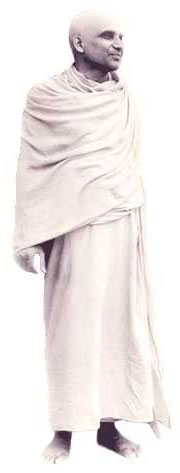
by Swami Krishnananda
Tat premāt mārtham anyatra naiva manyārtha mātmanah, atasat paramaṁ tena paramā nandata’tmanaḥ. All joy that we feel in respect of external things is actually a foisting of the basic Atman bliss upon the objects outside – the bliss of our own Self. The objects are not the cause of our happiness. We are the cause of the happiness that we wrongly feel in objects. So we conclude hereby that bliss supreme is the nature of the Atman. Therefore, we also conclude that the Atman is supreme bliss unparalleled, incomparable, non-temporal. Eternity is the nature of this bliss of the Atman that we are.
Itthaṁ saccitparānanda ātmā yuktyā tathāvidham, paraṁ brahma tayoś caikyaṁ śrutyan teṣū padiśyate (10). Because of the universality of the consciousness of the Atman in us, it is Brahman also in essence. When we consider consciousness as present in us individuals, we call it the Atman. When we consider this consciousness present everywhere in the universe, universally, we call it Brahman. This Atman being the same in essence as the Universal Consciousness, the Atman is identical with Brahman: ayam atma brahma. Through analysis and logical investigation, it has now been proved that sat-chit-ananda, Existence-Consciousness-Bliss, is the nature of the Atman. It is also proved that it is basically bliss in its nature. That is the nature of Brahman also. Brahman is Existence-Consciousness-Bliss Absolute. So is the Atman.
Satyaṁ jñānam anantam brahma (Tait. Up. II-1), says the Upanishad. This Brahman, the Absolute, is Truth-Knowledge-Infinity, and it appears to be locked up in this body and mind complex. That is the source of this individual consciousness. By sruti, or scriptural statement, and also by logical argument, we come to the conclusion that bliss and self consciousness constitute the essence of Atman.
All these verses that we have studied now, from the beginning to the ninth, is a kind of logical analysis which establishes the nature of the Self as independence, freedom, eternity, and bliss.
The scriptures also proclaim this. The Ishavasya Upanishad says, īśavāsyam idaṁ sarvam (Isa 1): All this universe is pervaded by God. And the Kenopanishad says, “Who is the thinker behind the thought? Who is the hearer of the ear?” etc. It establishes consciousness behind sense functions. The Kathopanishad and the Mundakopanishad established the existence of a Universal Consciousness prior to all concepts of space, time and objectivity. The Chhandogya and the Brihadaranyaka Upanishads highlight the greatness of Brahman as the only reality. So the scripture corroborates this philosophical, logical analysis through which we have arrived at the conclusion that Atman and Brahman are inseparable and they constitute one reality, namely, Existence-Consciousness-Bliss.
Now we have a peculiar quandary here. If this Self is not known at all, it would not be a source of joy and self love. How could we love ourselves unless the Self is manifest in some way? If the Atman is totally obliterated from our experience, we would be like stones, rocks, granite. We would not even know that we are existing. Why do we love ourselves so much? The love that we evince in regard to ourselves shows that it has to be revealed in our life in some form.
Abhāne na paraṁ prema bhāne na viṣaye spṛhā, ato bhāne’pyabhātā’sau paramā nandatā tmanaḥ (11). Abhāne na paraṁ prema: The supreme bliss that we evince in regard to ourselves cannot be explained, cannot be accounted for if it is totally obliterated and we are oblivious of its very existence. But if we say that it is really manifest, why do we love objects of sense? The love that we evince in regard to the objects outside shows the Self is not manifest properly. But if it is not manifest, then why do we love ourselves? Here is a quandary before us. If it is manifest, the objects cannot attract us. If it is manifest, the objects cannot be the sources of apparent joy. If it is not manifest at all, we would be like inanimate objects. We will not have any love for ourselves. We must explain this situation. Why this dual situation in which we find ourselves? On the one hand, it appears to be revealed; on the other hand, it does not seem to be revealed at all.
Abhāne na paraṁ prema: If it is not revealed, no self-love is possible. Bhāne na viṣaye spṛhā: If it is revealed, object-love is not possible. Ato bhāne’pyabhātā’sau paramā nandatā tmanaḥ: Therefore, the supreme bliss of the Atman is indistinctly revealed; it is not distinctly revealed. If it is distinctly revealed, we will never talk to anyone in the world afterwards. We will never look at anything, and we will have no dealings with anything in this world. It is not so distinctly revealed, so our mind sometimes distracts us in the direction of an object outside. After all, it is not clear whether the Self is manifest or not. It is not clear whether it exists at all because it is not felt in the form of happiness in life; so it runs after objects.
But sometimes it appears that we are important persons. We have got self-respect. We feel very hurt if we are insulted. We love ourselves. How can we love ourselves if the Self is not manifest? This peculiar dual character of the Self requires a kind of explanation. The author of the Panchadasi has an illustration to tell us how there is a mix-up of two aspects in our self.
Adhyetṛ varga madhya stha putrā dhyayana śabda vat, bhāne’pyabhānaṁ bhānasya prati bandhena yujyate (12). He gives an illustration as an example. Suppose there is a large group of Vedic scholars, students chanting Veda mantras loudly: Sahasraśīrṣā puruṣaḥ sahasrākśaḥ sahasrapāt, sa bhūmiṁ viśvato vṛtvā'tyatiṣṭaddaśāgulam (Purusha Sukta 1). Some fifty or a hundred boys are loudly chanting Veda mantras. There is a big chorus, and they are making a big noise. The father of one of the students is standing outside and listening to the chanting. In the crowd of the boys, he cannot distinctly hear the voice of his son. Yet by a little bit of concentration, he can indistinctly hear the voice of his son also. He must be a little concentrated – closing his eyes and listening to the loud chorus. In the big multitude of voices, he can sometimes hear the voice of his own son. He can indistinctly hear his son's voice because of his acquaintance with that voice.
If twenty people are talking, I can hear the voice of some people with whom I am acquainted, whom I have seen, in spite of the big multitude of noises – but I cannot hear them clearly, because there is an overwhelming sound coming from others sources, due to which without proper concentration, I cannot hear them clearly. Obviously, openly, it is not audible. But with some concentration and attention specifically paid, it is possible to hear it.
In the case of the father hearing his son chanting Veda mantras in the midst of many other students in a large classroom where the voice of a particular student can be heard only indistinctly, and not distinctly, the voice is both revealed and not revealed. From one point of view, the voice of the son is not revealed. He cannot hear the voice of his son. Yet, it is revealed. Revealed, and not revealed – both define the character of the sound of one boy, in the case of the father who is listening to it.
So is the case with the Self. There is a big multitude of noise – a huge clarion call of sounds that the sense organs and the mind, with all its desires, make. In this multitude of noises made by the mind and the sense organs, we are not able to distinctly locate the voice of the Self inside us. There is some obstacle which prevents us from distinctly knowing that there is a Self inside. The large noise of the senses and the desires appears to drown the little voice of the Self, or the soul inside.
Thus, there is a big obstacle before the Self which wants to reveal itself. In spite of this difficulty faced in manifesting itself – the large sounds made by the sense organs, etc. – it sometimes tries to reveal itself in intense longing for endless possessions, long life in this world, intense love of oneself, and a pleasure one feels in being alone by oneself. These are indistinct characters of the manifestation of the Self, but not distinct characters.
Because of the fact of the indistinctness of the manifestation of the Self in us, sometimes we feel entangled in the objects outside, and sometimes we feel fed up with the world. Every one of us has moments when we feel that we have had enough of things. But we also have occasions when we feel that it is not easily possible to withdraw ourselves from the world. Sometimes we feel the world is too much for us. We cannot be entirely free. Sometimes we feel we should not think of anything in the world. These two characteristics in our mind occasionally manifest themselves because of the dual character of the manifestation of Self – sometimes distinctly when we are totally Self conscious and introverted, as in meditation, and very indistinctly when we are thinking of the objects of sense, leading finally to a disgust with them.
Adhyetṛ varga madhya stha putrā dhyayana śabda vat, bhāne’pyabhānaṁ bhānasya prati bandhena yujyate: This obstacle that is preventing us from knowing ourselves is of two kinds, known as the asti and bhati aspects of the Self getting negatived. Does God exist? He does not seem to exist, because there is nothing to show that a thing called God exists. Do we know God in some way? There is nothing to show that we have any knowledge of God at all. Thus, this ignorance, this obstacle before the Self, manifests itself on the one hand as the denial of the existence of the basic Reality, and on the other hand the denial of the possible knowledge of the basic Reality.
The obstacle manifests itself on the one hand by a thing called avarana, and on the other hand by another thing called vikshepa. Avarana means the screening off of the universality of consciousness so that we can never have any occasion to know that there is anything called Universal Existence. Vikshepa is the compulsion that we feel that we individually exist and are involved in the objects of sense.
We have received two punishments. We are prevented from knowing that there is such a thing called the Universal, and we are totally brainwashed negatively into the compulsive feeling that we are individually existing. Well, let us not be conscious of the existence of the Universal. But why should we be further punished with this compulsion to know that we are bodily encased?
Thus, there is a double punishment meted out to us by something. No one knows how it happened. On the one hand, we do not know the reality. On the other hand, we know the unreality. It is enough for us. No further punishment is conceivable. The highest punishment has been meted out to us. Consciousness is obliterated by negativing its universality on the one hand and, on the other hand, the externality through space and time in terms of objects is impressed upon us.
Prati bandho’sti bhātīti vyava hārārha vastuni, tanni rasya viruddhasya tasyot pādanam ucyate (13). The creation of a non-existent externality is the real bondage, though it is caused by the actions of the consciousness of Universality.