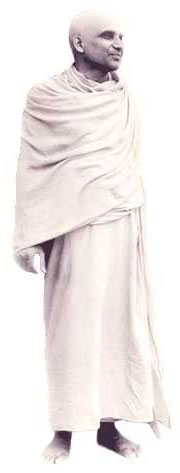
by Swami Krishnananda
Ādyo vikāra ākāśaḥ so’va kāśa svarū pavān, ākāśo’stīti sattattvam ākāśe’pyanu gacchati (60). What does maya create? In order that creation may be possible and conceivable, there should first of all be space and time. If there is no space and time, no creation is possible. Before conceiving the order of creation in terms of names and forms or in terms of the variety that is to be manifest, a background of the possibility of the manifestation of name and form has to be thought first.
The world cannot exist unless there is space and time, because what we call ‘world’, what we call ‘creation’, is nothing but extension and duration. Extension is space; duration is time. If there is no extension and there is no duration, there would be no existence of anything. All objects in the world, including our own bodies, are combinations of spatiality and temporality together with externality, characteristic of space itself. Hence, the origin of creation is nothing but the manifestation of space first.
Many philosophies and religions hold the view that God created the world out of nothing. It is another way of saying that there was a necessity to project an emptiness in the beginning of things. We may call it space if we like, because space is something like emptiness. God could not manifest Himself as the world either by modifying Himself into creation or through the instrumentality of something other than Himself. There was the difficulty.
What is the material out of which God creates the world? There is no material external to Him. Nor could it be His own body. Will He rip His body and then manufacture the world out of it? We cannot conceive either of these possibilities. Therefore, religions which would prefer to defend the integrality of God even when accepting the possibility of creation hold that God created everything out of nothing.
Again we come to the point of nihilism. A kind of vacuum was there in the beginning. In the same sense as in dream, we first of all create a vacuous spatial and temporal condition in which we manifest names and forms by the projection of thought. God created the world in the same way, perhaps, as we create mental dreams.
The first creation, therefore, is spatiality. What is the quality of space? Accommodation, room, extension, the possibility of anything to exist – that is called avakasha. The quality of akasha is avakasha. Accommodation, room is the quality of space. This is the first evolute: akasha, space.
Ākāśo’stīti sattattvam ākāśe’pyanu gacchati. We say, "Space exists." When we make a statement like "Space exists," we understand that the spatiality of creation has also to be rooted in Existence, which is Brahman. Even the vacuous concept of space has to be rooted in Brahman, Pure Existence. If Brahman, which is Existence, is not to be associated with space, there would be no existence of space – which is another way of saying that it is non-existence of space. So even to imagine a vacuum, an emptiness or a sheer extension like space, we have to associate that concept of spatiality with Existence. That is why we say, "Space exists." The quality of space is, therefore, dual. It exists, and it is extended. Existence and extension are the two qualities of space.
Eka svabhāvaṁ sattattvam ākāśo dvi svathāvakaḥ, nāva kāśaḥ sati vyomni sa caiṣo’pi dadvayaṁ sthitam (61). Existence has only one quality – namely, Existence itself. Existence cannot have a quality other than existence. Therefore, unitary-ness is the nature of Existence. It has only one character: Eka svabhāvaṁ sattattvam. But space has two qualities: existence and spatiality.
Nāva kāśaḥ sati: Spatiality is not to be found in Brahman. Brahman is not extended like space, and is not measurable like the distance that we can see in space. Immeasurable is Brahman, whereas spatial extension is measurable by a foot ruler or a chain. That is the difference between space and Brahman Existence. Brahman is not measurable, while space is measurable. Vyomni sa caiṣo’pi dadvayaṁ sthitam: Oneness is the quality of Brahman; duality is the character of space – that is, existence and spatiality.
Yadvā prati dhvanir vyomno guṇo nāsau satī kṣyate, vyomni dvau sad dhvanī tena sadekaṁ dviguṇaṁ viyat (62). Reverberation of sound is also the quality of space. It can echo sounds. But no such echo is possible in Brahman, the Absolute, because extension in the form of spatiality is unthinkable in Brahman. Echo, sound production, reverberation, are not to be found in Existence, pure and simple, while it can be seen in space. Existence and sound are both to be seen in space; but in Existence, no sound is there. Existence is one. Space is pure.
Yā śaktiḥ kalpayed vyoma sā sadvyomnora bhinnataṁ, āpādya dharma dhamitvaṁ vyatya yenāva kalpayet (63). Maya has a peculiar quality of distorting facts. It makes us feel that Truth is untruth, and untruth is Truth. A total distortion of fact is necessary in order that we may be forced to believe in the reality of the world. It has to convert us into fools first and brainwash us totally before we are forced to accept that there is such a thing called the world outside. What does it do?
That shakti, that power, that maya which has become responsible for the creation of space as extension, somehow or other creates in our mind an illusion that spatiality and Existence are inseparable. Do we in our perceptual process ever recognise that Existence is different from spatiality? We see spatiality extendedness, of course, in front of us. But do we believe that this cannot be the nature of Existence? We confirm every day in our lives that Existence is the same as space; space is the same as Existence. And what do we say? Space exists.
Here we commit a great mistake even linguistically speaking, because when we say, "Space exists," we consider ‘space’ as a noun, the subject of the sentence, and ‘existence’ as the predicate. We give a secondary importance to Existence, and a primary importance to space. Space exists, building exists, table exists, this exists, that exists. The form which is actually a subsequent effect of Existence is given primary importance, and the original cause which is responsible for the manifestation of this form is given a secondary importance.
This is what maya does. It prevents us from recognising the fact that Existence is prior, and space is posterior. But what do we say? We always feel that Existence is posterior and the objects (space, etc.) are prior. So we give the importance of a substantive, or a noun, in a sentence to space, etc., and give the secondary importance of predicate to the Existence. Actually, Existence is the noun; space is the quality of Existence. But we make a confusion and reverse the order of cause and effect when we say, "Space exists." Space is not the noun; Existence is the noun. And Existence is not a quality of space; it is space that is the quality of Existence. So by reversing the order or precedence of cause and effect, maya creates the confusion in our heads.
Yenāva kalpayet: Topsy-turvy perception is the nature of human perception. That which is universal appears as an external thing; that which is a product, like individuality, looks like the subjective originality. We are late products; man came very late in evolution, and yet he thinks that he is primary, and he starts judging everything, even that which existed prior to him. Dharma and dharmi are substance and quality. The mix-up of issues in terms of substance and quality is taking place due to the operation of maya. Substance is Existence; quality is space. But in our statements, we always consider wrongly that space is substance and Existence is a quality. That is why we say that space exists. The sentence itself is erroneous in its construction. This is how maya works in us.
Sato vyomatva māpannaṁ vyomnaḥ sattāṁ tu laukikāḥ, tārkikā ścāva gacchanti māyāyā ucitaṁ hi tat (64). What has happened? After all, poor Existence has become space. It has been reduced to the vacuous condition of extension – while Brahman Consciousness, which is indivisible, cannot become vacuous, and it cannot become an extension.
Logicians like the Nyaya and the Vaishesika philosophers, thinking like ordinary children, caught up in this maya of the confusion of issues between substance and quality, assert that space is one of the ultimate categories of Existence. According to Nyaya philosophy or Vaishesika philosophy, there are nine realities: earth, water, fire, air, ether – the five elements – then time (they consider time also as an independent existence), extension (that is seven), mind (which is eight), soul (which is nine). These are the nine independent substances accepted to be ultimately independently real by themselves, according to the Nyaya and the Vaishesika philosophies.
Space also is considered as an Ultimate Reality. That is, they have mixed up between two issues. The Naiyayikas and the Vaishesikas, the logicians, wrongly think, like prattling children, that Existence is the quality of space, while actually Existence is not a quality of space. We should not say, "Space exists." The sentence itself is wrongly construed. It is a work of maya.
Yadyathā vartate tasya tathātvaṁ bhāti mānataḥ, anyathātvaṁ bhrameṇeti nyāyo’yaṁ sārva laukikaḥ (65). Right perception alone can give us a vision of Reality as it is in itself. But maya will not permit us to have right perception. The processes of sensory perception, inference, and all logicality based on the duality of concepts – all these are based on maya because they are based on certain assumptions which are unfounded, basically.
The externality of the world is taken for granted, while the world is not external, it is Universal Existence; and the perceiving consciousness is also considered as totally independent of the object that is perceived. This is the defect of modern science. This also is the work of maya. Neither does the consciousness perceive independently of the object of perception, because by assuming such a thing, we will not perceive anything outside at all, nor is it true that the world is external. It is total inclusiveness. So, how does maya work?
Right perception is impossible under ordinary conditions of sensory operation and intellectual activity. Only direct intuition independent of the senses and mind will give us an idea as to what truly exists. The senses, intellect, and argumentation based on intellectually construed logic can never give us an idea as to what truly exists. We are always blindfolded and move from place to place, walking in darkness, groping for a little grasp of Truth, and finding it nowhere in the world. Blind men are led by blind men in search of light. This is the analogy before us. All our search for Truth in this world is like a blind man groping in darkness for a little ray of light, which he will never find. This is how the maya works. Anyathātvaṁ bhrameṇeti nyāyo’yaṁ sārva laukikaḥ.
Thus, evaṁ śruti vicārāt prāg yathā yadvastu bhāsate, vicāreṇa viparyeti tatas taccintyatāṁ viyat (66). We have to thoroughly investigate into this situation, like a medical diagnosis. What has actually happened to us? How could it be that we make such a blunder in commonsense perception where we say that this body exists, I exist, etc.? Existence is considered as a predicate even in the case of our own individuality. Therefore, both in the case of the objective world of the five elements and in the case of the subjective world of the five sheaths, a thoroughgoing analysis is to be conducted in order to separate Pure Existence from the imagined externality, temporality and objectivity – which subject is taken up in the following verses.