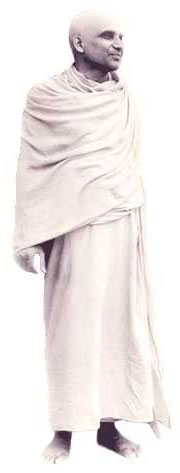
by Swami Krishnananda
Sa vetti vedyaṁ tat sarvaṁ nānyas tasy-āsti veditā, viditā-viditābhyāṁ tat pṛthag-bodha-svarūpakam (18). All that is to be known is known by it. That which cannot ordinarily be known by available means of knowledge also is known by it. Even the apparently unknowable is known by It. Vidita and avidita are the terms used in the Kenopanishad. Vidita is that which is known; avidita is not yet known. The not-yet-known may also be that which cannot be known.
The fact that we are asserting that something is incapable of being known implies our having known it in some way. The negation of the knowledge of something is indirectly an acceptance of the possibility of knowing something, because no one can deny a non-existent thing. It must be there in some form; else, nobody will make a denial of it.
It is a universality that is covering the entire existence, part of which is the object of our empirical knowledge and the larger part of it is left unknown to empirical means of knowing – unknown because of the fact that our faculties (intellect, mind, etc.) have a limited area of action. Their jurisdiction is limited. They cannot go beyond the horizon of knowledge. That is the reason why we seem to know very little, and even that little that we know seems to be faulty knowledge. It is not a genuine and ultimately reliable thing.
But here is one principle behind us that is enveloping all things, outside as well as inside. By enveloping things outside, it becomes the source of the knowledge of objects externally there; and being inside everything, it becomes the source of knowledge itself. It connects the object with the subject because of its all-pervasiveness. It knows all things because it exists as the knower in each individual. It is the pure subjectivity in us and, therefore, it is the knower of all things.
On account of its universality, it also becomes the connecting link between the knower and the known. For the same reason, it also becomes the object itself, even as one single mass of water (which is the ocean) is at the back of the rising of one wave and another wave, wherein one collides with the other and also acts as the medium of the connection of one with the other. The one wave is the ocean; the other wave is also the ocean. The action of colliding is also the ocean because of the ocean being there at the back, at the bottom of the two waves.
So is the case with this collision of consciousness, if we can put it in that way. The subjectivity aspect of it becomes the knowing principle, the objectivity aspect of it becomes the object of knowledge, and the link that is there as necessary for the purpose of knowing anything at all is also itself, as the ocean is between the two waves.
Bodhe’pya-nubhavo yasya na kathañcana jāyate, taṁ kathaṁ bodhaye-cchāstraṁ losṭaṁ nara-samā-kṛtim (19). After having said so much, if we say, “I cannot understand what consciousness is,” it is impossible to instruct us. The author says if a person is more like a stone rather than an intelligent individual, what kind of instruction can be imparted to that person? Despite there being a direct perception of consciousness in daily life – which is obvious because of the very fact of knowing things – yet we put a question, “Where is consciousness?”
How could we put a question, “Where is consciousness?” unless we are already conscious of the question that we are raising? So the question becomes redundant. We cannot instruct a person who is unable to argue properly in a syllogistic manner, and who is like a person who has a tongue putting a question whether there is a tongue or not – because if there were no tongue, the question itself would not have arisen; he would not have spoken a word. So is the person who puts a question, “Is there consciousness?” If consciousness had not been there, he would not have even spoken. Even the question would not have arisen.
Jivhā me’sti na vetyuktiḥ-lajjāyai kevalaṁ yathā, na budhyate mayā bodho boddhavya iti tādṛśī (20). It is a meaningless, absurd question to ask whether the tongue exists or not because if the tongue is not there, how would we speak? Similar is this absurdity behind the question of whether consciousness can be known or not. It is directly known, and is at the background of even the question whether it can be known or not. It is at the background of even the doubt whether it exists or not. Therefore, any attempt at refuting the ultimate existence of consciousness is impossible.
This consciousness is the Atman. This is the pure Self. And inasmuch as it is not in one place only, it is not your Atman, my Atman and somebody else’s Atman. It is the Atman of every little atom in the cosmos. Therefore, it is the universal Atman. Because of the universality of the Atman, we call it Brahman, the Absolute. When Brahman is conceived as the subjective principle of individuals, it is called Atman. When the Atman is known as an all-pervading Universal Principle, we call it Brahman. Therefore, Atman is Brahman.
Yasmin-yasminn-asti loke bodhas-tat-tad-upekṣaṇe, yad-bodha-mātraṁ tad-brahmeti-evaṁ dhīr-brahma-niścayaḥ (21). Here the author gives a practical suggestion for daily routine. We can eliminate the involvement of consciousness in objects by a little bit of concentration in daily life.
If you are aware that there is a tree in front of you, try to put a question to your own self: “Who is it that is aware that there is a tree in front?” Eliminate the objective aspect of the tree being there as something outside in space and time. Eliminate even the process of knowing, which also is in space and time. Also eliminate all the five sheaths through whose medium the consciousness seems to be aware that there is a tree outside. Go inside gradually, stage by stage: from the tree, withdraw into the process; from the process, withdraw into the perceptive organs; from the organs, go inside into the mind; from the mind, go into the intellect, and finally to that which is causing the intellect to shine.
The intellect and the mind are like mirrors. A mirror has no light of its own. A mirror does not shine by itself; it shines only when light falls on it. Similar is the case with the intellectuality, or the rationality, or the intelligence of the intellect. The intelligence in the intellect is the light that is shed on it, as on a mirror, by the Atman that is within, but because of the confusion that has taken place between the Atman and the medium which is the intellect, we begin to feel that we know things.
By a careful analysis of the objectivity involved in knowledge, we can go into the deeper subjectivity of it. This is the practice that we have to carry on every day in order that we may not get involved unnecessarily in the world of objects. This is called Brahma-niscayah, the ascertainment of the existence of Brahman. Every minute we have to be conscious that Brahman exists. It is another way of saying consciousness exists – not merely consciousness of mine or yours, but consciousness as such.
All knowledge, whether it is of a positive nature or a negative nature – by affirmation or negation, whatever it be – all knowledge is a manifestation of a principle that defies definition in any type of language. It is Brahma-niscayah.
Pañca-kośa parityāge sākṣi-bodhā-vaśeṣataḥ, sva-svarūpaṁ sa eva syāt-śhūnyatvaṁ tasya durghaṭam (22). If we go deeper and deeper, from the physical body inwardly until we reach the causal body, and then eliminate contact even with the causal body itself, with great power of discrimination we will realise that we are there as an uncontaminated awareness.
The condition of deep sleep is a great instance here on the point. Ordinarily this kind of elimination of objectivity from consciousness is difficult. It is like peeling one’s skin. We cannot do that. It is part of our body. How will we do it? So objects have become so much a part of our consciousness that this talk of eliminating objectivity from consciousness is impractical for all ordinary persons, unless there is assiduity behind the practice; and the success will be there only after years and years of such a practice.
It is only in deep sleep that we can have some inkling of the possibility of our being totally independent of connection with objects. Here is a practical illustration before us that we were there, isolated from objects of every kind in the world. Even if we were an emperor, a ruler of the whole world, with all the wealth of the continent – what does it matter? We have been isolated from it in deep sleep. All the glory of which people are generally proud vanishes in one second when they go to sleep because all this external glory is a foisted association. It is not the true nature of oneself. In spite of there being no food to eat, nothing to drink, no money to touch, no friends to talk to, nothing that we can call our own – in that condition we are so happy, while we are miserable when we have so many things in the waking world. With all the appurtenances of life, people are grief-stricken, while with nothing available in sleep, we are very happy. Therefore, the possession of objects is not the source of happiness. The non-possession is the source of joy – so that when we possess nothing, not even the body, we remain as isolated, uncontaminated bliss. We have been in that state in deep sleep, but we never go into the mystery of what is happening to us. We get up in the morning, and what do we do? We plunge into the daily activity which was left unfinished the previous day. So the earliest activity of ours is work only, and then there is no thought of what actually happened to us in deep sleep.
In the early morning it is necessary for us to sit quiet for a few minutes and put a question to our own self, “Where was I for so many hours when I was not aware of myself? Was I aware? No. Was I existing? Yes.” In what condition were we existing?
We did not exist in sleep as an emperor of the world. We did not exist as a rich person or a poor person, neither as a healthy person nor as a sick person, neither this nor that. What was it that we were existing as? That is our essential nature. If contemplation of this kind can be carried on for a long time, we will really be detached from the world and we will want nothing afterwards. Everything will come to us spontaneously.
Asti tāvat-svayaṁ nāma vivādā-viṣaya-tvataḥ, svasminn-api vivādas-cet prativādy-atra ko bhavet (23). The conclusion, therefore, is: There is such a thing as the Self. All this study has led us to the conclusion that there is such a thing called the Self. It has to be there, and it is there. It must be there; it is very clear that it is there. It is not the object of argument, doubt or any kind of disputation because argument, doubt and disputation are conducted by the very consciousness about which we are carrying on this disputation. Therefore, indubitable, indisputable, and firmly established certainty is this Self which is not in possession of consciousness, but is itself consciousness. The Self is not conscious; the Self is consciousness. The very substance of the Self is consciousness. If we can doubt our own Self, then who can instruct us? Who can teach us?
No one doubts one’s own Self. No one thinks, “Do I really exist?” Nobody feels like that. The certainty that is there at the back of one’s feeling of one’s own existence is the proof of the Self being there. And the possibility of existing even independent of the five sheaths in deep sleep is proof enough of it being consciousness. So what is established now is that there is the Self – and it is Pure Consciousness.