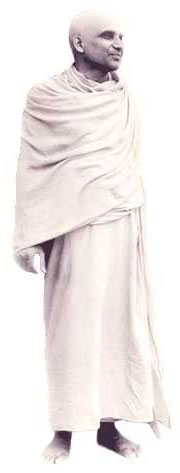
by Swami Krishnananda
Īśena yadyapy-etāni nirmitāni svarūpataḥ, tathāpi jñānakarmābhyāṁ jīvo’kārṣāttadannatām (17). Actually, the trouble does not arise from Ishvara who created these things. Grains, etc., are not manufactured by us; they are the action of God. We only throw the seed on the ground, but we cannot produce the grain. That is done by the will of God, and the offerings reach the divinities due to some operation of the will of God Himself. Even the milk production from cattle is not our action, and the cows do not deliberately think the process. Some natural process takes place, which is also to be attributed to God.
The mind, the process of speech and the breath are all phases, aspects of the five elements sabda, sparsa, rupa, rasa, gandha – prithivi, apah, tejas, vayu, akasha – about which we have already studied in the earlier chapters. All these are God-made. How is it that they cause trouble to us? The reason is that in spite of the fact that things, including even the mind, the speech and the prana, are products of God’s will, what happens is that we appropriate these to our own selves. “This is my field, this is my cow, this is my house, and this is my body.” This ‘my’ business has started, which is not to be attributed to Ishvara.
There is no ‘my’ consciousness in Ishvara because there is no outside object and, therefore, nothing can be called ‘mine’ in Ishvara. We see things outside and isolate ourselves from other individuals, and create a situation where we begin to feel that something belongs to us, something does not belong to us. We like certain things because they appear to belong to us, and we dislike certain things because we think that they are not ours.
Tathāpi jñānakarmābhyāṁ jīvo’kārṣāttadannatām: The very thing that God has created becomes the source of sorrow for the human individual on account of the creation of ‘my-ness’ in things – attachment, in simple terms. God has no attachment, but individuals are nothing but bundles of attachments.
Īśakāryaṁ jīvabhogyaṁ jagad dvābhyām samanvitam, pitṛjanyā bhartṛbhogyā yathā yoṣit tathe ṣyatām (18). The world is created by God, but it is enjoyed by the individual. God does not enjoy this world. The question of enjoyment does not arise, because God is Pure Being. And this Pure Being beholds; God simply beholds, and that is His satisfaction. But we will not be happy merely by beholding a thing. It has to become our personal property. It has to become part and parcel of our personality. Our ego has to be satisfied. Here is the difference between jiva consciousness struggling in the mire of ignorance, and Ishvara consciousness which is just looking, unconcerned – like the bird which is described in the Mundaka Upanishad.
For instance, a woman is born as a daughter to her father, but she becomes the wife of somebody else. The very same person is viewed in two different ways and it appears as if the woman has two personalities, when viewed by the husband and by the father. And such a difference is created by these two persons (father and husband) that she looks like two individuals, while really she is one independent person and cannot be viewed in two different ways.
So is the case with this world. Though it is one universal substance, it is viewed in one way by the Father, the Supreme Being, who wants nothing from the daughter or the son. And here, the jiva is in the sense of possession of property, making a distinction between itself and Ishvara.
Māyā vṛttyā tmako hiśa kaṁkalpaḥ sādhanaṁ janau, mano vṛttyātmako jīv asaṁkalpo bhoga sādhanam (19). Creation of the universe is the act of God through the instrumentality of maya which is shuddha sattva pradhana. Mano vṛttyātmako jīv asaṁkalpo bhoga sādhanam: The idea of enjoyment and possession arises on account of there being no shuddha sattva pradhana in the jiva. There is only the mind, which is characterised by rajas and tamas; therefore, it wills in terms of longing – like and dislike. The jiva wants to enjoy. It cannot be happy merely by being. We cannot be happy by merely existing in the world, whereas God is happy merely existing. This is the difference between us and God Almighty. We can never be happy merely existing. Here is the point.
Īśanirmita maṇyādau vastu nyekavidhe sthite, bhoktṛ dhīvṛtti nānātvāt tadbhogo bahu deṣayate (20). For instance, there is a gem, a jewel dug from the earth – a precious stone. It is created by God; we cannot manufacture a gem like that. It is identical to everybody’s perception. A monkey can see it, a dog can see it, a man can see it, and even an insect can crawl over it. It is self-identical, unconcerned, existing by itself as what we call the gem. But it is viewed in different ways by different perceivers – those who think that they can possess it, and those for whom it has no meaning at all.
Hṛṣya ty eko maṇiṁ labdhvā drudhya ty ano hyalā bhataḥ, paśyaty-eva virakto’tra na hṛṣyati na kupyati (21). A person who possesses the gem is happy. But the one who loses it is very angry. See how it is that the very same object can cause happiness in one person and anger in another? Paśyaty-eva virakto’tra: But a sage is indifferent to the existence of the gem. The very same gem causes joy in one person, anger in another, and indifference in a third person. How can we explain this?
The explanation does not lie in the gem. The gem itsel is unconcerned with the feelings of these people. But the trouble has arisen on account of the reaction produced by the minds of the three different categories of people. The sage simply sees, beholds. Na hṛṣyati na kupyati: Neither is he happy if it is in his hand, nor is he unhappy if it is lost.
Priyo’priya upekṣya sceti ākārā maṇigās trayaḥ, sṛṣṭā jīvair-īśa-sṛṣṭaṁ rūpaṁ sādhāraṇaṁ triṣu (22). The quality of a gem, therefore, is threefold: desirable, not desirable, or an object of complete neglect. If the jewel is ours, it is desirable. If the jewel has gone into somebody’s hand, it is not desirable. And in the case of a sage, it is an object of total unconcern.
Sṛṣṭā jīvair-īśa-sṛṣṭaṁ rūpaṁ sādhāraṇaṁ triṣu: The world of God, this creation which is the manifestation of God, is viewed in a similar manner in various ways by the individuals on account of the difference in their mental structure – though the object, the world as such, is the same for everybody. Right from creation until dissolution, it will not change its substance. It is the same. But this human history has demonstrated the turmoil through which people can pass in regard to the very same thing that has been existing throughout eternity.
Bhāryā snuṣā nanāndā ca yātā māte tyanekadhā, pratiyogi dhiyā yoṣid bhidyate na svarūpataḥ (23). A person says, “This is my wife.” Another says, “This is my sister-in-law.” Another says, “It is my daughter-in-law.” Another says, “It is my niece.” And someone else says, “It is my mother.” Now, what is this woman by herself? We mostly define ourselves in this manner.
Who are we, sir? We cannot say anything about ourselves, truly speaking. All our definitions are meaningless definitions because they are in connection with what we are not. “I am the son of Mr. So-and-so.” Otherwise, what are we, if we are not the son of So-and-so? Are we also something? Why should we say that we are the son of So-and-so? “I am an officer in the government.” “I am a shopkeeper.” “I own a tea shop.” “I am a labourer.”
We have no way of describing what we are except in terms of what we own or what we do. Independent of what we do and what we own, are we also something? Suppose we own nothing and do nothing. Do we become non-existent? See how confusedly we define ourselves: we say this person is something to us though for another person, the same individual is another thing altogether.
Pratiyogi dhiyā yoṣid bhidyate na svarūpataḥ: On account of the perceivers’ difference in mentality, on account of ownership and changes in doership, the same individual looks different. Now, does the individual really become different?
There is a judge in the Supreme Court, and he looks thus to the lawyers and the clients. He is another thing when he comes home and has a little child to take care of. Has he become a different person? He is really a different person, in one way. The way he thinks in the court is different from the way he thinks in the home. And he thinks about himself in a third way altogether when he is totally alone in a bathroom, for instance. He has some peculiar view of himself there. Now what kind of person is he individually? We can have hundreds of definitions for the same person on account of external relationships and changes of circumstance.
Nanu jñānāni bhidyantām ākarastu na bhidyate, yoṣid vapuṣya tiśayo na dṛṣṭo jīva nirmitaḥ (24). Our idea of a thing may change, but the thing itself cannot change. Therefore, do not unnecessarily create problems in life. This is an instruction for us. Pratiyogi dhiyā yoṣid bhidyate na svarūpataḥ: As in the case with a woman or a father or a mother, etc., individually they are the same individuals. They never become different on account of the relationship. Yet on account of the perception of only the relation, minus the individuality of the person, we create problems in life.
There is a daughter who is very happy with her father. After marriage she goes to her in-laws, and hell descends on her immediately. Why should it be like that? This is what happens every day in this world.
Maivaṁ māṁsa-mayī yoṣit kācid anyā mano mayī, māṁsa mayyā abhede’pi bhidyate he mano mayī (25). Though the mother and the wife are identical individuals, they differ totally on account of the experience, as in the case of the daughter. She will cry because of the suffering she has in her in-laws’ house; and she will become very happy when she goes to her mother. What has happened to her? She is the same person, the same mind, same intellect, same body. External relationship has transformed her individuality into a false definition of herself, which is also the false definition imputed to her by other people. Mental creation is different from the physical creation of God.
To a tiger, every human being is only food. It does not think that it is a king, a child, a man, woman; no such idea is there. It is food. That is the viewpoint of a tiger.
Bhrānti svapna manorājya smṛtiṣ vastu mano mayam, jāgran manena meyasya na mano maya teti cet (26). A great difficulty arises now. Does the mind really change the object? Really speaking, the mind cannot change the object. It cannot change a tree into something else. And yet, the mind seems to be determining the object to such an extent that all our sorrows are due to the mental reaction produced in respect of things outside. Life would be meaningless if mental reactions were not there. These things are to be there, and are to be viewed exactly in the way they exist independently by themselves. In spite of the fact that objects are just what they are by themselves, they appear to be totally different – without which factor, life would not be the sorrow that it is.