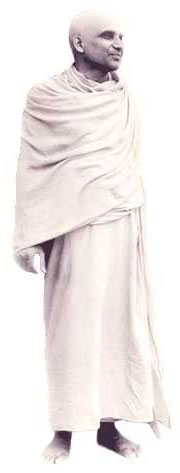
by Swami Krishnananda
Svānu bhūtāva viśvāse tarkasyā pyana vasthiteḥ, kathaṁ vā tārkikaṁ manyaḥ tattva niścaya māpnuyāt (29). If we say that direct experience is not possible and logic is also futile, there would be no way of knowing anything in this world. Either we should have the power of proper reasoning of a positive nature which will give us some kind of indirect knowledge of what is happening, or we should have direct experience or realisation. If we deny both aspects, then neither logic is possible nor experience is practicable, and we will then be in the same old condition of ignorance. Spiritual progress would not be possible.
Logical arguments, ratiocination and intellectual study are finally not of any utility in Self-experience. But it gives this support to us in the sense that it can lead us to a higher experience in the form of an indication of what is above it. The limited consciousness indicates that there is something that is beyond limitation. The finitude that we are experiencing is suggestive of something that is not finite. In that sense the reason is helpful, even if by itself it is not ultimately valid.
Buddhyā rohāya tarkaścet apekṣeta tathā sati, svānu bhūtyanu sāreṇa tarkyatām mā kutarkyatām (30). Arguments of any kind should not go against scriptural ordinance. Every kind of logical deduction should be in the direction of a positive attainment of truth. We should not be led to nihilism, regressus ad infinitum, circular reasoning, or vicious arguments, etc. That is not proper argument. All logic should be a proper deduction from premises that are accepted, and they should be positive in the sense that they will lead us to Truth; otherwise, what is the use of arguing? Where is the need for logic and argumentation? Why should we apply our reason at all, if that is not going to lead us to any conclusion? Uncontrolled and unbridled reasoning will take us to no conclusion. Well-conducted reasoning will lead us to a kind of conclusion that will indicate the nature of Truth. All logic has to be based on the veracity of self-experience or scripture.
Svānu bhūtira vidyāyām āvṛtau ca pradarśitā, ataḥ kūṭastha caitanyam avirodhīti tarkyatām (31). Taccet virōdhi keneyam āviṛtir hyanu bhūyatām, vivekastu virodhasyāḥ tattva jñānini dṛśyatām (32). There are two kinds of consciousness, defined in two ways, namely, svarupa jnana and vikshepa jnana, vritti jnana. The knowledge of the Atman that we have in the state of deep sleep is not adequate to destroy the ignorance that is there in sleep. It is Universality, and therefore it will not act. Ignorance can be destroyed only by the action of consciousness. Just as an ocean that does not have any kind of contact with anything will not move in any particular direction, the Universality of consciousness that is in the state of deep sleep will not destroy the ignorance in sleep. This ignorance can be destroyed only by vritti jnana, actual meditative consciousness.
Consciousness that is other than Universal has to be focussed as a direct action along the lines of concentration on a single thought of the Universal. Only when there is activity of consciousness is there a possibility of the dispelling of ignorance. This distinction is made in Vedanta between general consciousness and particularised consciousness. General consciousness cannot destroy ignorance, because it does not act. There is no rajas; nothing is possible there. The destruction of ignorance is possible only when action is associated with consciousness – that is, meditation.
Pure Universal consciousness is not opposed to ignorance. What is opposed to ignorance is vritti jnana, or the action of consciousness through the reason and the process of meditation. Viveka - discrimination, direct meditation – is the opposition of avidya.
Avidyā vṛta kūṭasthe deha dvaya yutā citiḥ, śuktau rūpya vada dhyastā vikṣepā dhyāsa eva hi (33). This dual body, deya-dvaya, the gross and the subtle body – or rather, this body complex, we may say – is superimposed on the Kutastha Atman just as the quality of silver is superimposed on mother-of-pearl. We know what mother-of-pearl is – a kind of shell. It is also called nacre. When it is kept in sunlight, it shines; and from a distance, it looks like a silver piece. As the non-existent silver-ness is superimposed on the existent shell which is the mother-of-pearl, and the existent shell-ness is superimposed on the non-existent silver-ness, there is a mutual superimposition taking place – unreality getting superimposed on reality, and reality getting superimposed on unreality. It is the reality of the mother-of-pearl getting superimposed on the silver-ness that is perceived is the reason why we feel that the silver is real. If the nacre or the shell was not there, the silver would also not be visible.
So the reality that we attribute to the perceived silver-ness is due to the actual reality of its background – namely, the mother-of-pearl. Conversely, the silver-ness is superimposed on the mother-of-pearl and we seem to feel that the mother-of-pearl itself has become silver.
In a similar manner, superimposition takes place in our own person. The bodies, the koshas, are superimposed on the Kutastha Atman. “I am existing.” This statement that we sometimes make is a confusion of two factors. What is really existing, is not clear when this statement is made. It is like saying, “I am seeing silver.” We are seeing the mother-of-pearl, but not the silver; but the possibility of seeing the silver could not be there if the mother-of-pearl was not there. So two factors are necessary; appearance and reality are both essential to perceive real-like appearance.
This body complex, the five sheaths, are said to be real, and we feel their existence. “I am tall, I am short, I am hungry, I am tired, I am thinking, I am understanding, I am sleepy.” These statements that we make are associated with the five sheaths. The five sheaths have to exist first of all, in order that we may make any statement in regard to them. They appear to exist (sat) on account of the existence aspect of the Kutastha Atman being superimposed onto them. The sheaths themselves are really nothing. They are an accretion that has grown on consciousness. They have no substance, but they appear to have a substance in the same way as silver in the nacre appears to have a substantiality.
So when I say, “I am existing,” it is a confused statement where there is a mix-up of two qualities – the Pure Existence aspect of the consciousness of the Kutastha getting mixed up with the tentative physical or psychological I-consciousness, over which it is superimposed.
Similarly, when we say, “I am existing,” there is a converse superimposition. The finitude of this physical complex is superimposed on the consciousness. On the one hand, the existence aspect of consciousness is superimposed on the sheaths, which is why we feel that the sheaths are existing and alive, they are kicking, and everything is well with them. But the other side is that we feel we are finite and limited and sitting in one place only. That is the finitude of the body getting superimposed on the Universal consciousness. This is called mutual superimposition.
The Universal consciousness is superimposed on the finite body. Then the finite body appears to be existing. On the other hand, the finitude of the body is superimposed on consciousness. Then the consciousness appears to be finite. So then we make a statement, “I am existing; I am Mr. So-and-so.” This Mr. So-and-so does not exist, really speaking. It is a hallucination, a mix-up that has been conjured up by a superimposition of two factors; and if we separate the two, we will find that this Mr. So-and-So personality vanishes into thin air. We will cease to exist in one moment if discrimination arises in us.
Idamaṁ śaśca satyatvaṁ śuktigaṁ rūpya īkṣyate, svayaṁ tvaṁ vastutā caivaṁ vikṣepe vīkṣyate’nyagam (34). “This is silver,” we say, when we see some shining piece in front of us. The this-ness does not appear to be silver. This-ness is actually an indication of that which is really there. So when we say, “This is silver,” the demonstrative pronoun ‘this’ appears to be connected to the mother-of-pearl, rather than to the silver.
Idamaṁ śaśca satyatvaṁ. The reality of the silver consists in the this-ness or the real existence of the mother-of-pearl, and it is seen shining, as it were, in the imagined silver. Svayaṁ tvaṁ vastutā caivaṁ vikṣepe vīkṣyate’nyagam. In a similar manner, the real I-consciousness, which is attributable only to the Universal Being, is transferred to the finitude of the body-mind complex, similar to the transference of the mother-of-pearl’s existence to the imagined silver.
The Universal Consciousness is the real ‘I’; the body is not the ‘I’, the mind is not the ‘I’, this visible person is not the ‘I’. The real ‘I’ is that which says, “I am what I am. I am that I am, indescribable Universality.” That is the real ‘I’ which says, “I am coming.” Who are they? Who are you? ‘I’. Who is that inside? ‘I’. This ‘I’ is actually the retort coming from the Universal that is inside us. But when we open the door, it is not the Universal that is opening it; it is the finitude over which it has been superimposed.
Nīlapṛṣtha triko ṇatvaṁ yathā śuktau tirohitam, asaṅgā nandatā dyevaṁ kūṭasthe’pi tirohitam (35). The concave or triangular shape and the green-ness, etc., of the shell is transferred to the imagined silver, and the silver appears to have that concave or triangular shape. Like that, the immutable blissful Atman inside, this Kutastha Atman, is superimposed on the body and gets obscured by the consciousness of the body. The silver consciousness obscures the mother-of-pearl consciousness. Similarly, this body-mind complex consciousness obscures the real Universality that is within us. That is what has happened to us.