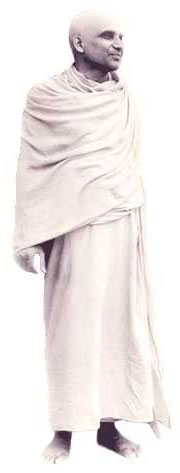
by Swami Krishnananda
This has been done; and so each one, each entity, each item, thinks that it is different from the other. On account of this division of consciousness, and the feeling of individuality or isolation in each one, there is a difficulty that arises spontaneously – namely, the impossibility to exist in a finite condition. The separation causes the consciousness of finitude. Each one thinks, “I am limited.” Now who would like to be limited? It is a sorrow to be in a state of limitation of freedom. In order that this limitation can be made good, the individual that is finite engages itself in certain actions by which it comes in contact with the objects of the world, and creates a relative atmosphere of inclusiveness of the objects with itself.
When we associate ourselves with people outside or things in general in a social form, there is a false appearance of our finitude getting expanded. We feel more comfortable in a society, in a body of an organisation, as a citizen of a nation, than when we are totally individual. It does not mean that the nation or the organisation has expanded our finitude. There is a false feeling of security on account of an externalised or foisted increase in the dimension of personality. Life is a falsehood ultimately because of the false assurance given to us that we are secure in this world by associations with external objects and persons and things, while we are totally insecure finally. We are basically finite. The finitude does not go.
It cannot go by any kind of external contact. It can go only by the internalisation of consciousness. The infinity that we are asking for, the infinity that is the opposite of finitude that we are, is not outside. It is inside. It is in Selfhood and, therefore, any kind of external contact does not bring this security that we seek in this world.
The explanation of the nature of God’s creation is over and the nature of the jiva individual is taken up; and tentatively it is mentioned that the mistake of the individual or jiva is to identify itself with its personality, individuality. This is the subject which we were discussing till yesterday.
This individuality of ours (this is sloka number 70) is constituted of an involvement of consciousness in the five sheaths already mentioned – causal, intellectual, mental, vital and physical. The intellectual body is also the source of the ego-consciousness, the consciousness of personality that we entertain.
Ahaṁ vṛtti ridaṁ vṛttiḥ ityantaḥ karaṇaṁ dividhā, vijñānaṁ syādahaṁ vṛttiḥ idaṁ vṛttir mano bhavet (70). “I am, and this is mine.” These are the two statements generally that we make in respect of our life. “This is me, and this is mine.” The statement “This is me” is made by the ego-consciousness, which is operating through the intellect. The statement “This is mine” is made by the mind, which is a secondary instrument of the intellect. The mind is objective to the intellect or reason. The intellect is subjective, internal, to the mind. In the same way as our property – the ownership that we have in respect of things – is external to our true being, I-ness comes first; my-ness comes afterwards.
Ahaṁ pratyaya bījatvam idaṁ vṛtte riti sphuṭam, aviditvā svamā tmānaṁ bāhyaṁ vetti na tu kvacit (71). I-consciousness comes first; all other consciousness of the world comes afterwards. If we are not aware that we are existing, how would we know that other things are existing? When we wake up from deep sleep, sometimes we do not know where we are. It takes some few minutes for us to be aware that we have woken up and we are self-conscious. When a person is in deep sleep and he wakes up, he takes a few minutes to know that he is existing at all. He is dozing, very giddy, rubbing his eyes, and does not know at all that even the body exists. Slowly, he becomes conscious that his body is there. Afterwards, slowly he begins to perceive that something is there outside. What is there outside is not very clear. Then it becomes clear; it is a door that is in front.
Sometimes people who are in very deep sleep cannot suddenly know the direction of a door or a window, when they wake up in the middle of the night. If they want to go to the bathroom, for example, they hit their head against the wall because they think it is a door. Such is the effect of consciousness that is not there at all in respect of the body.
So gradually, from I-consciousness, body-consciousness, personality-consciousness, there is consciousness of externality, something being there, indistinctly at first; and afterwards, distinctly we begin to perceive that it is so-and-so. This is the action of these two principles inside – the intellect and the mind. After we know ourselves, we begin to know that something is there outside.
Kṣaṇe kṣaṇe janma nāśau ahaṁ vṛtter mitau yataḥ, vijñānaṁ kṣaṇikaṁ tena svaprakāśaṁ svato miteḥ (72). The intellect is a process, as Buddhist psychology will tell us. It is not a continuity, as the flow of oil from a pot; it is an apparent continuity. Even the flame of a lamp is not supposedly a solid mass. It is, as modern science tells us, constituted of little particles, packets of waves or particles, as they call it in our so-called quantum theories. We will not find continuity, in the sense of a solidity, in anything in this world.
Even the intellectual process is such a movement of little bits of thought, ideations, moving in the direction of a particular object or the world outside, and giving the impression that there is a flow. Every minute there is cessation of the earlier bit of ideation, and a new bit starts manifesting itself, giving an impression of its connection with the earlier bit, so that a continuity, or a chain of thoughts, is maintained though the chain is made up of different links, one link being different from the other.
The sub-consciousness of the intellect is not actually the consciousness of the intellect by itself, because anything that is made up of little bits cannot be conscious of itself as indivisibility. Something else, which is self-luminous, is at the back of it and gives it the impression that it is self-conscious.
Vijñāna maya kośo’yaṁ jīva ityāgamā jaguḥ, sarva saṁsāra etasya janma nāśa sukhā dikaḥ (73). Scriptures and certain philosophical thoughts affirm that this vijnanamaya kosha, intellectual sheath, is the real jiva. What we call individuality, personality, jiva-hood, is the name of this intellectuality, this egoism, going together in a single action. All samsara, world entanglement, is caused by this.
Birth and death also are caused by this consciousness of body, which is created by the intellectual identification of ego with the body. The whole entanglement is to be attributed to this personality-consciousness.
Vijñānaṁ kṣaṇikaṁ nātmā vidyu dabhra nimeṣa vat, anyasyā nupa labdhatvāt śunyaṁ mādhyamikā jaguḥ (74). As it was already mentioned, this intellectual consciousness is momentary. It is made up of bits of thought. Therefore, it cannot be identified with the Atman, which is indivisible. It flashes forth like a lightening in the sky. But it does not stay there for a long time.
There are some people who feel that finally we enter into a nothingness. If we go on abrogating all the sheaths, including the causal sheath, including the intellectual sheath, what remains? If we disentangle ourselves from our reason and understanding, what remains? We will find that practically nothing will remain there. We will feel like nil, a zero, a darkness, a thoughtless vacuum. This is what people say is nil, or shunya.
There is one school of thought that holds that a vacuum is the Ultimate Reality: Everything is nothingness, finally. The whole solid universe can be reduced to nothingness ultimately by reduction of the effects into causes. This is one thought and one school of belief.
Asadevda mityāda vidameva śrutaṁ tataḥ, jñāna jñeyā tmakaṁ sarvaṁ jagad bhrānti prakalpitam (75). This philosophy which holds that ultimately everything is nil quotes a peculiar scripture from the Upanishad which says, “Nothingness was there ultimately.” The Upanishad, when it says, “Nothingness was there,” does not mean that really there was nothingness. It means that the world was not there.
The manifestation of names and forms was not there at the beginning of creation. Non-existence of the variety of creation in the form of names and forms is called asat, or non-existence. What was there in the beginning? Non-existence was there. Non-existence does not really mean non-existence of everything. It is only the non-existence of variety, creation, solidity, externality, name, form. The vacuous philosophers mistakenly conclude this statement means that nothing really exists, finally. But it cannot be.
Mere vacuum is inconceivable. How can we know that nothing is there unless there is somebody who says that nothing is there? There must be an awareness that nothing is there; therefore, we cannot say consciousness also is not there. The statement that nothing is there finally is a statement made by consciousness, and that itself cannot be nothing. So the vacuous philosophy does not hold water. There is something behind even the concept of nil, or zero, and that is the ‘That which is’.
Niradhi ṣṭhāna vibhrānteḥ abhāvā dātmano’stitā, śūnyasyāpi sasākṣitvāt anyathā noktirasya te (76). There must be a witnessing consciousness of even the nothing that is there. If everything has gone, let it go. But somebody should know that everything has gone. Or, if there is nobody to know that everything has gone, how would we say that everything has gone? The statement is irrelevant. There is a witness consciousness necessary to observe the phenomenon of non-entity, even taking for granted that the whole entire world can be reduced to nothingness one day in the state of pralaya or dissolution.
Anyo vijñāna mayata ānandmaya āntaraḥ, astī tyevo palabdhavya iti vaidika darśanam (77). The Mimamsa doctrine is another school of thought which holds that intellect is not the final reality, and there is no use of going on haranguing on the nature of the intellect or even the concept of shunyatva or nil, which is untenable. There is the causal sheath or anandamaya kosha, which is the fundamental criterion of the individuality of a person. That individuality is permanent. We need not identify individuality with the intellect, the mind, the senses, the prana and the body, taken for granted; but there is something which is behind them that is the primary individuality called anandamaya kosha. This is the doctrine of the Mimamsakas, which we will take up afterwards.