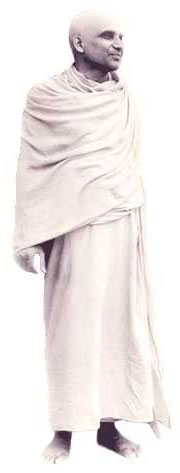
by Swami Krishnananda
Udgītha brāhmaṇe tasya māhātmyamati vistṛtam, liṅga satve’pi jīvatvaṁ nāsya karmādya bhāvataḥ (112). Udgitha Brahmana is a particular passage in the Brahmana portions of the Vedas where Hiranyagarbha, maha-prana or Cosmic prana, is glorified in abundant ways. It shows that Hiranyagarbha does exist, and He should be considered as the creator of all beings.
Even if there is a subtlety of the body of Hiranyagarbha, He should not be identified with any particular individual. He is not a jiva, because Hiranyagarbha has no karma. The karma potentials do not act on Ishvara or Hiranyagarbha, because Hiranyagarbha and Ishvara are Universal Beings. Universality cannot work or act in any particular direction of objects of senses. Hence, they are free from the botheration of karmaphala, or the effects of actions.
Sthūla dehaṁ vinā liṅga deho na kvāpi dṛśyate, vairājo deha īśo’taḥ sarvato masta kādi mān (113). There are others who feel they have never seen the subtle body becoming the cause of anything at all. Have we seen the subtle body of a carpenter manufacturing furniture? It is the gross body; the actual body of the carpenter manifests itself. Any action in this world, whatever it be, is the outcome of the physical body of somebody working. Have we seen merely a subtle body working? Therefore, Hiranyagarbha as a subtle potential of the cosmos should not be regarded as direct creator of the universe. Virat is the creator because He is the cosmic physical body.
Sahasraśīrṣā puruṣaḥ (Purusha Sukta 1.1). Everywhere are the eyes, everywhere is the head, everywhere are the limbs are the descriptions of Virat, the cosmic manifestation as we have it described in the eleventh chapter of the Bhagavad Gita.
This Virat, the cosmic body, should be regarded as the real creator of the universe – not Hiranyagarbha – because mere subtle body cannot directly act on the physical universe. Virat, who is the physical universe animated by consciousness, should be regarded as the cause of the physical universe.
Sahasra śīrṣe tyevaṁ ca viśvata ścakṣu rityapi, śruti mityāhu raniśaṁ viśva rūpasya cinta kāḥ (114). Sahasraśīrṣā puruṣaḥ, says the Rig Veda, Yajur Veda. Such a great purusha, with all eyes, with all ears everywhere, does exist; and also the Rig Veda says that all hands, all feet, all eyes are spread out of this Great Being. Such definitions apply to the Virat-purusha, Vaishvanara, who should be considered as the creator of the universe.
In the Rudradhaya of the Yajur Veda we also have a variety of cosmically-oriented descriptions of God; and Vishvarupa, therefore, becomes a fitting instrument for the manifestation of this cosmic physicality.
Sarvataḥ pāṇi pādatve kṛmyāde rapi ceśatā, tataś catur mukho deva eveśo netaraḥ pumān (115). The others say neither Hiranyagarbha nor Virat is the creator of the universe. What is the use of saying that He had many eyes, many ears, etc.? That is not a great point because creativity requires a particular attention on specific details. Virat is not specific, but general consciousness, as is Hiranyagarbha. General consciousness cannot create specific objects. Particular things in the world with all the variety that they have cannot be attributed to a general creative principle. Therefore, even Virat should not be regarded as the real creator – not Ishvara, not Hiranyagarbha, nor Virat, but Brahma, the four-headed Being who has the specific consciousness of what is going to be created. That Brahma, one of the trinity of Brahma, Vishnu, Siva, hailed in the Puranas as the real creator of things, should be regarded as the true creator. Tataś catur mukho deva eveśo netaraḥ pumān: Four-headed Brahma is the real God.
Putrārthaṁ tamupāsīnā eva māhuḥ prajā patiḥ, prajā asṛjatetyādi śrutiṁ codā harantyamī (116). Many scriptures proclaim the greatness of Prajapati, Brahma, as the creator. For the sake of prosperity, progeny, wealth and long life, etc., people offer prayers and perform tapas for darshan of this great being, this Brahma. The Upanishads themselves, the scripture itself, should be regarded as authority enough to show that Brahma is the creator of the Universe – not Ishvara, Hiranyagarbha, Virat, etc.
Viṣṇor nābheḥ samud bhūtaḥ vedhāḥ kamalaja stataḥ, viṣṇu reveśa ityāhuḥ loke bhāga vatā janāḥ (117). But there are others who think that Brahma cannot be regarded as the final creator because Brahma came from the navel of Vishnu. This is the description of the Puranas. Narayana, Vishnu, was the original being. He was sleeping on the cosmic waters at the end of the dissolution of the universe. And from his navel, a cosmic lotus emerged. On the lotus Brahma was seated; Brahma, therefore, is the manifestation from Narayana, Vishnu. Vishnu is the cause of Brahma, so how could we say that Brahma is the final creator? The Vaishnavas say Vishnu is the creator; Narayana is the creator because He is the source of Brahma also.
Śivasya pādā vanveṣṭuṁ śārṅgya śaktastataḥ śivaḥ, īśo na viṣṇu rityāhuḥ śaivā āgama māninaḥ (118). Saivas, worshippers of Lord Siva, say Vishnu cannot be regarded as the creator of the universe. Siva is the creator because there is a story that Lord Siva appeared as a column of light which ran from the nether regions up to the heaven; Vishnu and Brahma tried to locate the origin or the beginning of this column of light, and Vishnu found that it was not possible to locate it. Inasmuch as Vishnu himself could not locate the origin of this column of light which was Lord Siva himself, we cannot regard Vishnu as the creator of the universe. Siva is All-in-All. Therefore, Saivas come into force here.
Puratrayaṁ sādayituṁ vighneśaṁ so’pya pūjayat, vināyakaṁ prāhu rīśam gāṇapatya mate ratāḥ (119). Even Siva is not the original creator. This is what the devotees of Ganapati or Ganesha say, because when Lord Siva had to go to war against the Tripura demons, he worshipped Ganesha first. But for that worship, he would not have succeeded in winning victory over the Tripuras. Ganesha is always worshipped first, and all the other gods come afterwards. Hence, Ganesha, and not any other being, should be regarded as the Supreme Being – not Brahma, Vishnu, Siva. This is the opinion of the Ganapati worshippers.
Eva manya sva sva prakṣābhi mānenā nyathā’nyathā, mantrārtha vādakalpādī nāśritya pratipedire (120). Thus, there are hundreds and hundreds of varieties of arguments and definitions of what God could be. These definitions pertain to the way in which people think in their minds, their predilections, their limitations, their religious proclivities, cultural background. All these things decide the concept of God in the minds of people. Nobody can define God impersonally without some prejudice. These prejudices arise on account of various conditioning factors in which people live, geographically, culturally, historically, etc. And one can quote anything in support of one’s own opinion: this scripture says this, that scripture says that, all the Vedas say that, the Siva Purana says that, Bible says this, and Koran says that. Well, they may all be saying different things and, therefore, are we to conclude that there are varieties of gods, many gods? How will we reconcile these various concepts? Here is a quandary before the definition of Ishvara.
Antaryāmiṇa mārabhya sthā varānteśa vādinaḥ, santya śvatthār kavaṁśādeḥ kuladaivata darśanāt (121). There are people who worship anything and everything as an object of their religious adoration. Right from the indwelling Universality, right through Ishvara, Hiranyagarbha, Virat, Brahma, Vishnu, Siva, Ganapati, there are people who also worship even trees like asvattha or bamboo, or anything whatsoever – even a little piece of stone – as a deity determining the welfare of one’s family. There is nothing that people do not worship and regard as final, a symbol of their own God.
Tattva niścaya kāmena nyāyā gama vicāriṇāṁ, ekaiva pratipattiḥ syāt sā’pyatra sphuṭa mucyate (122). But we have to come to some conclusion. We cannot go on wading through this tangle of definitions, and we shall try here to give a most reasonable definition of Ishvara, or God, with no detriment to the definitions given by different religions of the world.
Māyāṁ tu prakṛtiṁ vidyān māyinaṁ tu maheśvaram, asyā vayava bhūtaistu vyāptaṁ sarva midaṁ jagat (123). The Svetasvatara Upanishad is quoted here in this verse. Prakriti should be considered as maya; maya should be considered as prakriti, which is the objective power of God. And the wielder of this prakriti or maya is mayi, that is Maheshvara, the Supreme Lord. All this universe is studded in the cosmic body of this Being as pearls are studded, beads are studded or linked through a thread in a garland.
The entire cosmos is hanging, organically related to God. He is not extra-cosmic or outside the world, uncontaminated or unconnected. The very cosmos is His body. The very intelligence that pervades the cosmos is God, Ishvara. There is no God outside the universe, transcendentally, unless of course we also accept the immanence of God at the same time. Because God is not exhausted in the creation of the world, we call Him transcendent; but because He is immanently present in all little things also, we call Him immanent. He is everywhere in the universe, and yet beyond the universe. He is, therefore, immanent and transcendent both at the same time.
Iti śrutyanu sāreṇa nyāyyo nirṇaya īśvare, tathā satya virodhaḥ syāt sthāvarānteśa vādinām (124). Inasmuch as everything in the universe is pervaded by God, there is no harm in people taking up any particular item in the universe as their object. We can reach the Absolute through any item in the world because when we touch anything in the world, we are actually touching a part of God – whatever that object be. It may be inanimate or animate, as the case may be; it does not matter. Even inanimate objects cannot exist unless the existence of Ishvara is there at the back.
So there is no objection to people worshipping God in various ways according to their own predilections, provided that they believe honestly that this is the final God and they do not have any distractions in their mind carrying them away in some other direction. The defect in meditation is not the choice of the object, because any object is very good. The defect is in the movement of the mind in another direction altogether than towards the object of meditation.
Māyā ceyaṁ tamo rūpā tāpanīye tadīraṇāt, anubhūtiṁ tatra mānaṁ prati jajñe śrutiḥ svayam (125). Prakriti and maya – which is the power of God which He wields in His omnipotence; it was said, this maya is essentially tamo-rupa, darkness in nature, because when the gunas of prakriti or maya are not disturbed in the process of creation, they remain in a state of harmony. In this state of harmony, sattva does not specifically manifest itself; therefore, there is no illumination at all. The cosmic condition of dissolution of the universe, where nothing is specifically visible, is one of darkness because tamas predominates there. So maya can be regarded as essentially inert, dark, and obstructive to light.
Where does it exist? We can know it in our own experience in the state of deep sleep. Why do we not know anything in the state of deep sleep? What is the obstacle? That obstacle is the darkness characteristic of this maya tattva operating in our own individual case also, in the state of deep sleep.