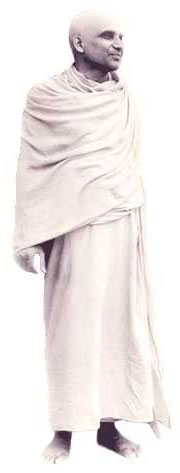
by Swami Krishnananda
When creation starts after a long, long time, Ishvara becomes the cause of the manifestation of a universe which is of such a nature that it will be just fitted for providing a field of experience for the jivas who were unliberated at the time of the dissolution of the universe and were lying like seeds in that condition. Now they are to germinate into action and a set of jivas, or individuals – a particular category of individuals – is grouped together for the purpose of the necessary experience in that given field; and so the kind of world in which we live is fitted exactly to the kind of karmas that we are supposed to work out in this world.
It is a very, very necessary world for people like us. It is necessary for the kind of people that we are. If we were different types of people, this world would not have been suitable for us. We would have been born in some other world – some other realm of being, higher or lower.
So Ishvara's creation is not actually a direct manifestation of non-existent things. The existent potentials of jivas existing unliberated at the time of previous dissolution have to be given a chance to express their karmas, and creation is nothing but the providing of the field for the working out of the karmas of the individuals. And so we may say Ishvara creates the world, or we may say these seeds of individuals create the world, as the case may be. The earth is the cause of the plant, or the seed of the plant is the cause. Either way, we may say this or that is the cause.
Punas tirobhāvayati svātmanye vākhilaṁ jagat, prāṇi karma kṣaya vaśāt saṅkocita paṭo yathā (184). After the drama of creation is over for many, many millions of years, He withdraws the whole thing into Himself, though here also the withdrawing is not done by Ishvara by His whim and fancy. As creation is not a whim, just as it is determined by the potential karmas of jivas who have to find a field for the expression of their karmas, in a similar manner, dissolution does not take place suddenly like that. It will take place only when the karmas of all the jivas living in a particular world are over and they cannot any more find a suitable atmosphere for the fructification of their other karmas. They want to have another world altogether. This world is unsuitable. Just as the body is cast off when the karmas cannot be worked out through the body, the world is also cast off, withdrawn completely into the original source, and again dissolution takes place.
So this is a cycle of creation and destruction eternally going on, as it were; neither has it a beginning nor has it an end. Such is the drama of endlessness in beginning and endlessness in dissolution. From eternity to eternity is this drama of creation and destruction.
Rātri ghasrau supti bodhau unmīlana nimīlane tūṣṇīṁ bhāva manorājye iva sṛṣṭi layā vimau (185). As are night and day, as are sleep and waking, as are closing the eyelids and opening the eyelids, as are keeping quiet and then thinking erratically, so are creation and dissolution. Creation is the light of things; dissolution is the darkness of things. Creation is the waking of things; dissolution is the sleeping of things. Creation is the opening of the eyes of all things; dissolution is the closing of the eyes. Creation is the activity of all things; dissolution is the stillness of all things.
With every winking of the eye of Ishvara, millions of Brahmandas or universes are created, they say. Millions of Brahmandas or cosmoses are created and destroyed in the time Ishvara winks His eyes.
Āvirbhāva tirobhāva śakti matvena hetunā, ārambha pariṇāmādi codyānāṁ nātra saṁbhavaḥ (186). Naiyayikas or logicians say that creation is absolutely a new coming of something which is not already in the cause. They say cloth is not just a bundle of threads. They have a peculiar view of the causal relation of thread and cloth. We cannot say that cloth is only just threads. Threads do not directly manifest themselves as cloth. The character of cloth cannot be seen in threads. This is the peculiar notion of the Naiyayikas.
We know the difference between threads and cloth. The function that threads perform and the function that the cloth performs are different. We can wear a cloth, but we cannot wear threads. So the effect is totally different from the cause. This is the Naiyayikas' argument.
The Samkhyas say the effect is not a new beginning. It is something manifest already existing in the cause. That which is not existing in the cause cannot manifest itself at all. Otherwise, anybody would reap any fruit if the effect has no connection with the cause. We may do some action and somebody else will reap the fruit of it. This should not happen. Everyone will have to bear the fruit or the dessert of one's own actions. Therefore, the argument that effects are totally new and unconnected with the cause is untenable.
The modification of the cause into the nature of the effect, as the Samkhya also holds, is not correct because when Ishvara creates the universe, neither does He manifest something totally new and non-existent earlier, nor does He modify Himself into the world – as milk turns into curd, for instance. Ishvara does not become converted into the world. Otherwise, there would be death of Ishvara. Milk dies when curd is manufactured; curd cannot become milk once again. But an effect can go back into the cause. Else, salvation would not be possible. We cannot have God-realisation if God is no more there, if He has already become the world. This does not happen.
Actually, God has become the world as the rope has become the snake. So the rope is still there and it is not affected in any way by the manifestation of the snake of this world. Doctrines do not apply here.
Satyaṁ jñānaṁ anantaṁ yat brahma tasmāt samutthitāḥ, khaṁ vāyvagni jalor vyoṣaddhi annadehā iti śrutiḥ (191). In the Taittiriya Upanishad, the Brahmanandavalli says that the nature of the Absolute is satyaṁ jñānam anantam (Tait. 2.1.1): truth, knowledge, infinity is Brahman. From that Supreme Being, the knowledge of which will enable a person to have immediate knowledge of all things in the world, was the source and the creator of all the elements.
The Taittiriya Upanishad says, tasmād vā etasmād ātmana ākāśas sambhūtaḥ (Tait. 2.1.1): From that Supreme Brahman-Atman, space was created. Ākāśād vāyuh: From akasha, vayu came. Vāyor agniḥ: From vayu, agni or fire came. Agner āpaḥ: From fire, water came. Adbhyaḥ pṛthivī: From condensed water, we have earth. Pṛthivyā oṣadhayaḥ: From earth we have all the plantations, the vegetables, the trees, etc. Oṣadhībhyo annam: From these plantations we have food. Annāt puruṣaḥ: From the food that is eaten, man is born. This is how creation is described in the Taittiriya Upanishad, as arising from Brahman directly up to the body of the human individual. It is one big chain of causation.
Āpāta dṛṣṭitas tatra brahmaṇo bhāti hetutā, hetośca satyatā tasmāt anyonyā dhyāsa iṣyate (192). Brahman does not directly create as a carpenter manufactures things, but His presence is necessary for the manufacture of this world. His existence itself is action. This is the difference between activity of individuals and the activity of Ishvara. The very being of God is His action. He just is, like the sun. His existence is all the activity of His.
There is a superimposition of characteristics of creativity and dual existence when we consider the Absolute itself directly being the cause of things. This is why philosophers have introduced a principle called Ishvara, which is a description of that condition of Brahman where creativity (which is otherwise not applicable to the Supreme Absolute) becomes a necessary feature of that which will become the cause of this world.
A principle called prakriti or maya has been introduced only to explain how the unmanifest can manifest itself – how the unattached Brahman can appear to be attached to the world – how the featureless Absolute can become Ishvara or the God of creation. This kind of transference of qualities from one to another is called anyo 'nyadhyasa or the superimposition of characters of one thing upon another – the Brahman qualities on Ishvara and Ishvara's qualities on Brahman.
The creativity of the world is attributable to Ishvara and not Brahman; but the Universal consciousness that is there in Ishvara is of Brahman and not of somebody else. So there is a mix-up of two issues, two qualities joined together, as it were, in a mutually superimposed manner. Anyonyā dhyāsa is the name given to it. Thus, creation takes place. The creative activity together with the omniscience of Brahman becomes what we call the God who creates the world.
Anyonyā dhyāsa rūpo’sau anna lipta paṭo yathā, ghaṭṭi tenaikatā meti tadvat bhrāntyai katāṁ gataḥ (193). As cloth is superimposed on the starch in the painted canvas and the starch is also superimposed on the cloth (this is anyonyā dhyāsa again here), the background of the cloth is superimposed on the stiffening starch and the starch is superimposed on the cloth so that we do not make a distinction between the starch and the cloth when we say, "Here is a canvas."
The canvas is Ishvara, the cloth is Brahman, and the stiffening is the creative activity. This is the illustration through an analogy of a painted picture in respect of God's creation.
Meghākāśa mahā kāśau viviceyete na pāmaraiḥ, tadvat brahme śayo raikyaṁ paśyantyā pāta darśinaḥ (194). Just as to the naked eye the distinction between pure sky and the sky reflected through the clouds is not discernable, the distinction between Brahman and Ishvara is not easily discernable to the naked perception. When we see the canvas, we don't distinguish between the starch and the cloth. We see both and we call it ‘canvas’, a new name altogether. Neither do we call it starch, nor do we call it cloth; we have a new name – canvas – for that particular appearance. So is a new name given to that particular appearance of creativity of Brahman, and that name is Ishvara.
The canvas does not exist; what exists is cloth and starch. Yet the canvas does exist; without it, painting cannot take place. So too is Ishvara. He does not exist independent of Brahman, but some sort of independence is there, as we assume a sort of independence of the canvas to merely a cloth and starch. This is an illustration again of superimposition – Brahman-consciousness getting identified with creativity or will, thus becoming Ishvara-consciousness.