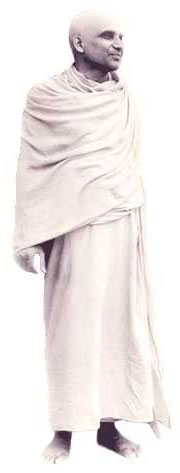
by Swami Krishnananda
Aihikā muṣmikaḥ sarvaḥ saṁsāro vāstavas tataḥ, na bhāti nāsti cādvaitam itya jñāni viniścayaḥ (240). Ignorant people do not even know that there is a world other than this world. And even if they are told there is something like that, they believe in the reality of an earthly existence and the solid reality of a heavenly world. The samsara, this bondage, this suffering of life, is considered as permanently valid by ignorant people. Neither do they know what is above the world, nor do they have any idea of the non-dual character of the Ultimate Reality. This is the essence of ignorance, ajnana.
But the jnanin, or the knower, is of a different character. He knows that this world and also the other realms such as heaven, etc., are degrees of reality – apparently there but really not there, for reasons already mentioned in earlier verses.
Jñānino viparīto’smāt niśayaḥ samyagī kṣyate, svasva niścayato baddho mukto’haṁ ceti manyate (241). Ultimately, nothing affects the jnanin. If he gains something, it is all right for him. If he loses something, that is also all right for him because he feels that any material gain is not going to make a person really happy. And inasmuch as nothing that comes can make him happy, nothing that goes can make him unhappy. This is what the jnanin really feels.
On account of a lack of clarity in understanding, one feels that he is bound; the other feels he is free. The freedom and the bondage of the soul are actually caused by the variety of thinking processes taking place in the mind. The mind thinking in terms of objects is what is bound. The mind thinking in terms of soul consciousness, independent of the objects, is what is free.
Nādvaitam aparokṣaṁ cet na cidrūpeṇa bhāsanāt, aśeṣeṇa na bhātaṁ cet dvaitaṁ kiṁ bhāsate’khilam (242). It may be held that this unitary consciousness that is non-dual is not visible to the eyes. Why not? The very nature of consciousness is of the character of non-duality. We cannot say that non-duality is not visible. Our consciousness itself is a demonstration of this unreality. Do we feel that we are two persons because we have got two hands or two ears or two legs? Do we feel that we are a multiple complex individual because our body is made up of many, many little parts, fractions, or cells? Do we not feel that we are one indivisible consciousness?
When we go into deep sleep, all the associations of the consciousness with the five sheaths are obliterated completely. Do we not feel at that time that there is one single bliss-like experience? We had a wholeness of feeling in the state of deep sleep. That wholeness is nothing but indivisibility. Indivisibility is nothing but non-duality of consciousness. So the non-duality of consciousness is actually demonstrated before our very eyes every day in our day-to-day experience.
Aśeṣeṇa na bhātaṁ cet dvaitaṁ kiṁ bhāsate’khilam: The only thing is, it is not entirely clear to us. That is the case with the dual world also. Do we see the dual world entirely with our eyes? The astronomical universe is so large that even the most powerful telescope cannot fathom it. But have we seen the entire dual world? If that is the case, why complain that the non-dual consciousness is only partially being felt? It is partially felt because of the encumbrance of the karma potencies that are heaped up in the layer called the causal body, which obscures the consciousness in the state of deep sleep. But for that, we would have seen the entirety of the unitary consciousness. This is the reason why we have the experience only in fraction and not in wholeness.
Diṅmātreṇa vibhānaṁ tu dvayorapi samaṁ khalu, dvaita siddhi vada dvaita siddhiste tāvatā na kim (243). Fraction is the nature of our experience. Neither the dual world nor the non-dual consciousness can be experienced by us completely and, therefore, they stand on an equal footing. There is the dual perception of the world of astronomy or the non-dual perception of consciousness. Therefore, there is no comparison of superior or inferior in respect of our awareness of the dual world or the non-dual consciousness. Both of them are known only in fraction, for reasons already mentioned.
Dvaitena hīna madvaitaṁ dvaita jñāne kathaṁ tvidam, cid bhānaṁ tva virodhyasya dvaita syāto’same ubhe (244). Actually, we in our ignorance may imagine the non-duality is an abstraction, that it is an absence of duality. This is not so. The origin of duality presupposes the existence of a non-dual consciousness. In order that we may know that two people are sitting, our consciousness should rise above the concept of these two people. Otherwise, our consciousness will be also divided into two persons, one on this side and one on the other side. How do we, in a single grasp of our awareness, know that two persons are sitting in front of us? As the one is totally different from the other, it is not possible for anyone to know that both are simultaneously sitting. The simultaneity of the awareness of two people sitting together or many things being there is because of there being consciousness in us which clubs them together; and the multiplicity of the world can also be seen in one stroke. With one stretch we can see the whole thing because our consciousness, which is Kutastha-chetanya, is basically Brahma-chetanya. It pervades the entire cosmos.
Unknowingly, it does the work of providing us with the knowledge of the totality of the world, though they are multifarious in their nature. Very difficult is this notion. We have to go deep into the subject for understanding its true meaning.
Dual consciousness is totally impossible because when things are actually two, it is not possible to know that there are two things. The consciousness of two things is possible only if there is a consciousness which is not two. If there are only dualities or multiplicities, as the dualists contend, there would be nobody to know that these dualities exist at all. So even in our contention that the dual world exists or that many things in the world do exist, we are unwittingly accepting the existence of an awareness of all these dualities. We are falling into non-duality, whether we want it or not.
Evaṁ tarhi śṛṇu dvaitam asan māyā mayatvataḥ, tena vāstava madvaitaṁ pariśeṣāt vibhāsate (245). Now what is the conclusion, sir? After hearing all this, the non-dual consciousness is the Ultimate Reality. Brahman is the supreme truth, and it is in our own heart scintillating, radiating as Atman. Advaita, the non-dual character of consciousness, is the final reality, and all that is dual hangs on it because the very knowledge of duality would be impossible without a transcendent consciousness which is not dual.
Acintya racanā rūpaṁ māyaiva sakalaṁ jagat, iti niścitya vastutvam advaite pari śeṣyatām (246). Impossible it is for anyone to understand how this world is made. Any amount of intellectual jugglery, argumentation or scientific observation will not lead us anywhere. The mystery of the world remains always a mystery. Having realised that there is a fantastic mystery that is operating behind this so-called apparent world, we should withdraw our consciousness from it and be non-attached to it. May we be established in the consciousness of that unitary existence by disconnecting our consciousness from all that is contrary to it, knowing well that this wonderful world is a magical performance and its variety is no proof of its real existence.
Punar dvaitasya vastutvaṁ bhāti cettvaṁ tathā punaḥ, pariśīlaya ko vātra prayāsa stena te vada (247). Even if we go on meditating on the unitariness of the Absolute, when we open our eyes we will see many things in front of us. The dual consciousness cannot leave us or give us rest. Again and again we will see many things in the world, causing love and hatred, attraction-repulsion, etc. Though we are meditating for one hour, two hours, three hours, we will see the world is too much for us in spite of our meditation. Then what should be done?
Our time for meditation should increase. If we are meditating only for one hour, we should increase it to two hours; if it is two hours, we should make it three hours, four hours or five hours. At least five hours of meditation is necessary. Ordinary people will find it difficult to find time, but the attempt has to be made, at least in bits of process of meditation. Again and again we must habituate ourselves to this contemplation on sarvam kalvidam brahama – the All is the Absolute. And then, gradually, we will find the harassing duality-consciousness will leave us one day or the other.
Kiyantaṁ kāla miti cet khedo’yaṁ dvaita iṣyatām, advaite tu na yukto’yaṁ sarvā nartha nivāraṇāt (248). How long should I meditate? In the Brahma Sutra a question of this kind is raised. We may go on meditating either till Self-realisation or till death, whichever is earlier. Why should we put a question like that, "How long should I meditate," as if it is a job for which we are paid? We have to spend the whole life in meditation. We have no other duty. So don't put a question – kiyantaṁ kāla: How long?
Would we ask a question: How long should we go on looking at the world? We are never tired of seeing the beauties and the distractions of life. Why did we not put a question "How long will I see them?" And now when we are asked to meditate, we say "how long?" as if it is something thrust upon us. Our duty is contemplation. The Atman is made of contemplation in substance, and action is not its essential nature. Action, work, bondage of any kind born of that is the character of the physical sheath, the subtle body, the causal body, etc. The Atman by itself is unattached and, therefore, it works not. Its very existence is its activity.
Therefore, we should go on meditating until we attain Self-realisation. Even if death snatches us up before Self-realisation takes place – because in most cases Self-realisation may not take place in one life, and death may overtake a person – it does not matter. This question was raised by Arjuna in the sixth chapter of the Bhagavadgita when Bhagavan Sri Krishna gave the answer, "There is no loss of any good work." Even if we have meditated sincerely for only three days, it will be a great asset for us which will be carried forward in our positive balance sheet of action in the next birth. Because of the continuous meditation that we have practiced in this life, in the next birth we will find it very easy.
Have we not seen people in this world, even little children, suddenly appearing to be very precocious, quickly understanding things? Many young boys and girls suddenly take to spiritual life without any kind of practice earlier in their lives. What could be the reason? They have been practicing it in previous births. That great yogis suddenly became masters within a few years after their birth can be explained only in terms of the great sadhana that they did in their previous lives.
So is the case with people who may not attain Self-realisation in this life; and therefore, we should not be afraid. There is no need for despondency, melancholy, etc. We should let the meditation go on, and be sure that our primary duty in life is this only. There is nothing else.