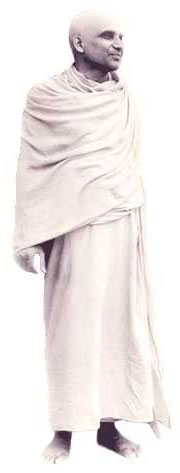
by Swami Krishnananda
Sarah: What is Cosmic Action?
SWAMIJI: Cosmic Action is Total Action of the cosmos simultaneously; also the movement of the individual, or the finite, towards the Infinite. The entire universe is moving towards the Absolute; this is what we call evolution. The universe is restless and it cannot keep quiet until it coalesces into the Absolute.
Sarah: When you say the universe, you mean this dream universe is moving towards the Absolute?
SWAMIJI: Everything, every atom, is moving towards that Goal.
Larry: And the dream universe is the Absolute?
SWAMIJI: Yes, you may say the whole process of evolution itself is a kind of dream. A cosmic dream it is, but it is done very systematically; therefore, you call it evolution, systematic and symmetrical.
Sarah: But if it’s a dream, nothing really happens.
SWAMIJI: It does happen! When you are actually dreaming, it does happen; otherwise, you don’t call it a dream at all. You are saying that nothing happens because you have woken up, but actually when you are dreaming, it is a very real thing. Similarly, you will not see this world when you enter the Absolute. But before that experience takes place, the world is there as an object of perception.
Sarah: But it seems that when you are in the consciousness of the Absolute, the dream world looks as if it is just spinning its wheels; it is not doing anything.
SWAMIJI: When you enter the consciousness of the Absolute, you will not see the world, in the same way as when you wake up the dream world vanishes. It has entered your mind. All the phenomena of dream have entered your mind in waking. In the same way, all the phenomena of waking will enter the Absolute. Just as you don’t see the world of dream in waking, you will not see the world of waking in the Absolute—not that it vanishes; it has entered into the original source of it. By not seeing people of the dream in waking, you have not lost anybody. You don’t bother about bereavement; you have seen a friend in dream and now you have woken up and the friend is not visible—“Oh I have lost,” you don’t cry, because the person has entered your mind itself. So, you will lose nothing by entering the Absolute. You will absorb the whole thing into It and you will be the all-inclusive completeness.
Sarah: So, with this absorption, I don’t understand . . .
SWAMIJI: The absorption is just like the dream objects entering your waking mind. In a similar manner it happens.
Sarah: And what is this process of the universe?
SWAMIJI: The process of the universe is the gross melting into the subtle, the subtle into the causal, the causal into the Absolute. The outer becomes the inner; the inner becomes the Universal. Three or four stages are there. That’s the process.
Larry: Is the Absolute beyond this universe? Is It this universe, or is It beyond this universe?
SWAMIJI: Is the waking mind beyond the dreaming mind, or is it not beyond it? The waking mind that is now thinking and dreamt yesterday—is it beyond the dreaming mind? One mind dreamt yesterday; one mind is thinking now in waking. Now, is this waking mind beyond that mind which dreamt yesterday, or is it the same mind?
Larry: It is a different condition of the same mind.
SWAMIJI: Then it is the same answer to your question: a different condition of the same thing. They are not two different things.
Larry: Is that not a limitation, though, on the Infinite, that It can have a different condition?
SWAMIJI: Is there a limitation between the dreaming mind and the waking mind? There is no limitation because there are no two minds, as one mind only is looking like two. There is no limitation. Are you feeling a kind of loss because you have woken up from dream? Then, where is the limitation? You are complete and full even now, in spite of having seen things in dream and, apparently, lost them.
Larry: The limitation is that while I was dreaming, I was not awake and doing whatever I could do.
SWAMIJI: In that sense you are limited now because you are thinking you are Mr. So-and-so, and you are not believing that you are the Universal. In that lack of belief in the universality of yours, you may say that you are limited, though really you are not like that. You are not really limited, but somehow you are affirming the limitation. That has to be overcome by a counterproductive activity of consciousness that is called ‘universal meditation’. You must think in the opposite way—not as a subject thinking, but as the Universal thinking.
Larry: So the Absolute has different conditions.
SWAMIJI: It has no conditions by Itself, but it looks as if It has conditions from your individual point of view. All these questions arise because you have isolated yourself from the Absolute and you are arguing as if the Absolute is in front of you, sitting as an object of inquiry. It is not an object of inquiry before you. You yourself are That. But you, somehow, have isolated yourself from It in a psychological fashion and so you are asking where It is, and so on. There is no ‘it’. The observed is not an it. It is you, just this person.
Larry: So I am going through an evolutionary process.
SWAMIJI: You are going through an evolutionary process in every way. You are trying to become yourself. You are to become yourself in larger and larger dimensions.
Larry: And yet I was myself to begin with.
SWAMIJI: You were always yourself only. You were like an acorn, you were like a seed, you were like an atom. You became a vegetable, you became a plant, you became an animal, you became a human being. You are becoming wider in your dimension, and the evolutionary process is going on even now.
Larry: And yet I began as the Absolute.
SWAMIJI: You began as the Absolute and you will end as the Absolute.
Larry: And I will end as the Absolute, too?
SWAMIJI: Yes, yes, you have to.
Larry: And yet I am going through an evolutionary process to take me back to where I began.
SWAMIJI: Yes, in a cycle—a kind of consciousness-cycle.
Larry: Why would that happen?
SWAMIJI: Again you are asking the same question! I told you, don’t ask such questions. You are asking the same question again and again. The effect cannot know the cause as long as it stands outside the cause as an effect thereof.
Larry: If I already am the Absolute . . .
SWAMIJI: You do not believe it. The whole point is that. You are not the Absolute, as you don’t believe it is so. You are not the Absolute to yourself because you don’t feel that you are such on account of placing yourself outside It.
Larry: Why is it important that I feel that I am the Absolute? If I am the Absolute, I am the Absolute. What is the difference if I know that I am the Absolute?
SWAMIJI: No, no. The Absolute doesn’t want to know that It has some kind of cocoon around Itself. You are asking why the cocoon is around It. You may ask It when you go there! Now you should not ask. “Why did I dream that there is a mountain?” You will never put such a question because it is a phantasm. You will never put such a question at all. You saw a mountain in a dream and you are asking everybody, you go all over the marketplace and ask people, “Why did I dream of a mountain yesterday?” You will never put such a question, as it is an utter stupidity to ask such questions, because it never happened. You will think, “It is some kind of phantasmagoria in my brain.” You will never put such questions to people. It is like a dreaming man asking, “What is waking?” He can never answer that question. No man who is dreaming can know what waking is unless he wakes up. So, no ‘why’. It is a question of direct practice and experience. If you eat the sugar, only then will you know what sweetness is. It is better to put the sugar into your mouth than to ask another man, “What is sweetness?” By mere theoretical argument nobody can know what sweetness is.
Larry: All right. I can’t ask the question but I can understand the condition. And the condition is that I began as the Absolute . . .
SWAMIJI: You neither began, nor did anything like that happen. Again, you are bringing the question of cause and effect.
Larry: All right, I was always the Absolute.
SWAMIJI: All these questions of yours imply that you are separate from the Absolute. You are insisting again and again on that wrong point of view, and will never get an answer. All your questions are rooted in the belief that you are outside the Absolute. Else, why is there any doubt?
Larry: Right. But, that is because. . .
SWAMIJI: What then? Where do you stand? You have hypnotised yourself into the belief that you are outside the Absolute. You are under a spell of hypnotism created around yourself, and you are putting questions about the spell of hypnotism itself. The questions are also a part of the hypnotic effect; they are not rational questions. There is no necessity to go on arguing the same point, as it is an erroneous standpoint that the consciousness is taking. And I request you to remember what I told you in the morning. Transfer your consciousness from this body, which is putting the question, and let it sit on the carpet here, outside. Then you will never raise the question. Let this consciousness that is raising questions sit here, some ten feet away, and let it look at this person who is putting a question. Then you will see what happens. You will melt immediately. Yoga is a practice. It is not a theory. It is not a question; it is a doing something. It is eating the pudding. Yoga is doing, not simply thinking.
Larry: But one step is recognising that there is a cocoon around oneself.
SWAMIJI: That cocoon is the consciousness of your being a questioner, an individual, and imagining that the Absolute is outside to be questioned about and known. The Absolute is not outside you and you cannot ask questions about It, because who is asking the question about whom, finally? Again you have created a gulf between the questioner and the object being questioned about. The whole point is a psychological gulf between the subject and the object. Wherever you go, however much you may ask, you get into the clutches of this duality between the questioner and the object being questioned about. It is a very difficult technique. Yoga is a difficult technique. However much you may try, you will slip out of it. It will go out, like this. Your mind will not concentrate on that element which is between you and that about which you are questioning. Your consciousness should root itself in that which is between yourself and that about which you are talking. You must be impersonal in your questions. You are not doing the practice, so you are asking questions. I would like you to meditate the whole night. Meditate the whole night and see what happens. You should not be in yourself; you must be outside yourself. Place yourself outside yourself. Be somebody other than you, and see what happens.
Larry: And I can do that just through a meditative process?
SWAMIJI: In one second you can do that. In one second. This is what they do in ordinary telepathic communication, etc. You can affect a person in London by deeply thinking about that person. It means that your consciousness travels outside the body; this is telepathic action. But if your consciousness is locked inside the body, no telepathic action can take place. Deep meditation is necessary. You always try to be other than what you are—outside you, beyond you, larger than you, more than you, not just what you are. Why should you be what you are? You have already been there for years together and suffered very much. Now let there be a little different thing. You become an object of your own consciousness (you are outside yourself and you are an object) and you will not worry about yourself as much as you are doing now.