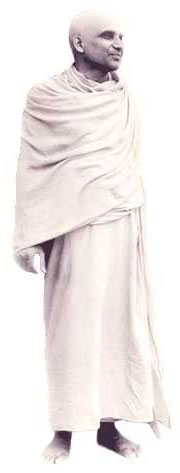
Swamiji on Facebook Swamiji on Twitter Swamiji on Youtube

The Problems of Spiritual Life

by Swami Krishnananda

December 16, 1990 (Continued)

SWAMIJI: No, they are not differences in consciousness. If they are differences in consciousness you will not know that you have had three states. In that case, each state will be different from the other, and there would be no link of one with the other. But consciousness is continuous. It does not change in the three states; otherwise, the person who wakes would be different from the one who dreams, and the one who dreams different from the one who sleeps. A connecting link has to be there, and you are aware that you are the same person who had the experiences.

Larry: As I begin my practice, what kind of obstacles should I be conscious of?

SWAMIJI: Your own desires not fulfilled – they are the obstacles. If you have any desire that you have not fulfilled, that will come and stand before you as a creditor.

Larry: So, I should fulfil my desires and move through them?

SWAMIJI: You have to face them by fulfilling, or not fulfilling, as the case may be. How you will handle them depends on the circumstances of the case. But, they should not be there.

Larry: Will it not be that my desires have no end?

SWAMIJI: They can be ended in one minute if you only know why they arise. It does not take a lot of time to end them, provided you know why they have arisen. You must diagnose the case. If you know why they are there, then, you will know also how to tackle them. They arise due to some misconception. It is not that you really want anything. Anyway, they can be handled with some caution. Small desires can be fulfilled. Big desires also can be fulfilled, provided they are not going to be harmful or deleterious to your spiritual health.

And desires there can be which you cannot fulfil in this birth, for instance, if you want to be the king of the world. This idea may not be feasible. If you want to be a huge business magnate, though it is not an impossible thing, the possibility is so remote that it may be an obstacle even to think like that. Such ideas should not arise at all. All the desires should be within the reasonable limit. If it is within reason, you may fulfil it. But what happens to these desires is that once you fulfil them, they want to repeat themselves. Desires do not get exhausted by fulfilment. They sometimes become more intense after fulfilment due to the habit that is formed by the mind. Certain desires may thereby extinguish themselves also; others may repeat themselves on account of the pleasure that one feels in the fulfilment.

There are varieties of desires. They are not of the same kind or category. And you must know what are your desires. Apart from the desire for creature comforts, what other desires are there? Creature comforts are no trouble. Food, clothing, shelter – these are the minimal needs. But there are other things that rise out of egoism.

At present, why do you worry about all these things? You have no obstacles now. Just now, you do not have any difficulty. When they come, then only you think. Why are you imagining them?

Larry: Because I know when I am in Rishikesh I have no obstacles. When I am in Toronto, it is a very different world.

SWAMIJI: One of the obstacles may be your career itself. You may be occupied with your profession, may have to give a lot of time for that work, and very little time may be left for you to be alone to yourself. All these are the common difficulties one may face in life. You may get tired, exhausted, and may not like to sit for meditation. These may be the little difficulties. That may not be a major problem. These are minor things. You can adjust yourself.

But the greatest obstacle is another thing. It is the inability of the mind to accommodate itself to the very thought of God. That is the real obstacle. The mind cannot accept the thought of God – that is all. The trouble doesn't come from outside; it doesn't come from people. It comes from your mind. Finally, it will say, "This is not for me." 

Therefore, every day you must find time to ponder over this, and do meditation. If you miss it for a few days, the habit will break. If you cannot think abstractly, at least have a little scripture to read which will enable you to raise your thoughts to the levels required. Every day, continuously, you cannot go on thinking like this. It is a question of years of practice. Not even a saint can maintain such a consciousness all the twenty-four hours. It is not possible. So one has to be very cautious.

Doubts will arise in the mind. The greatest tragedy is doubt: "Oh, it may not be like this! I may be on the wrong path. Perhaps it is different." Or, "I may not be fit for it." Or, "What is the good of it, finally?" These are the questions that can come up. These questions can arise after ten years even. You will be wondering how they arise. The mind can keep quiet in ambush. "I will teach this man a lesson. He is pressing me. I shall keep quiet for some time." And after years, it can come up and catch you unawares and make you go somewhere else. That is why you have to keep good company, read good books, and have good habits, and all that is prescribed.

The inability to contain the thought of God correctly is the only obstacle finally. All other obstacles are minor and they will run away if this difficulty does not arise. Other obstacles are nothing before this; they are practically insignificant. That we are discussing so much about this matter is itself a proof of doubt still persisting in the mind. It is not cleared completely. Some cloud is there hanging. It may be a thin cloud, but afterwards it can become thick. After all, "why"; this question will persist in the mind. "After all, what will happen to me? What am I pursuing? Am I in a phantasm?" Therefore, keep the good company of a person who is saintly, or at least a scripture, something must be with you. Nobody maintains God-consciousness throughout one's life.

Larry: Is that not part of the process if it does slip from the mind?

SWAMIJI: If it is a part of the process, how does it benefit you? You are not any way better by knowing that it is a part of the process. You will be once again the same old man that you were years back. You will not know that it is a part of the process at that time, because to know that it is a part of the process also is a kind of understanding. You will not say so, at that time. You will get caught up in a whirl, and the whole thing will dwindle down.

Even those who start with noble thoughts of God-realisation being the only aim in life, often, towards the end of their life, start world-uplifting organisations and think that they are meant for saving mankind, as prophets. "The world is in great trouble. I have to raise humanity." These ideas may arise towards the end of life, and all God-realisation enthusiasm may wither away.

The Devil can come in any form. It will tell you, "Why are you going to God when others are here suffering? You are a fool!" The voice will come and whisper in your ear, and you will suddenly accept that – "Oh yes, yes, there is a point in it," you will think. "Why should I go to God alone? I can take my family also with me. Why should I leave the world here and go to God? How selfish I am! Oh, you are right, you are right. Let me work for the welfare of humanity. I will take all people in a big boat." 

What is wrong with this thought? It looks very sensible and reasonable. Though it is most idiotic to think like that, it seems very rational. "So many are suffering, and you are going to God alone? What do you mean? Are you so selfish, sir?" The consciousness of God-Being has been swept away by the whirlwind of psychosocial agitation.

This world-uplifting idea may not come to you because that comes only in the case of very advanced people. You are just beginning to be engaged and so these ideas will not come to you. You are not likely to think that you are a prophet come to save humanity and all that, but it is also a possibility. The world will look so real, people around will be so meaningful, the events of history will be so very significant to you that you will come back to the lowest level from where you rose, under the impression that you have risen to the highest level. So, these are the obstacles, to give you some general idea of such things.

Sarah: I thought when the pot smashes, it doesn't get rebuilt. Once you have God-realisation, how can you slip back?

SWAMIJI: Such a person has not attained God-realisation. He is only conceptually thinking like that; actually he has not got it, It is a notion of the realisation, not an actual experience. The mind has its own tricks. It is very intelligent and knows how to handle you. A guide is necessary here.

Every now and then you must refer yourself to that guide. When you pass through some experience you must immediately refer: "I am passing through these experiences; what do you say about this?" You should not stand on your own two feet completely for all times. Now and then a check-up of experience is necessary. Without a guide it is difficult. Also, sometimes you may meditate wrongly, as this friend [another student present at darshan] is meditating on the point between the eyebrows, and he cannot sleep in the night. There are errors galore, and at each step one has to be aware of their chameleon-like shapes and colours.