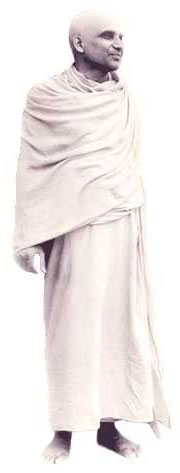
A Treatise on the Vedanta Philosophy and Its Methodology
by Swami Krishnananda
The Imperishable Being is declared as That in which space is woven breadthwise and lengthwise, in which is everything that is above the heaven, beneath the earth, between the heaven and the earth, that which is past, present and future, as woven within and throughout through space. “This Brahman has neither front nor behind, neither inner nor outer.” It is the spaceless infinitude “which is beneath and above, to the west and the east, to the south and the north; it alone is this whole existence” (Chh. Up., VII. 25). “It is infinite on all sides.” Spatiality is the admission of difference which is detrimental to the rigorous non-duality of Brahman. Space is a lapse from pure perfection, for it allows in temporality in existence. “This Self is smaller than a grain of rice; this Self is greater than the whole universe” (Chh. Up., III. 14. 3). “This Self is a part of the hundredth part of the point of a hair subdivided again a hundredfold; and this rises to Infinitude” (Svet. Up., V. 9). Indivisibility implies independence over space, for all that is in space is divisible. Omnipresence is spacelessness. Brahman is there, and that which is there is here (vide Katha Up., II. 1. 10). “As a Unity alone is this to be known, this immeasurable eternal being;” “he goes to death after death who perceives duality here” (Brih. Up., IV. 4. 20, 19). Thus, space is transcended in Brahman.
Time, too, is denied in Brahman. “That which is past, present and future, and that which transcends this threefold distinction of time, is the indestructible Om, the All, which is Brahman” (Mand. Up., 1, 2). Brahman is anadi and ananta, i.e., of infinite duration, which is timelessness. “Over that bridge (which is the Atman), neither day, nor night, nor old age, nor death can cross” (Chh. Up., VIII. 4. 1). The instantaneous duration of the flash of consciousness, its absolute immediacy of experience, its independence over limit, its non-objective nature, marks out its timeless being.
Causation is motion, and that which is perfectly real cannot be said to move. Movement is transitoriness of nature, but Brahman is eternal. There is no world-process in the essential Reality, for all process is change. Changelessness is causationlessness. The Imperishable, the akshara, is without even the least tinge of action. In the Brihadaranyaka Upanishad (IV. 4. 20) the Absolute is described as “the Great Oneness, unborn, unchanging, eternal, immeasurable, unblemished, exalted above space.” Uddalaka says that all modification is only a name, a mere matter of words, not true. It is depicted as different from coming into being and different from not coming into being, beyond death and deathlessness. It is the One which the wise speak of diversely, and hence it excludes all plurality, and therefore all relations in space, succession in time, becoming cause of an effect or effect of a cause, and all opposition of subject and object.
The objective world of space, time and cause represents merely a condition of experience. Space, time and causation are interdependent and none of them seems to have the character of reality. Without the one the other cannot be explained, and the argument leads to a vicious circle. Since reason itself is bound by these concepts, they cannot be reasoned about. They constitute the way of thinking itself, the very stuff of all methods of knowing, and therefore human knowledge is only another name for the conscious manifestation of these relations. Objectively nothing is known except these relations. Space, time and causality represent, ultimately, only ideas and nothing more. These are the self-projections of the process of thought, in the form of an external world, in order to make possible and give value to the act of thinking. The law of Nature is always in relation to an individual or a group of individuals, and never an eternally existent fact, except, of course, in the sense of the eternally changeless indivisible Nature of Brahman. Space, time and cause are certain manners of the perception of external conditions or objects, and thus form relations and not anything truly existent. The perceiving mind always wishes to work in terms of system and order, and not in a chaotic manner. For this purpose these universally accepted relations called space, time and cause are formulated by the perceiving consciousness which is individualised and externalised. The whole universe is summed up in the three ideas of spatiality, temporality and causality. These are the very condition of all knowledge and experience in an individual, and hence these concepts refuse to become objects of knowledge in any way. Either we know everything in terms of space, time and cause or we know nothing at all. Individuality is subject to these categories of relative experience, and so all knowledge in the universe is relative, phenomenal, a make-shift, and not ultimately valid. As space, time and cause are the ideal necessary constructions of all empirical experience, all the objects of experience, too, are mere conditions, becomings, relative to the reality of the experiencers, and do not have independent existence. The object of perception lasts only as long as the particular mental states of the individuals cognising the object last. There is no permanent reality of the form of an object independent of the psychoses of the perceivers. Objects in their isolated nature have no reality, though the essence of the world and the individuals is absolutely real—for this essential existence belongs to what is incorruptible and unlimited. The world of objects in its presented state is false, being dependent on relative perceptions; its form is unreal because form is an imaginary construction of the objectified centres of consciousness in the universe driven by potent desire-impulses. The Cosmic Mind acts as the ultimate subject whose consciousness is the creator of all norms, in all the degrees of manifestation. The worldness in what is manifested, or, in other words, the very act or process of manifestation itself, is to be construed in the sense of what is illusory, though the world-essence or the ultimate substance of the world is eternal. It is the form and not the essence that is unreal. The nature of every object is said to be fivefold—existence, consciousness, joy, name, form. Of these, existence-consciousness-joy constitutes the self-identical immediate reality of everything, and hence it can never cease to be. This ceaseless Self-Perfection is the Absolute. The name and the form of the world, together with its contents, are only an apparition in the Real. If the Absolute is the sole Reality, space, time and causation can only be meaningless terms.
“All this is what this Self is.” —Brih. Up., II. 4. 6.
“This is the Self, this is the Immortal, this is the Absolute, this is all Existence.” —Brih. Up., II. 5. 1.
The failure of all arguments in determining the exact nature of Reality and its relation to appearance points to the unknowable character of Reality. Hence it is defined as “not this, not this.” But in the admission of our limited knowledge and our inability to know Reality is implied our claim to know it. It is known through relative means, but it is realised in immediate experience which is above relative knowledge.
The indeterminable Brahman is only a subject of speculation for the individual which is bound by the limitations of the intellect caught up in the process of space, time and causation, which are the hard undeniable facts of life. To the man who is confined to the world, the Essential Reality will appear to be outside the ken of knowledge. His highest is only the highest of his thinking. The human mind cannot be said to comprehend Reality from its own standpoint. We cannot see through the Real and say, “thus is the Real,” for the Real as Real is known only in self-identical, non-objective experience. The Absolute Truth cannot be expressed, or even thought; else, thereby, it would lose its Truth-hood and become untruth. Our Absolute is the conceptual Absolute, and this highest conceptual is “God” or “Ishvara”, the determinate Real, the object of pious meditation and of the highest form of devotion, para-bhakti, while Brahman is the eternal subject of pure indeterminate knowledge. The relative intellect seeks to find a solution for the difficulties that are presented by the notion of the independence of the world and the individual’s experiences therein. The causal argument leads it to find support in a conceptual reality which would explain the world without abandoning the idea of causality. The intellect, being inextricably bound by the causal chain, cannot comprehend that Reality which is beyond causation and its concomitants. The pure Indivisible Being cannot be the object of the understanding working through the phenomenal categories. The general tendency among human beings is to feel the necessity for a Supreme Ruler who would dispense justice and apportion the fruits of their thoughts and actions. The feeling demands a merciful and loving God who will respond to its expressions and liberate it from sorrow. The religious mind protests that the world requires a God who cannot be dispensed with as a mere logical error. It pays little heed to the laws of reason and subjects the same to the laws of the feelings of man. To it, knowledge which knows itself alone and not anything else cannot satisfy the aspirations of the individual. The constitution within is extended to the universe, and the result is the natural feeling that if manyness and oneness, death and immortality, are both shadows of Reality and form its complementary conceptual aspects, such a Reality shall ever remain unmanageable and unknowable to the individual existing in the universe of experience. To take a whole view of the Real is to attempt what is beyond the finite intellect, and to take a partial view is to accept a defeat in knowing the Real. This is how the limited human mind fares in solving the deepest problems of life and beyond.
The relative individual can read only relative facts even in the highest Truth, however magnified and grand its conceptions be. For the individual man, God is a magnified Man, the Cosmic Person who has all knowledge and all power. He is the Creator, the Preserver and the Destroyer of the universe, who, in His unexcellable majesty, lords over the earth and the heaven, who fashions the sun, the moon and the stars, who extends far beyond the limitless space. He is the highest perfection and magnitude of the complete opposite of what the limited individual is. God is unlimited in every sense. He is the Supreme Purusha, the Father of the entire creation. He excludes none, all are within His superhuman body. He is the Virat, the universal King, the absolute unifying form in which all beings are strung together like beads in a thread; He is Hiranyagarbha, the inner animating life-principle of everything; He is Ishvara, the universal consciousness that sustains all manifestation. There is none besides Him. He triumphs and glories in His own Greatness. He is the ocean of all that is best at any place or time. He is the immediate presupposition and presence of whatever can ever be. He is the Antaryamin, the Inner Controller; the Avyakrita, the Unmanifest, beyond sense-perception; the Sutratma or the Thread-Soul that connects all selfs; the Mahaprana, the Cosmic Vital Energy. He hails as the supreme object of all adoration and worship.
Ishvara is the manifested Form of Reality. He is the Saguna-Brahman, the Absolute endowed with all glorious attributes. This qualified Reality, though the highest open to any of us, is not the highest in itself. But, as long as the Real in itself is of no practical utility in our processes of thought, life and action, it is immaterial, so far as life is concerned, whether the highest Reality is qualified or not. As long as we live within the boundaries of the rational intellect, the Highest in itself cannot be taken as a part of life’s considerations, and we are bound to be satisfied with what is highest from our own standpoint.
The Cosmic Person, though not an independent existence from the standpoint of the Brahman of intuition, is much more real than the universe and its individual contents. Though below Brahman, God is above the world, and controls the world as its perfect master. So long as our personality is real, God also is real, and, if the personal God is to be rejected as unreal, we ourselves have no right to live as individuals. The personal Ishvara is not opposed to the impersonal Brahman, but is Brahman only as we understand it. But we, as individuals, are relative, and our relative views are bound to be sublated and transcended in a higher experience. The precision of the discriminative faculty is compelled to adopt an extreme of spiritual unworldliness, whether or not it is pleasing to our weaker human side. Our inability to embrace the strictest Truth makes us demand a God who is relative to the empirical world. Saner perception, however, does not condescend to accept the permanent reality of a cosmic objective God, as the form of objective existence is not independent of the processes of the subjective consciousness. If all appearances are unintelligible, Ishvara who can only be an appearance of the Real, is equally unintelligible. It is not Brahman that changes itself into God and the world, but the knowing subject that takes Brahman as such. When thought is no more, the individual is annulled, and together with it Ishvara and the world sink into Pure Being. It is not possible to rest contented that a personal God is the ultimate Reality, however displeasing this may be to those who do not want to dispense with thinking in terms of the categories of the world. The philosopher-aspirant who is possessed of a flaming passion for integrating himself in Existence does not have the dull patience to linger on with the slow process of progressive self-transcendence through the channels of the different degrees of reality. The highest scientific mind always tries to cling to the Whole, and not to even the biggest part, for, according to it, partiteness in existence is illogical and an ignorant conception. Truth, dependent on its own Self, transcends even the ideas of omniscience and omnipotence, for these involve relations which are a limitation on the Absolute. And, yet, we find the Vedas and the Upanishads giving intimations of a Personal Purusha, the Purushottama, the Source, Being and End of the universe, which gives us an idea of the impartial attitude which the ancient seers had towards the different conceptions of Reality, and of that magnificent vision of the One in the many which they possessed and articulated in sublime states of the Consciousness of the totality of creation.
The first visualisation of the Cosmic Purusha is expressed in the celebrated hymn of the Rigveda, called the Purusha-Sukta.
“Thousand-headed was the Purusha, thousand-eyed and thousand-legged. He, covering the earth on all sides, stretched Himself beyond it by ten fingers’ length. All this is the Purusha alone, whatever was and whatever shall be.... One-fourth of Him all beings are, (but) three-fourths of Him is immortal in the (highest) heaven.” —Rigveda, X. 90.
Here the word “thousand” is to be taken to mean “numberless” or “infinite” and not to denote any fixed number. The description is to give an idea of the all-encompassing nature of the supreme Purusha. He does not completely manifest Himself in the form of the universe; only a small aspect of Him is expressed as relativity—the larger aspect of Him exists unmanifested and remains as the shining Immutable. This does not suggest that God can be divided into aspects or cut into parts, but only means figuratively that God is not in any way limited but is above manifestation, though He is also the Self of all that is manifested. God is both immanent and transcendent, for He is present in every speck of the universe, and yet transcends it to an inconceivable extent. Truth is neither a pantheism nor a deism which consider God as either wholly exhausted in the world or existing wholly beyond the world. The universe is one organic unity sustained by the single being of God, of whom everything is a part, and who is the inner and outer reality of everything. Absolutism is the highest point, the culmination of all true philosophy, according to which the Absolute Spirit or the Absolute God is the only Reality.