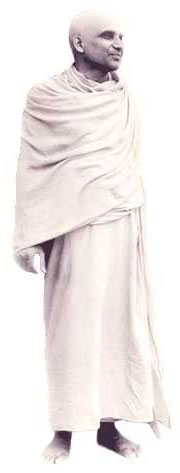
by Swami Krishnananda
Go a little deep into this matter. Is it true that you are this physical body? Because there is nothing else in you except this body that you can visualise, you say, “Yes, there cannot be anything else to me.” Do you mean to say that this ‘me’, this ‘I’, is this total aggregate of the limbs of this physical body? “Yes,” will be the answer, “These hands and feet, this nose, these eyes, these lungs, this heart, this flesh, bone, marrow, and so on—all this put together in a proportion is me. I am all these things assembled in a particular way.” Are you sure that this is the answer to your question? The first answer is, “Yes, what else? I am this conglomeration of the physical elements.”
If some limbs are not there, some part of ‘me’ will not be there. Is it true? There are people without legs. Are they a little less in their ‘me’ or ‘I’, in comparison with those who have two legs? Suppose there is a person who has no legs and no hands; a large percentage of ‘me’ has gone away. Ask him, “Are you wholly existing, or only partially?” He will say, “I am whole.” He will not say, “I am a half man.” The limbless person is not a half person; he is a whole person. How is it possible? If all the limbs are necessary to make you feel whole, how can limbless people feel that they are whole? Legless and handless, fifty percent has gone; he should feel that he is only fifty percent, and not a whole person. But that is not so. If fifty percent of the body is not there, due to amputation or to some accident, the person is still whole. What do you mean by this feeling of wholeness? “I am full, sir.” He is as great a person as any who has all his limbs intact.
Do you agree that there is a defect in your definition of the personality as just this body with all the limbs? You have to think thrice before saying anything further. “So, ‘I’, this ‘me’, does not seem to be merely the conglomeration of these limbs of the body, because without them also I seem to be there. I am existing there. But what is this ‘I’? The personality itself is in doubt. In the beginning, I thought everything was clear to me. Now I am feeling that there is some mistake because I have analysed the situation a little further and feel that even if fifty percent of the physical body has gone, I will be still whole.” How is this possible? How could you be whole, when half of you has gone? Is it not a contradiction? “Maybe, but still I am whole.”
Ancient thinkers, philosophers, masters and sages have analysed this situation further. You cannot easily answer this question as to why you feel whole, in spite of the body having gone in some percentage. The analysis conducted is in terms of certain experiences through which you are passing. What are the experiences through which you are passing? In waking life, you have an externality consciousness. But you are not always in the waking condition. You also go to sleep and dream. When you dream, you have a consciousness in the same way as you have a consciousness in waking. But there is a difference. The sense organs—eyes, ears, etc.—are active in waking life; they are not active in dream. The physical body is not an object of your consciousness in dream. You are not aware that you have a body, yet you are aware of something.
Now, think of this situation. Are you existing in the state of dream? Certainly. Are you existing with body-consciousness, or minus it? You are totally bereft of body-consciousness. In the beginning, you thought that this body is ‘you’ because there was nothing else that you can say about your body. Then it became a matter of doubt because you felt that the body does not seem to be the entire ‘me’, because even if you are bereft of certain limbs, you seem to be whole. And now you are in a third predicament—that you seem to be capable of existing even without being conscious of the body. Why? Because in dream, which is also a state of existence, which is a state of consciousness, you are totally free from association with the physical body.
The third analysis or conclusion is: You can exist minus consciousness of the body and minus consciousness of your wealth, property, relations, family, circumstances, and so on. In ordinary life you identify yourself with family, political conditions, etc., and you get mixed up with them to such an extent that you are always thinking of yourself as a father, mother, husband, wife, etc. You have no other definition. But in the dream state, these associations are severed; you can exist independently, minus these associations—minus even the body. In the state of dream, you are existing even without the body. What is it that is existing in dream? It is a mental operation. You are existing as a ‘psyche’, rather than as a body. All right, let us take for granted that you are the ‘psyche’—that you are more a mind than a body. Let us come to this conclusion. Are you sure? It is clear that you can exist only as a mind, minus the body, because it is seen in dream. Now go deeper.
When you are fast asleep, what happens to the mind? It does not think. It sees nothing. There is no consciousness whatsoever of anything at all when you are fast asleep—no body, no social relations, no mind either. Now, think of this situation again: In the state of deep sleep, you exist, isn’t it? Certainly, you do exist in sleep, minus associations of every kind. You are not a president, a minister, a rich man, a boss, a husband, or a wife. You are not anything—not even the body, not even the mind. Did you exist in deep sleep? How do you know that you existed in deep sleep? Who told you? Are you verifying this by comparing your experience with somebody else’s? Did you wake up in the morning and ask somebody: “Did I really exist yesterday?” No, you do not put questions like that. You do not have to verify by any kind of experiment whether you really existed in sleep. But without any kind of verifiable medium, how did you come to know that you did exist in sleep while you had no consciousness? Minus consciousness, there is no experience. You had totally no experience in the state of sleep—no consciousness. What makes you feel that you existed there? Who told you?
Now here is a further analytical process, which is psychological and philosophical. You may say, “I know that I did exist in the state of sleep by the memory that I have. I was, yesterday, and I had a very good sleep.” People say, “Oh, I had a very good sleep.” Who makes this statement? Mr. So-and-so? That Mr. So-and-so was not there; he was totally dissociated from what existed in the state of deep sleep. Who is saying that they had a memory of sleep? Tell me, what do you mean by memory? You use the word ‘memory’—a recollection. What does it mean?
Memory is a consequence that follows as an aftermath of a conscious experience. If you have no experience, there will be no memory afterwards. That means to say, in order to have a memory of having slept and having existed in the state of deep sleep, you must have had some experience in that state. Minus experience, how could you have memory? You would be like a brick. A brick does not remember anything. But you are not like a brick in the state of deep sleep. Though you look like a brick for all practical purposes, it does not seem to be that way because if that had been the case, there would be no memory. Were you having an experience in the state of sleep? At that time, you cannot say that you had any experience, because experience minus consciousness is unthinkable, and there was no consciousness. Therefore, you can say, “I had no experience.” But if that is the case, there is no memory. So, you face a contradiction here again. Somehow or other, there seems to have been some sort of an experience even in the state of that total unconsciousness which is sleep—without which, there would have been no memory afterwards. What experience were you having in the state of deep sleep? It was not an experience of body, not of mind, not of any kind of external social relation; it was just existence. What kind of existence? The existence in the state of deep sleep was free from associations of every kind. See how some great truth comes out from this little analysis.
Were you very happy in sleep, or very unhappy? Even an unhappy person wakes up with happiness after sleeping. Even if there is a wound which is giving agonising pain, you feel a little refreshed after a good sleep. The joy of sleep is incomparable, as everyone knows. The restfulness, the blissfulness and the composure that you feel in the state of deep sleep is incomparable. It cannot be compared with any kind of happiness that you can think of in this world—which means to say, you can be happy without any relation with anything, if the time for it comes. Not only can you be happy without any relation with things, it is the greatest happiness. Other types of happiness are elusive; they can run away from you any day. There can be bereavement of causes that appear to be giving you satisfaction in life. But here is something which will not leave you.
This is an incidental, secondary matter; we shall not touch upon it just now. The point is that you had a kind of peculiar existence-consciousness, we may say, though you cannot verify it by any method of observation. By inference of the circumstance of deep sleep, you can come to the conclusion because of the memory following it that there must have been a state of consciousness; otherwise, memory cannot be explained. You existed, pure and simple, a bare fact of being, unrelated to circumstances outside—not even related to space and time, let alone other things.
Again listen to me carefully. You had a consciousness in the state of deep sleep; you cannot say that there was anything else. “I have a consciousness that I slept.” At that time, did you have other consciousness of anything else other than the fact of having slept? No, there was no consciousness of anything else. There was no consciousness of the world of space and time and objects. “It was only a consciousness of my having been there. There was no other consciousness.” Your consciousness of having been there means consciousness of your existence. What was it that was there in the state of deep sleep? Consciousness of existence—existence which was conscious of itself. Do not allow the mind to slip away from this fact that you existed as existence which was conscious of itself, that only consciousness was existing.
Now, I will use two other Sanskrit words. In Sanskrit, Existence is called sat. Pure Being is called sat; and Consciousness is called chit. In Sanskrit philosophical terminology it is said that we were in the state of deep sleep as sat-chit, Existence-Consciousness. Inasmuch as we were also happy, we were also associated with ananda. So what was our state? Sat-chit-ananda is the Sanskrit definition of Existence-Consciousness-Bliss. We were existing as Existence-Consciousness-Bliss. Not existence of something—it is pure, unadulterated, featureless, transparent Existence. It is not consciousness of something, but Consciousness of Existence only, so it is not an objective consciousness. It is Consciousness, pure and simple, unrelated. Unrelated consciousness is something worth considering.
What is the meaning of unrelated consciousness? “I have never heard of such a thing, because all consciousness is related to something—related to the world outside, people outside, this body, this mind.” We have abrogated all these associations; now we have come to the conclusion that we seem to be something fantastic—not as we thought ourselves to be. “I never knew that I am like this! I am not a bundle of social relations—not even this body and mind. I seem to be something which I never thought myself to be—a great discovery of myself.” It is featured featureless, unrelated existence which is conscious of itself, conscious of itself only—not conscious of something else. It is Pure Existence-Consciousness, Pure Bliss unrelated to anything else. “Oh wonderful! This is me!”
‘Unrelated’ means not having anything external to it. Anything that has no externality also has no relativity. Therefore, we call it Absolute. It is Absolute Existence-Consciousness-Bliss—not related consciousness, related bliss, etc. Incidentally, anything that is absolute, which is not relative, is also timeless. Actually, eternity was scintillating in you when you were in deep sleep, of which you are not aware. This fact has to be investigated further, deeper. Let us see how we can do it.