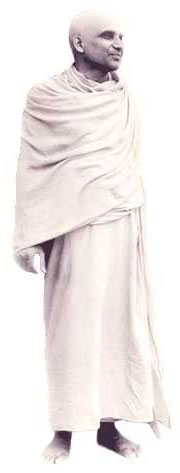
by Swami Krishnananda
But the most important thing is the method that you are adopting. The place and the time are secondary matters. Later on you will know very well which place is good and what time is proper. But the method—what are you doing when you sit for meditation? All sorts of things are told by people. “I think nothing,” is one answer. “I drive away all the thoughts,” is another answer. “I think of my breath,” is a third answer. “I think of my heart,” is a fourth answer. “I concentrate on the point between the eyebrows,” is a fifth answer. Now, what is your answer? In meditation, you are directing the attention of your mind on something. Concentration—or meditation, as you may call it—is an attention on something, a continuous fixation of the flow of the consciousness through the mind. But on what? On that which you want. This is a simple answer.
Meditation is an attention of the mind on that which you really want. The psychology of the mind is such that you will certainly get whatever you want deeply, from the recesses of your being. There is nothing in this world which you cannot achieve. Even so-called impossible things can be attained. The impossibility is due only to external factors intruding into the practice. Actually, there is nothing impossible. The only condition is, you must really want it. Anything that is wanted by you wholly, wholeheartedly, from your very soul, will be at your service. The heavens will descend, if only you want the heavens to descend. But if you have a doubt in the mind that this is an impracticable thing, then you are to blame.
Choose for yourself what it is that you want to contemplate upon in meditation. It is no use reading a book, asking questions to various Gurus, and getting into some sort of a routine of practice, unless it is really the thing that you want. I mentioned to you one of the methods is the concentration on breath. Let it be; go on with it. But is it the thing that you want? Are you entering into spiritual life, religious practice, meditation, because you want to breathe properly? You will feel that this is not so. “What I want is not merely breathing, though it is true that I would like to breathe well.” Then what is it that you want, finally? This question cannot easily be answered unless you have a very good philosophical mind. You want only that which is truly there and which is going to fill you with a completion of your being, and you may add various qualifications like deathlessness, immortality—or you may say God-Being.
That concept has to be clear in the mind, and it can be entertained by various techniques which are prescribed in the yoga shastras. That on which you are concentrating or meditating is a kind of god. By ‘god’, I do not mean the creator of the universe. I mean something that is complete, without which you cannot exist, and which promises you every kind of fulfilment. That is why it is called a beloved deity, an Ishta Devata. The Sanskrit term is Ishta Devata. It is a very dear, beloved thing. The object of meditation is not merely a technique of discipline. It is a very, very beautiful, dear, inseparable thing. Have you seen anything in this world which is dear to you, which is beloved, before which the heart shakes, is thrilled, is enthused or in rapture? Have you seen anything in this world? Or you are in a state of dispiritedness always, and nothing pleases you? Generally, nothing in the world can please you always.
A certain stimulation of the psyche may appear to be pleasing for the time being; but that stimulation may cease, and then the pleasure also ceases. All pleasures in this world are stimulations of nerves, it is said. So, to always keep something as your final goal is difficult in this world. Even wealth cannot attract you for all times. High position in society cannot be always secure. This is the reason why the yoga shastras, the scriptures in yoga, prescribe an adjustment of thought in such a way that it will create before itself something very dear. There are no dear things in this world, finally. They perish, and you are bereaved of them. You can lose anything in this world, even the dearest thing. Hence, to perpetually hold on to something which is dear is difficult here; but there must be something. Inasmuch as the Ultimate Reality of all this creation is a substance which is inseparable from consciousness, your Ishta or beloved deity also is a form of consciousness. If God Himself is consciousness, the object of your meditation cannot but be that.
You should attempt to create a presentation before you; you have to create a god for yourself. How will you create a god? The consciousness, which is your essential being, adjusts itself to a particular formation of itself, before itself, which is associated with all the qualities of permanency, inclusiveness, blessedness, beauty and perfection. The object of meditation should not only be dear; it should also be perfect, inclusive, in which you can find the fulfilment of all your wishes. All that you want will be found there. It is a divinity because it transcends all the things of this world in its perfection and inclusiveness. It is difficult to conceive of such an object.
You may ask again and again, “What is this Ishta Devata? Who is my Ishta Devata?” Inasmuch as a student in the initial stages cannot prescribe this concept for himself or herself, a readymade concept is placed before the student. Your Ishta Devata is the god whom you worship. Everyone has a concept of God. It may be adequate or inadequate, perfect or otherwise; it does not matter. The very concept of God is a concept of that in which you will find your fulfilment. It does not matter what that concept is. In all religious practices, in all religious circles, there is a prescription of a concept of God which they consider as final for them. This is a purely religious idea. It may be Hinduism, Buddhism, Christianity, or whatever it is. There are people who do not belong to any religion, or at least they say so. But, they still have some concept of what they finally need, as one cannot always be negative, wanting nothing and having nothing to regard as final.
The choice of the particular deity is left to you; and if you cannot choose it for yourself, it has to be entertained with the consent of a teacher whom you consider as competent—your Guru. The choice of this Ishta Devata is a purely personal matter, and it cannot be the topic of a public lecture. It is a relationship between a Guru and a disciple, because each person differs in their concept of the Ishta Devata, or the beloved deity.
Whatever that deity be, it is something which has a peculiar characteristic differentiating it from all other things in the world. And that differentiating factor is that it is above you and not just outside you. Your god is not sitting outside you, in front of you, or entirely external to you. A thing may be appearing to be outside you, and yet it may be transcendent.
There are illustrations of this kind even in this world. Someone who is holding an authority over a particular atmosphere may be a person, and in the sense of a person, that person appears to be outside. You can see that person holding the authority, so you may say it is external. But that person’s importance or authority cannot be seen as an external object in front of your eyes. It is a pervasive principle transcending you; you should call it above you, not outside you. I hope you understand what I mean. Authority, kingship or administrative responsibility is not an external object, though the person holding that responsibility may look like somebody sitting on a chair. Here is an illustration of how something which is very important is really above you, transcending you, superior to you; yet, its manifestation may look like something placed before you as an object or a person.
Thus, you can have an Ishta Devata’s picture in front of you: a god that is a painted picture, an idol, a concept, a symbol, a diagram—whatever it is. And yet, you need not regard your deity as something sitting in that particular symbol. Just as responsibility and authority are not identical with the personality of the individual concerned, the god whom you are worshipping is not identical with the symbol or the image, though it is the medium of the expression of that divinity which is otherwise transcendent. Hence, the god on whom you meditate is something above you. A very clear concept of how it is above has to be entertained. Inasmuch as it is above you, it fills you. Inasmuch as it is above you and is transcendent to you, you are inside it—just as you are included in the pervasive atmosphere of someone’s authority, in spite of the fact that you are an independent person.
Therefore, this god whom you are worshipping, concentrating upon, this deity or Ishta Devata, is a pervasive force above you, transcendent in every way—filling you, and including you. So you will feel an expansion of your being in meditation. You will not be simply sitting and thinking something, and then getting up. Even if your meditation along this line is only for a few minutes—even if it be only for five minutes—you will get up with a sense of fullness, as if a great authority has been injected into you, to give a homely example. A great power has been given to you.
Do you feel a sense of inclusiveness, fullness, strength, completion, expansion of being at that time? That will happen to you in meditation. You will not get up in the same condition as you sat. “I have done the meditation, but nothing has happened.” It cannot be like that. Five minutes of sitting is enough if your mind is clear, and you have properly grasped the spirit of the very idea of meditation and that which you call the object of meditation. It is not something outside you. This is very important. If it is outside, it cannot come to you. All things that are external to you will leave you one day, so this externality is only a secondary aspect of this object of meditation. The real feature of it is transcendence and, therefore, it can never perish, because it is beyond you. It includes you. It cannot leave you. This god will possess you always. You will literally be possessed by a god, and in a few minutes of your seatedness in meditation you will feel as if some nectarine dish has been poured into you. I am not joking. It is a fact.
You are your master. You are the maker of your destiny. Some people say man creates God. In whatever sense they speak, there is some truth in this statement. You have created your god—but you are yourself that, and cannot be isolated from it. You are the miniature Universality. You are a drop of this Absolute and, therefore, that supreme inclusiveness scintillates through your littleness. Thus, this little so-called ‘you’ is also very big. Hence, the bigness that you are is the object of the meditation of the so-called littleness that you are. The little you is contemplating on the big you, so you are contemplating on yourself only, finally, in an enlarged form.
Meditation is wonderful. It is not something which somebody may do when they become old and retire from life. Without it, nobody can succeed in anything in this world—because it is contact with reality, and who can succeed without such a contact? Thus, we enter into a stream of movement in the direction of a glorious achievement, which is the aim of meditation.