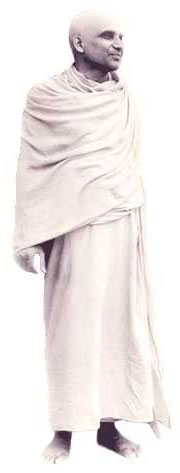
by Swami Krishnananda
We may call it a condensation of space-time. Here again we have the difficulty of how hard substances like stone and brick and can be regarded as a condensation of space and time, because space seems to be empty, and time is indescribable and enigmatic. We cannot see time, and we cannot see space. We see some emptiness, and something called time, in a concept of the mind. But, space and time are not mere voids, and they are not just empty concepts. They are the very background and the matrix of the later developments in the process of evolution, in the form of the tanmatras and the five elements of earth, water, fire, air and ether. If space and time are not a vessel in which the physical universe is contained, as we wrongly think, but physicality is just a form of space-time itself, then thinking of the universe in terms of space and time ceases.
It is not possible for ordinary people to entertain these areas of thought and meditation. You cannot go on thinking like this for a long time. You will become giddy; you will fall asleep; you will feel that this is not for you. You may appear to understand what I am saying, but you cannot carry it for a long time. The very first step was difficult, and the second step becomes even more difficult because here is a prescription whereby you are not to think of space outside, and not even time. Why is it so? It is because, in the same way as nature is not outside your body, space-time is not outside nature. As you are not outside nature, nature is not outside space-time. This is how you begin to withdraw yourself in an ascending order of concept, or push yourself forward into the causes of the effects that appear as this phenomenal world.
I mentioned that in creation, effects follow causes. In meditation, causes follow effects. That is to say, from the lower, you go to the higher. The lowest is the political concept, the social concept, the physical concept. Then you go to the higher concept of your inseparability with nature, which is physical. Now you go still further into the concept of the inseparability of nature as a whole from space-time itself. This is the second stage of samapatti, or samadhi, where you do not know what is happening. I can describe it only in this manner. There is no language which can describe this condition because all language, all definition, all description is in terms of qualities and relations. When we speak of anything, something is compared with something else and some quality or adjunct is associated with another quality or adjunct. But here, this becomes impossible on account of there being no qualities, no relations, no adjuncts whatsoever outside what you consider as the object of your meditation. Who is meditating? The ‘you’ that meditates ceases to be there because it has already gone into the very substance of the object of meditation, which has become all nature and all space and time. It looks as if nature itself is contemplating itself. Dhyayet eva, says the Upanishad. The earth is contemplating, nature is meditating, the whole cosmos is becoming aware of itself. You are not meditating anymore; you have now gone beyond meditation.
Meditation is a very simple thing. It is a kindergarten stage compared to all this that we are discussing now. You are on a very high level where you are not contemplating anything; you have become one with nature. So, who is meditating? Nature is contemplating itself as existing. But that is not even sufficient. It is now not contemplating itself as existing in space and time. The idea of nature thinking that it exists in space and time also has gone. What is left now? Here your speech becomes hushed, and nobody is there to tell you anything. Language ceases, thought does not function further in the manner it was functioning earlier, and you are caught in a whirlpool of a cosmic tide that is flooding over you. You are no more a human being. You have no friends around you, and nothing to see. What is existing? Here, all human effort ceases. Up to this time there was effort to do something, to think some way, and then see that you do not get distracted into some other way of thinking. Now, at this moment, the effort itself ceases.
If the effort ceases, how do you progress onwards? For this there is an Upanishadic declaration that a divine hand starts operating at that moment. Up to this time you have been doing something, but now you cannot do anything; you have become totally helpless. When your limbs are removed and you are melting down into the substance of the world, what effort is possible on your part? How is it possible that there can be further progress? The Upanishad says that some non-human or super-human power takes care of you at that time. It takes you up by the hand, as it were, and leads you along a path which is not visible to the eyes but can be felt by your consciousness. It is the point where you are directly in contact with the ambassadors of God, as it were. Until that time, you are far away from these great personalities. Even to contact these ambassadors is very difficult. You have to struggle so much, with such force, with agony for such a long time to contact these mere officials of God—and God is still further.
However, it is a wonderful thing to meet these great officials. Once they raise their green flag, you will have no problem. Then in modern style, you may say, they will present you with a green card to the Absolute, and you shall have no problems. You cannot move because you have no eyes, you have no legs, you have no limbs; you are not a person. There, the movement is of consciousness; consciousness moves into Consciousness. All this wondrous description is associated with the second stage. This is the nirvitarka stage. Actually, in these first two stages of savitarka and nirvitarka, you are still in the level of the physical cosmos, though you have by some means overcome the limitations of the concept of space and time.
There is something higher—the tanmatras. Remember the process of evolution. I mentioned that the Original Absolute appears as adhibhuta on one side, adhyatma on the other side, and adhidaiva in the middle; and the tanmatras—the potentials of hearing, seeing, touching, smelling, tasting—become the latent forces which, by a certain permutation and combination, become the five elements of earth, water, fire, air and ether.
Up to this time we have been considering only the level of the physical elements—either with the association of space and time or without such association. Now we are going to consider pure potentials, not the physical universe. These are the tanmatras, as they are called—the universe as constituted of pure force. The concept of force is also difficult to entertain because you know only electric force and so on, but this is something more than electricity. It is prana, in one way. What is prana? You may in a way compare it to electric energy, but it is subtler than that; it is vitality. There is no vitality in electricity. It is a dead force. It is a tremendous force indeed, but it has no life, and it cannot understand. But vitality is something which has motivation and, therefore, it transcends the concept of force as electricity. In this realm of the tanmatras, you enter into a non-physical environment of continuity. It is spaceless and timeless. Modern science sometimes calls it the space-time continuum. It does not mean that there is space and time. It looks like a continuum of the melting together of even space and time, which means to say, a spaceless and timeless continuum—a fourth dimension, as we are intriguingly told. The fourth state is something like that. It transcends the three states of waking, dreaming and sleeping.
So we have savitarka, nirvitarka. Then there is savichara, which is the third stage, where the tanmatras come into operation. The fourth stage is nirvichara, in which the forces are not any more a continuum, because even the concept of the process of dynamism involves a tinge of spatiality and temporality. Even if you consider the universe as a process and not as a substance and a thing, you are somehow introducing spatiality and temporality into it. But it is something more than that. The Ultimate Reality is not in space and not in time, and cannot be thought of as being in space and in time.
All this is an area of consideration which is totally alien to ordinary human thinking. It is something surprising, transforming, shocking, and illuminating in a new way, and makes you something totally different from what you are. You cease to be a person, a human being, a man or a woman. You do not know what you are. You will be floating in some atmosphere which cannot be considered as anything at all in ordinary language.
These are some of the processes of communion of individuality with the cosmic. To repeat these designations of Patanjali, they are savitarka, nirvitarka, savichara and nirvichara. There are two or three more ascents and processes of moving higher up, which are not in any way related to the physical universe or even the forces of nature, not even to the tanmatras, but are pure cosmic thought. Here you are led by the ambassadors into the very Kingdom of God, and you are there.
In religious circles, in bhakti shastras or the yoga of devotion, we are told that salvation is of four kinds: salokya, samipya, sarupya, sayujya.
Salokya is something like feeling oneself in the Kingdom of God. You cannot understand what it all means. Suffice it to say it is something. You have entered the very Kingdom of the Absolute. Conceiving it is not practicable at present, because the mind is not prepared for it yet in this course of study. It is a matter for you to personally attain in your individual practice. When you feel as if you have landed on the runway, as it were, of the Kingdom of God—you have landed your plane in the airport of God’s Kingdom—you feel a thrill. You have not seen anything of God, but you are in His kingdom; that is itself sufficient. “I have landed in India.” You are still at the airport and have not seen anything yet, but it does not matter; you are there. This is one kind of salvation, to feel oneself as present in the Kingdom of God.
The second stage is nearness to the location of God, if at all you can conceive such a thing as location. You are nearer to the Supreme Being. You have not seen, you have not felt, you have not recognised, but you feel a sensation of being approximate to That. It is a higher stage than merely being conscious of being in the kingdom. This is called samipya, nearness.
In the third stage, you look like one of the denizens, citizens of that kingdom. You are not a foreigner with alien dress entering into that kingdom. You begin to shine like anybody else there. You look like everybody inhabiting that kingdom; you become a shining personality. The kind of being and contour cannot be described. This is called sarupya, having the same form as the people, the individuals, the salvation-attained souls inhabiting that kingdom. The last is, of course, the entry into God’s Being; that is sayujya.
This is something like what is told to us in these yoga techniques of an ascent that is going to rise higher than these stages that we have already considered as savitarka, nirvitarka, savichara and nirvichara—where pure Universal Thought begins to operate, and we stand inseparable from the Universe itself.