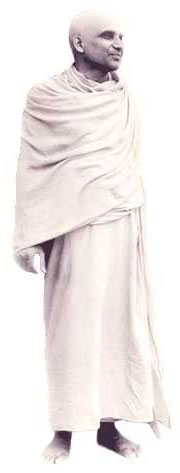
by Swami Krishnananda
Q: Is it true that all individuals are always meditating?
SWAMIJI: Why are you saying that? All individuals are not always meditating. They may be thinking something. Every individual is thinking something, but you cannot call it meditating. Meditating means thinking only one thing; and if you think that every individual in the world is thinking only one thing, you may say they are meditating. But nobody does that. Each one has his own thoughts, and nobody is meditating like that. Who is meditating? Meditation is one thought, and nobody has got one thought. All people have got many thoughts. That is not correct; all people are not meditating.
Q: How is it practical to be in that state always?
SWAMIJI: That is the same as being in a state of God-consciousness. It is the same thing, if you can intensely feel and convince yourself that you are inseparable from all that you see with the eyes, all this cosmos. I have mentioned to you so many times in the earlier lessons that your personality is made up of the same substance as the world outside; so when you think, naturally you cannot think the world outside. You will think that which is both – a blend of both. If this intention can be driven into your mind and you can feel it intensely, that is aham brahma asmi.
And so you are asking how long can you do it. So long as you can maintain this consciousness. You cannot do it for more than a few minutes because again you will think that something is outside. The moment that you think that there is something outside you, that cosmic consciousness is gone. You can think for yourself how many times you have felt that you are inseparable from the world. It may be a few seconds, a few minutes, but the whole day is spent thinking something else, unless you are deeply engaged in practice.
Q: In the perceptual process, does the thought come before the prana vibrates on the mind?
SWAMIJI: Thought comes first.
Q: Thought comes because prana vibrates on the mind. And when the prana goes to the sense object, then we perceive things?
SWAMIJI: Prana will not go to the object unless the mind starts thinking the object. Prana is mostly inside the body only. It can be driven out from the body and directed to an object outside when the mind thinks of that object. The thought of the mind in respect of an object is like a wire that connects this dynamo of the mind with that object and it becomes a live wire. The thought becomes a live wire, as it were, and the prana is discharged through the thought. Prana moves towards an object only when the mind thinks of the object. Otherwise, it will be inside the body only. Whatever you think in your mind is also the target of the prana. If you think something even at a very far-off distant place, the prana will go there, and it will operate.
There is a thing called telepathy. Telepathic action is due to the thought of the mind working in terms of some distant object and getting charged with the prana of the person, which travels invisibly because of the force of thought. So prana moves to an object only when the mind thinks of the object.
Q: The mind thinks because of the vibration of prana.
SWAMIJI: The mind thinks because of desire. Prana has no consciousness. Therefore, it cannot think an object. It is like electricity; it has no mind, no brain. It can be directed to something only if the engineer is behind it to direct it in some way. Prana cannot think, but it can act. The mind acts through the prana; prana and mind are like thought and action put together.
Q: That is also thought, Swamiji.
SWAMIJI: Maybe. When I say desire, it means thought only. When the mind thinks of an object, it is manifesting a desire – wanting it or not wanting it. Then it takes a step in the direction of fulfilling that desire; that step is in terms of the prana. Prana is the action of the mind. It thinks and then acts. Mere thinking is mind, but action is prana. If you think that you have to lift something with your hand, the prana actually moves the hand in that direction and lifts it. So thought and action – prana – go together.
Q: It is the prana that vibrates on the mind and generates thoughts.
SWAMIJI: Prana does not generate thought. It is not true. It is the mind that generates the prana – the other way around.
Q: Does a God-realised person do any work?
SWAMIJI: Do you mean to say that God is established in the Self, or not? Do you think God is established in the Self? Then what work is God doing? It is that same work that the person will do who is established in the Self. Does God work? What work is God doing just now? If He is not working, then a Self-realised man will not work. But if you say God is working, then he will also work.
There was a Maharaja. He saw one Mahatma like you. Bhavagrai Mahatma. He said, “Hey, come, Mahatmaji. Sit. Tell me, what is God doing just now.”
The Mahatma said that this is not the way of putting a question. ”You see, you are sitting on a throne and I am sitting on the floor in front of you, and you are asking me. You are like a student. I am like a teacher. A teacher sitting on the floor and a student on a throne is not a proper way. You must sit on the floor and I must sit on the throne. Then only the answer can come.”
“All right,” he said. ”I will sit on the floor.” The king got down and told him to sit on the throne.
“This is what God is doing,” he said. ”He puts the top man down and the down man up. You are a king; you sat on the floor. I am a poor fellow; I sat on the throne. This is what God does. So I answered your question about what God is doing.”
Q: How can I identify the presence of God?
SWAMIJI: When you cannot see anything outside you and your presence, your personality, is totally identified with everything that you see, you may say that you are God-conscious. You must have as much union of your consciousness with things that you see with your eyes, as your consciousness now is identified with this body. You are so very intimately connected with your body that you cannot say that the body is outside consciousness. If that intensity of consciousness can be felt in respect of things seen outside also, in the sense of all things that you see, you are one with nature and you may say it is one with God also.
It is a question of intense conviction and feeling of your heart. It can be done in one minute or it may take years, as is the case with the intensity of your longing for it.
Q: What is the most suitable method to realise God in this world?
SWAMIJI: If you want me to use a common answer which generally all mahatmas give, they say kirtan-bhajan is the best. God's name is the best way, easiest and best in this Kali Yuga. This is what they say. Hari Rama Hari Rama Rama Rama Hari Hari Hari Krishna Hari Krishna Krishna Krishna Hari Hari. This is the Kali-santarana mantra which enables you to cross over the samsara of Kali Yuga.
Q: What is the meaning of Hari Rama Hari Rama Rama Rama Hari Hari Hari Krishna Hari Krishna Krishna Krishna Hari Hari?
SWAMIJI: Hari is the Almighty Creator of the Universe. Sometimes they call him Narayana also. Rama and Krishna are his incarnations. In Rama's incarnation, he demonstrated perfect humanity, and in Krishna's incarnation, he demonstrated perfect divinity – so perfect Universality which is Hari, perfect humanity in Rama, and perfect divinity in Krishna. All three perfections are blended together in this mantra; so it is a very great, powerful mantra. So do kirtan every day.
It is said that Brahma told this mantra to Narada. It may be that Narayana, the original, must be thought of much more than the manifestations. You may say that. Brahma is the creative originality. You know Brahma, Vishnu, Siva; but Brahman is the Absolute, which is beyond all the three. Brahma, Vishnu, Siva are manifestations of another thing which is inclusive of all the three. The Supreme Absolute (Brahman) manifests itself as Creator, Preserver, Destroyer. When you think of the Absolute as the Creator, it is Brahma; as a Preserver, it is Vishnu; as a Dissolver of all things, it is Rudra or Siva, as the case may be. But Brahman is beyond all.
Q: Is time a movement of consciousness?
SWAMIJI: Yes. Correct.
Q: If so, why does time not move backwards?
SWAMIJI: The mind, which is basically our consciousness, is projected outwardly through the sense organs. We think only through the sense organs, we cannot think in any other way; and the force of the sense organs is always outward. They cannot think backward. It is not that you cannot go back; you can go. In certain states you can know the past also. But usually it cannot be done on account of the power of the sense organs which push the consciousness outward and, therefore, it looks as if only one direction is there and another is not there, though it has three directions: past, present and future. But mostly you can think only in one way because of the sense organs pushing the mind in one direction, like water gushing through a pipe. Only in one direction will it go.
Q: Is it possible for it to go back?
SWAMIJI: It can go back, if you control the senses.
You have heard a relativity physicist saying there was a person who came tomorrow and will go back yesterday. Now you will say that he has spoiled the whole time process, but it means that in a relativity cosmos, where everything is interdependent, there is no past, present and future. A person came tomorrow and he will return yesterday. It has no sense; but it has all sense when time is abolished.
Q: Where is the cosmos?
SWAMIJI: What you are seeing with your eyes is the entire cosmos. You are seeing one part of it. When it is very small, the whole thing can be seen. But it is so big, so you are seeing only a part of it, like [the story of] the blind men and an elephant. The elephant is so big, and they saw only one part – the leg, etc. So you are seeing only a part of it, and you are calling it something. You cannot see the whole cosmos with eyes that are so small and cannot see the entire thing. What you see with your eyes is the cosmos. You are seeing it only. You are walking on it.
Q: Are all mantras of equal value?
SWAMIJI: Yes, correct. All the names are finally names of God and, therefore, if you have faith that this name is really the name of God, it will take you to God.
Q: Is there any power in the mantra, or is it the concept of the mind that is the power?
SWAMIJI: A mantra has got its own power. Your conception also adds to it, but it has a power by itself. The very words of the mantra are arranged in such a way that they generate a kind of power when they are chanted. A chemical action takes place when the mantra is chanted. The words act and react to produce a force. That is why even by mantra chanting itself you can realise God, and you need not think of chakras. You can completely forget them. Mantras will do the work of other yogas as well. If you are convinced that this mantra is sufficient for you, you need not do any hatha yoga. That mantra will take care of you. It is enough. It is a complete yoga by itself.
Q: Is there a difference between the cosmos and within?
SWAMIJI: The within is included in the cosmos. The so-called within – within your person – is inside the cosmos. There is no within-without for that; it is including everything. The outside-inside are both included in the cosmos. So it has no inside and it has no outside. It is one total whole.
Q: What is the Mahakaran?
SWAMIJI: Mahakaran means the Supreme Cause – supreme cause of the universe, Mulaprakriti or God Himself.
Q: It is said that in meditation, concentration stops.
SWAMIJI: Concentration is the first stage; meditation is the next stage. When concentration deepens, when you go on concentrating on the same thing continuously and there is only one thought without break, that process of intensified, prolongated concentration is called meditation. When your meditating consciousness merges into the object, it is called samadhi.
Q: Does our life consist of different relationships of names and forms?
SWAMIJI: Correct.
Q: So relationships are not real, but nature is the real friend because nature constitutes the panchabhuta, and our body also constitutes the panchabhuta?
SWAMIJI: Actually, nature by itself has no name and form. Nature, you see; you are there as a person. If the body as a whole can be attributed with a consciousness of its own, it will not think that there are fingers, hands, legs and all that. It will only see that it is existing. Only you are giving names for your convenience – finger, hand, etc.). So likewise, nature itself may not be conscious of people, trees, leaves, etc. It only knows “I am”. That is the difference. So name and form exist for us, but it does not exist for nature by itself.
Thank you very much. God bless you. Om Namo Narayanaya.