Search
 
 
Home swamiji Ebooks Articles Multimedia Uploads Catalogue Sitemap Contact


Ebook
 
To thine own self be true

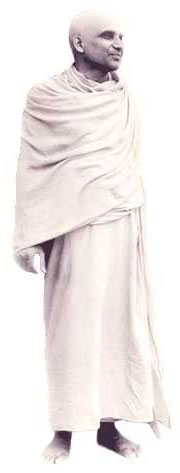
by Swami Krishnananda
The Divine Life Society - Sivananda Ashram, Rishikesh, India

1
1
Chapter 7: THE DOCTRINE OF THE BHAGAVAD GITA (Continued)
The Incarnation of God

Now, there is a guiding hand always; there is a leading angel sitting on our very shoulders. Every person is carrying within himself or herself a guiding power, a divinity. There is a divinity that is aware of what is happening. With millions of eyes it looks at us and sees us and notices what is happening to us. Our hairs are counted. The number of our breaths is known and whatever we think, feel and do is reverberating through the cosmos. There is one who knows the most secret deeds of our private personality and the whispers that we do in the ears of people in the remotest corner of the world. The little whisper that we make in the remotest corner of the world reaches the heavens like a thunder. Therefore, do not be under the impression that you are unguarded.

"Why are you afraid? I am here with you. When you are in danger, I shall come." The guiding hand of the Almighty is perpetually operating, not after some time, not tomorrow; it is just at this moment operating, whether we feel it or not. As it is well said, a sparrow cannot fall on your head without the will of the central power.

The fourth chapter of the Gita describes the operation of an avatara, the incarnation of God, in an assurance given to us, a promise made by God Himself: "I shall not desert you. My devotee cannot perish." Our hearts should jump with joy by listening to such a promise. "My devotee cannot perish." Are you a devotee? Then you will not perish; you will never be let down at any moment of time. But be sure that you are a devotee. God has never deserted His devotees. "Proclaim, my dear friend, to everybody, through the newspapers, the radio and television that I shall not desert my devotees. I am there, ready at hand to protect them. I shall save them from the ocean of samsara."

When this assurance enters our heart, together with the understanding that we have developed as has been given to us in the previous chapters, we rise to some extent above the turmoil of life which was presented in the first chapter, and we have now developed a positive type of the spirit of renunciation, which is what we feel and find enunciated in the fifth chapter. Already we have renounced many things, even when we have taken to spiritual life, but that is an unintelligent type of renunciation. Just because we are away from our house for a long time, it does not necessarily mean that we have renounced our connection with the world.


On Renunciation

Even if you have renounced the world, the taste for the world will not leave you easily. The world has been abandoned but the taste for the world has not gone. Though you have not eaten halva and drunk kheer for three months, you know its taste. Can you say the taste also has gone? It will not go. The beauty of life, the fragrance of things, the velvet-like comforts of life may not be there when you are living like a sanyasin, but does the sanyasin know that such things exist in the world? Even the knowledge that such palatable things exist is a negative deficit entry in the balance sheet of the spirit of renunciation.

There is no use saying that we have nothing. In some places, teachers of Yoga tell us that withdrawal of the sense organs from the objects does not mean closing the sense organs and plugging the holes of the apertures of perception. Really speaking, withdrawal of the sense organs means 'not being even aware that the objects exist at all as outside things'. That is real withdrawal. Being aware of something, and then shutting the eyes to it, is quite different from not being conscious of the externality of existences.

The earlier type of renunciation is immature. It is of a type of working knowledge that you have, not a qualified knowledge. The real renunciation is spiritual and not social, material or physical. You are not socially segregating yourself from anything materially or physically, which is actually what everyone does when one says he has renounced family circumstances, and the like.

Now, the instructions in the fifth chapter tell us that we are required to have another type of the spirit of renunciation which is purely spiritual in the sense that we have not even a taste for anything. "The pinnacle of Vairagya, or renunciation, is reached," says a great master, "when you consider that even the joy of Brahmaloka is like the taste of a dry straw." And what to speak of the joys of this world? These truths are all beyond our heads at present, but by intense practice and a hammering of these ideas again and again into the mind we will find that it is not only possible, it is an essential.

When this detachment of a wholly spiritual character takes possession of us, we become fit for direct confrontation of the reality of life. This is the preparation of the personality for the Yoga of meditation, as it is portrayed beautifully in the sixth chapter of the Bhagavad Gita. What is this Yoga that we have in this crucial phase?


The Great Spiritual Conquest

Uddharedatmanatmanam natmanamavasadayet;
Atmaiva hyatmano bandhuratmaiva ripuratmanah.
Bandhuratma'tmanastasya yenatmaivatmana jitah;
Anatmanastu satrutve vartetatmaiva satruvat.

"One should exalt the self by the Self. One should not deprecate the Self, for the Self alone is the friend of the self, and the Self alone is also the enemy of the self. The Self is the friend of him whose self has been conquered by the Self. Where the self remains unrestrained, the Self would behave as its enemy, as an external foe."

The whole of the sixth chapter is here in these two verses. The Yoga of meditation is the art of the higher Self pulling up with tremendous force all that our lower self is. The self has to be raised by the Self. We have to raise our self by our Self. What does this mean?

The archetypal Self, the original Self, the heavenly Self, the divine Self, the Absolute Self that also we are, raises the puny self, the individual self, the physical self, the Mr. self or Mrs. self, the political self, etc. You may make a list of all the kinds of selves that you are - all transitional types of self, which is a conglomeration of what is known as the individual personal self. This has to be melted down, like a lump of ice, before the blazing sun of the knowledge of the higher Self. But where is the higher Self? How many kilometres away?

How much distance is there between waking and dream - how many miles, light years of distance between waking and dream? A tremendous distance indeed! From one world we have gone to another world. There must be some distance, certainly. Yet, you will find that the distance is logically measurable but not physically calculable.

There is no physical distance between the higher Self and the lower self, between God and man. They are touching each other, not as two fingers meeting each other, but as the higher thought includes the lower thought, the higher knowledge transcends the lower knowledge, the higher education engulfs the lower education, the greater wisdom absorbs the lower wisdom. These are not physically or mathematically measurable in space; they are only measurements in understanding.

This higher Self, this God-driven Self which is our own Self, is our true friend, from which we can draw sustenance at any moment of time. It exudes veritable honey. But when the lower egoistic self asserts its independence and behaves not as a lower degree of the higher dimension of its own self, it will become its own enemy and thwart all its efforts. It is always well said, "To Thine own Self Be True."

Says the Taittiriya Upanishad, "If space itself were not the field of great joy, who would breathe?" If breath itself is not a joy, who would be wanting to live? The breath would burn your nostrils. The akasa, space around us is also a field of joy only. That is why we want to enjoy it by looking at it and inhaling the breath emanating from it. Existence, accommodation, is itself the highest freedom and bliss.

Sometimes we say that man proposes while God disposes. This, because the self is opposed to the higher Self, it looks as if the higher Self is disposing of everything which one is proposing, but it will not behave thus if one is friendly with it. Who is the person of whom the higher Self is a friend? What kind of person can regard himself as the friend of the higher Self?

A particular kind of person that you are, alone, can regard yourself as the friend of the higher Self. Every kind of personalty that you are is not capable of being a friend of the Self. You cannot shake hands with a highly placed dignitary unless you are also placed on an equal pedestal in some way. You want to shake hands with the higher Self; for that, you have to develop certain qualities which are required for that purpose. What are those qualities? The conquering of the self: atma jaya.

This question arose sometime in the context of the Udyoga Parva of the Mahabharata, where Dhritarashtra raises a question before Sanjaya: "Can I see that great messenger of the Pandavas who seems to be coming to meet us in our assembly? Can I have a vision of him?"

Sanjaya, the wise minister of Dhritarashtra, says, "You are asking me a question: whether you can see him. The Akritatman cannot behold the Kritatman that is Sri Krishna." The Kritatman is one who has totally subdued the self. The Akritatman is one who is a slave of the lower self. The person who is a slave of desires, befuddled in the midst of sensory attractions, cannot behold the great Being that is Krishna, who is a complete master of the self. The Eternal is irradiated through his Person.

The restraint of the sense organs is the means of subduing the self. Actually, the self that is to be subdued is nothing but the self of the sense longings. The sensory self is the self that is to be transmuted. We are now living in a world of sensations and the self that we are is ridden over by the potentialities of sense contacts, sense perceptions, sense desires. They have to be melted down into a liquefied menstruum of the power of the higher Self. "You must know that the One that is coming is All-in-all, and all your children, and all the henchmen behind them are nowhere behind this one Person," said Sanjaya to Dhritarashtra.

Many are the beauties and the powers and the joys of this world but the higher Self is standing singly by Itself. That one Being is greater than all the many things that are in this world. Therefore, Duryodhana made a mistake in choosing the army of Krishna, while Arjuna was wise enough to choose only one thing, who was Krishna. That One was greater than the multifold apparently strong soldiers of the army.

In the Mundakopanishad there is a similar analogy. Two birds are perching on a single tree, sitting on the same branch. There is a bird which is looking at the beautiful delicious fruits, but never eats them. The other one is very much engrossed in eating the delicious fruits - so much engaged in eating that it is not even aware that there is a friend sitting nearby. When the eating subsides, when the bird that is enjoying the delicious yield of this tree of life gets fed up with it and turns its gaze on the one who is silently witnessing only and not eating anything, its liberation takes place.

As long as Arjuna was looking at the army only, he was frightened. When he turned his eye to Krishna, energy entered him. Very active and virulent were the people whom he was facing in the front, known and unknown, kinsmen and enemies, put together. When seeing them, there was agitation in the heart and a valorous attitude manifested itself to fight the forces and attack them. But then he looked at the charming blue Man sitting, doing nothing. And that Nothing indeed was doing everything. Man does many things; God does nothing. That One who does nothing actually does more things than the many things apparently done by people in this world.

All our activities throughout history fade into a valueless nothingness before the tremendous activity of God. Who can say that the sun in the sky does nothing at all? He does not speak or proclaim himself. He minds his business silently locating himself in the blue sky. That silent existence itself is sufficient to make everything alive in this world. We run about, but the sun does not run about in that manner, while causing everything to run.

This higher Self is single; it is we, ourselves, in one lower position of ourselves, who feel we are multifold. We have many kinds of business, many things to do, many relationships. We have all sorts of engagements in the level of our lower selves, but in the higher one, there is nothing for us to do. We have only to be. When you just feel satisfied merely by your existence in the form of the higher Self, you have done everything; all the so-called needs for doing cease.

Conclusion

From the seventh to the eleventh chapter of the Gita is an ascending order of the rise of the consciousness of reality gradually revealing itself by stages. In the beginning one feels like a distant thing, away from God; afterwards we appear to come closer, then inseparable, then identical. God becomes our own Self, as in the Vishvarupa-darshana, the Cosmic Form extolled in the eleventh chapter.

Then, the following chapters tell us how this knowledge is to be applied in our daily life, in our day-to-day practical affairs, so that the Yoga of the Bhagavad Gita is seen as a masterpiece of superb techniques by which one can blend together God and creation, the here and the hereafter. This life that we are living here is the very life that we are going to live transfigured in eternity. Here is before us the solacing message of the Bhagavad Gita, which everyone has to study with an in-depth understanding of its teaching. "Where the Absolute and the relative melt into each other, death becomes life, all is seen in the All, and there is ever prosperity, victory, happiness, and established polity."

  1
 
  Catalogue Search Site Map Contact
  Design by Savitr as a Love Offering